LEARN · PRACTICE · EXPLORE
District of Columbia Grade 8 Math
Solve an original seven-ticket problem with two equations, reject a pair that meets only one condition, and use selected DC Grade 8 algebra references.
Focused lessons · Useful practice · Clear next steps
What do DC 8th graders learn in math?
In 8th grade, DC math centers on linear equations and functions, the Pythagorean theorem, exponents and scientific notation, transformations, and volume. Students take the DC CAPE grade 8 math test in the spring. This page explains each DC grade 8 math standard and pairs it with short lessons, skill quizzes, printable worksheets and a full-length practice test.
Printable DC grade 8 math books:
- 5 District of Columbia DC CAPE Grade 8 Math Practice Tests
- 6 District of Columbia DC CAPE Grade 8 Math Practice Tests
- 7 District of Columbia DC CAPE Grade 8 Math Practice Tests
- District of Columbia DC CAPE Grade 8 Math Preparation Bundle
- District of Columbia DC CAPE 8th Grade Math Workbook
- District of Columbia DC CAPE Grade 8 Math Made Ridiculously Simple
Standards source: DC Standards of Learning, Office of the State Superintendent of Education.
Meet both the ticket-count and money conditions
Work through the example
An imaginary event sells adult tickets for $3 and student tickets for $2. An order has seven tickets and costs $18, with no fees. Let x be the number of adult tickets and y the number of student tickets. Find the counts that satisfy both conditions.
| Adult, student | Ticket count | Cost | Fits order? |
|---|---|---|---|
| 4, 3 | 7 | $18 | Yes |
| 3, 4 | 7 | $17 | No |
Connect the model and calculation
The ticket count gives x + y = 7. The money condition gives 3x + 2y = 18. Multiply the first equation by 2 to get 2x + 2y = 14. Subtract it from the money equation: x = 4. Substitute into x + y = 7 to obtain y = 3. There are four adult and three student tickets. The pair (4, 3) passes both checks: 4 + 3 = 7 tickets and 3 × 4 + 2 × 3 = $18. The count and money equations use different units, even though both describe the same order.
Understand an incorrect answer
The pair (3, 4) makes seven tickets, but its cost is $17 rather than $18. It solves one equation and fails the other. Subtracting only the x terms while leaving the y terms unchanged does not subtract the two whole equations. Another error is using 3x + 2y = 7, which puts dollars on one side and a ticket count on the other. Label each condition before combining the equations, and keep the variable meanings consistent.
Transfer the idea to another example
View seven student tickets as a $14 starting order. Replacing one student ticket with one adult ticket keeps the count at seven and adds $1. Four replacements reach $18, matching the algebraic result. Then ask whether seven such tickets can total $22. Even seven adult tickets cost only $21. Algebra would produce x = 8 and y = −1, which satisfies the equations but violates this context’s nonnegative whole-number ticket counts. A mathematical solution must also fit the story’s constraints. Compare this impossible order with a changed total of $19, which gives five adult and two student tickets.
Selected DC Grade 8 references
The OSSE standards directory links the Common Core mathematics standards. DC adopted Common Core in July 2010. Use the adopted document and the school’s instructional sequence for planning. These labels describe the activity’s focus; the publisher’s mathematics document supplies the full expectations and mathematical practices.
| Reference | Activity focus | Official document |
|---|---|---|
| 8.EE.C.8b | Solve a pair of linear equations algebraically | Read PDF page 55 |
| 8.EE.C.8c | Model a context with two linear equations | Read PDF page 55 |
Sources checked October 5, 2026. This selected activity supports instruction; it does not cover the whole grade’s curriculum.
Connect the explanation with practice
Choose a related skill from the lesson, worksheet, and quiz directory. Use the worked example to decide what needs support, then read the selected resource’s directions before assigning it.
DC CAPE Next begins with the spring 2027 administration. OSSE lists mathematics assessments in Grades 3–8 and says the educational standards have not changed. Confirm current participation and preparation guidance with the school. Advanced Grade 8 course enrollment can affect whether a student takes Algebra I or the grade-level assessment; use the current OSSE participation policy and school guidance for the individual assignment. Read the DC CAPE Next changes and 2026–27 assessment policy.
The linked practice and books are independently published. Some editions may predate DC CAPE Next; check their contents and directions alongside current OSSE guidance rather than assuming their timer, question count, tools, or scoring matches the new assessment.
Keep one example of the student’s explanation with the practice result. Choose a smaller model, another related task, or a new context according to the difficulty shown in the activity.
Start With a DC CAPE Practice Test
Six full, timed District of Columbia DC CAPE Grade 8 math practice tests, 40 questions each, instant scoring, a topic-by-topic breakdown, and full step-by-step solutions. Each one opens right here in a popup. Calculator: Four-function calculator (on part).
DC CAPE Practice Test 1
A full diagnostic across every District of Columbia Grade 8 math topic.
Start Test 1 →
DC CAPE Practice Test 2
Fresh questions and problem types to build accuracy.
Start Test 2 →
DC CAPE Practice Test 3
New problems to add speed and confidence on every skill.
Start Test 3 →
DC CAPE Practice Test 4
Another complete, timed exam to build pacing and stamina.
Start Test 4 →
DC CAPE Practice Test 5
A brand-new mixed set to test your readiness.
Start Test 5 →
DC CAPE Practice Test 6
A final full-length simulation to confirm you are ready.
Start Test 6 →
District of Columbia Grade 8 Math Study Tools
A few minutes of quick review, flip through flashcards or scan every key formula. Both open right here.
District of Columbia Grade 8 Math Skill Quizzes
Short, focused quizzes, pick one skill, answer 10 questions, get instant scoring and full solutions, then jump to the matching lesson. Each opens right here.
The Number System & Real Numbers
A quick 10-question check on The Number System & Real Numbers with instant scoring and step-by-step solutions.
Start Quiz →
Exponents & Scientific Notation
A quick 10-question check on Exponents & Scientific Notation with instant scoring and step-by-step solutions.
Start Quiz →
Equations & Inequalities
A quick 10-question check on Equations & Inequalities with instant scoring and step-by-step solutions.
Start Quiz →
Functions
A quick 10-question check on Functions with instant scoring and step-by-step solutions.
Start Quiz →
Geometry & Transformations
A quick 10-question check on Geometry & Transformations with instant scoring and step-by-step solutions.
Start Quiz →
Statistics & Probability
A quick 10-question check on Statistics & Probability with instant scoring and step-by-step solutions.
Start Quiz →
Financial Literacy
A quick 10-question check on Financial Literacy with instant scoring and step-by-step solutions.
Start Quiz →
Mixed Grade 8 Review
A quick 10-question check on Mixed Grade 8 Review with instant scoring and step-by-step solutions.
Start Quiz →
Classroom practice and current DC assessment information
DC CAPE Next begins with the spring 2027 administration. OSSE lists mathematics assessments in Grades 3–8 and says the educational standards have not changed. Confirm current participation and preparation guidance with the school. Advanced Grade 8 course enrollment can affect whether a student takes Algebra I or the grade-level assessment; use the current OSSE participation policy and school guidance for the individual assignment. Read the current OSSE overview.
The original example above is a teaching activity. The resource directory below provides broader practice; independently published activities have their own instructions and scoring.
District of Columbia Grade 8 Math Topics
Choose a math lesson, worksheet, or topic quiz. This broader practice library includes review and enrichment; use the adopted standards and the school’s sequence to choose suitable skills.
Number Sense
- Rational and Irrational NumbersWorksheetsQuiz
- Turning Repeating Decimals into FractionsWorksheetsQuiz
- Estimating Irrational NumbersWorksheetsQuiz
- Estimating Expressions with Irrational NumbersWorksheetsQuiz
- Personal Financial LiteracyWorksheetsQuiz
- Prime Factorization with ExponentsWorksheetsQuiz
- Density of Real NumbersWorksheetsQuiz
Exponents and Scientific Notation
Equations and Inequalities
- Graphing Proportional RelationshipsWorksheetsQuiz
- Slope as Rate of ChangeWorksheetsQuiz
- Slope and the Equations of a LineWorksheetsQuiz
- Solving Linear Equations in One VariableWorksheetsQuiz
- Solving Systems of Two EquationsWorksheetsQuiz
- Solving Real Problems with SystemsWorksheetsQuiz
- Solving Linear InequalitiesWorksheetsQuiz
- Multiplying Linear Expressions and FactoringWorksheetsQuiz
- Graphing Linear Inequalities in Two VariablesWorksheetsQuiz
- Parallel and Perpendicular LinesWorksheetsQuiz
- Point Slope and Standard FormWorksheetsQuiz
- Literal EquationsWorksheetsQuiz
- Absolute Value Equations and InequalitiesWorksheetsQuiz
- Equations with Special SolutionsWorksheetsQuiz
Functions
- What is a FunctionWorksheetsQuiz
- Reading Function ValuesWorksheetsQuiz
- Comparing Two FunctionsWorksheetsQuiz
- Linear vs Nonlinear FunctionsWorksheetsQuiz
- Building Linear FunctionsWorksheetsQuiz
- Sketching and Describing Function GraphsWorksheetsQuiz
- Domain and Range of a FunctionWorksheetsQuiz
- Arithmetic SequencesWorksheetsQuiz
- Geometric SequencesWorksheetsQuiz
Geometry
- Rotations Reflections and TranslationsWorksheetsQuiz
- Congruent FiguresWorksheetsQuiz
- Transformations on the Coordinate PlaneWorksheetsQuiz
- Similarity and DilationsWorksheetsQuiz
- Angles in Triangles and Parallel LinesWorksheetsQuiz
- The Pythagorean TheoremWorksheetsQuiz
- Finding Distance with the Pythagorean TheoremWorksheetsQuiz
- Volume of CylindersWorksheetsQuiz
- Angle RelationshipsWorksheetsQuiz
- Surface Area of Prisms Cylinders and PyramidsWorksheetsQuiz
- Volume of PyramidsWorksheetsQuiz
- Composite Figures Area and PerimeterWorksheetsQuiz
- Interior Angles of PolygonsWorksheetsQuiz
- Triangle Inequality TheoremWorksheetsQuiz
- Surface Area of SpheresWorksheetsQuiz
- Arc Length and Area of SectorsWorksheetsQuiz
- Cross Sections of 3D FiguresWorksheetsQuiz
- Parallel Lines and TransversalsWorksheetsQuiz
- Volume of Cones and SpheresWorksheetsQuiz
Statistics and Probability
- Scatter Plots and Patterns in DataWorksheetsQuiz
- Fitting a Line to DataWorksheetsQuiz
- Using a Linear ModelWorksheetsQuiz
- Two Way Tables for Categorical DataWorksheetsQuiz
- Mean Absolute DeviationWorksheetsQuiz
- Probability of Simple EventsWorksheetsQuiz
- Counting Principle and PermutationsWorksheetsQuiz
- Box Plots and Interquartile RangeWorksheetsQuiz
- Random SamplingWorksheetsQuiz
- Effect of Data Changes on StatisticsWorksheetsQuiz
Best District of Columbia DC CAPE Grade 8 Math Books
Each book has a job: start from scratch, drill weak skills, or build pacing with full tests. All of them pair with the free tools on this page.
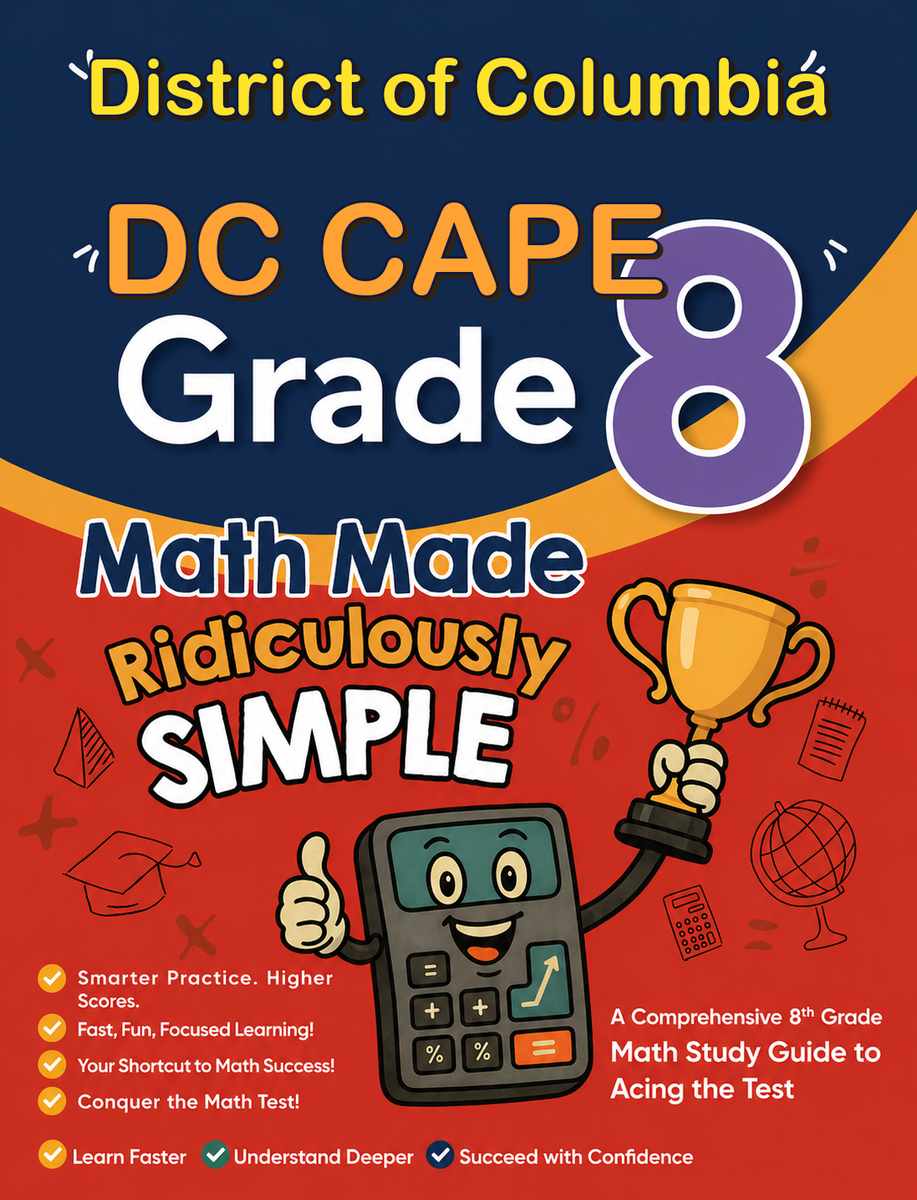
District of Columbia DC CAPE Grade 8 Math Made Ridiculously Simple
A step-by-step DC CAPE Grade 8 math book that rebuilds every tested skill clearly and in order, built to match the District of Columbia standards.
- Best starting point for the DC CAPE math test
- Pairs with District of Columbia flashcards and worksheets
- Use it before full timed practice tests
- Organized for students who need examples before drills
Step-by-step lessons
Short explanations show the move before the student practices it.
✍Worked examples
Examples translate DC CAPE-style wording into clear math steps.
Targeted practice
Rebuild one skill at a time instead of jumping around.
Test-day bridge
After each topic, connect to formulas, flashcards, and practice questions.
How to use it
- Read one lesson and copy the worked example.
- Do a short worksheet set on the same topic.
- Review the matching flashcards or formulas.
- Try a mixed quiz and mark every miss.
Choose the right District of Columbia Grade 8 math book
District of Columbia DC CAPE Grade 8 Math Made Ridiculously Simple
Start here to rebuild DC CAPE math from the ground up.
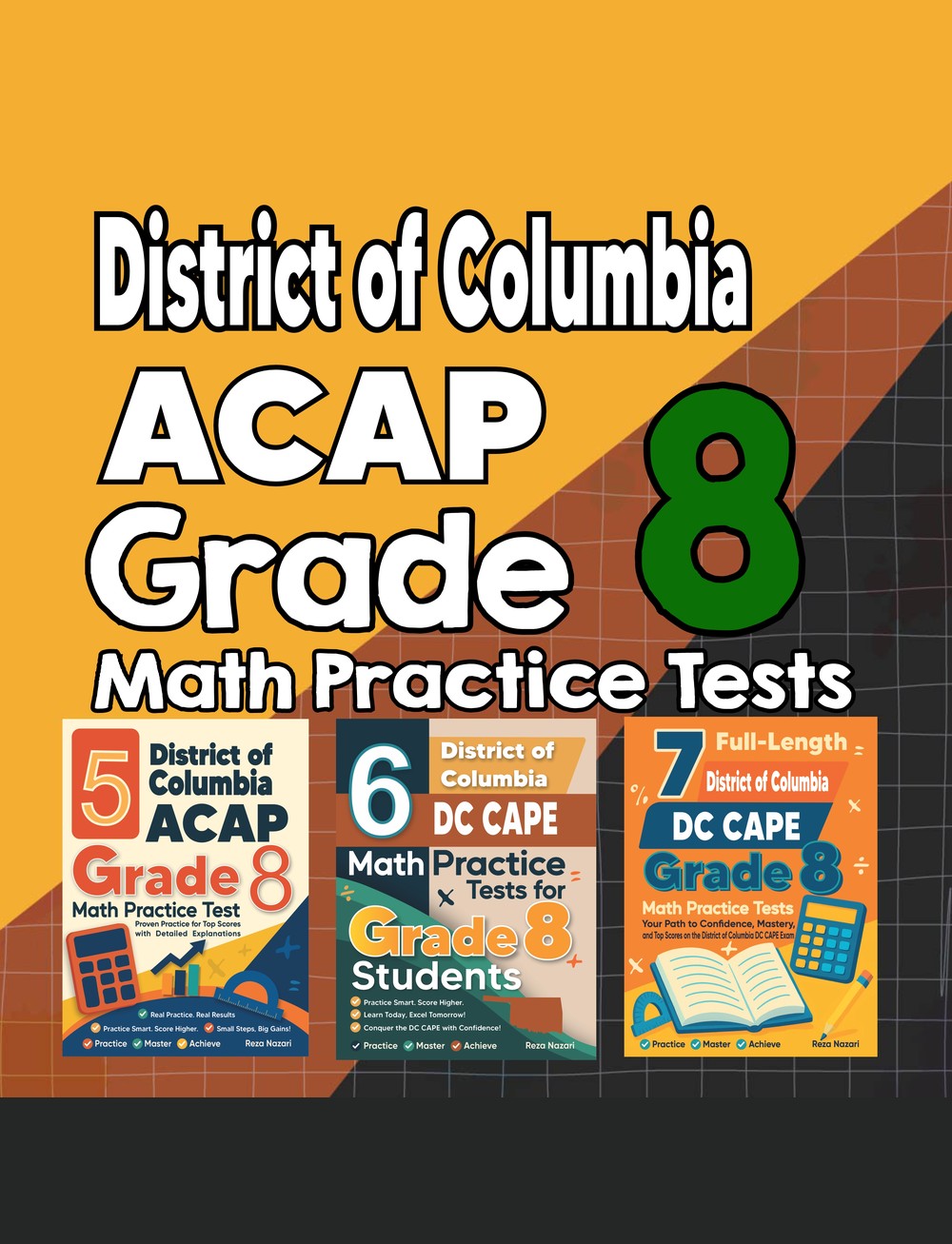
District of Columbia DC CAPE Grade 8 Math Preparation Bundle
The full prep library, study guide, workbook, and practice tests together.
7 District of Columbia DC CAPE Grade 8 Math Practice Tests
Use after topic review to build pacing and test stamina.
DC Grade 8 math planning reference
Use this domain-organized reference to navigate broader skills. Read the adopted mathematics document for complete wording, examples, and mathematical practices; shortened entries are not the full requirements.
8.NS · The Number System
- 8.NS.A.1Know that numbers that are not rational are called irrational. Understand informally that every number has a decimal expansion; for rational numbers show that the decimal expansion repeats eventually, and convert a decimal expansion which repeats eventually into a rational number
- 8.NS.A.2Use rational approximations of irrational numbers to compare the size of irrational numbers, locate them approximately on a number line diagram, and estimate the value of expressions (e.g., π²)
8.EE · Expressions & Equations
- 8.EE.A.1Know and apply the properties of integer exponents to generate equivalent numerical expressions
- 8.EE.A.2Use square root and cube root symbols to represent solutions to equations of the form x² = p and x³ = p, where p is a positive rational number. Evaluate square roots of small perfect squares and cube roots of small perfect cubes. Know that √2 is irrational
- 8.EE.A.3Use numbers expressed in the form of a single digit times an integer power of 10 to estimate very large or very small quantities, and to express how many times as much one is than the other
- 8.EE.A.4Perform operations with numbers expressed in scientific notation, including problems where both decimal and scientific notation are used. Use scientific notation and choose units of appropriate size for measurements of very large or very small quantities (e.g., use millimeters per year for seafloor spreading). Interpret scientific notation that has been generated by technology
- 8.EE.B.5Graph proportional relationships, interpreting the unit rate as the slope of the graph. Compare two different proportional relationships represented in different ways
- 8.EE.B.6Use similar triangles to explain why the slope m is the same between any two distinct points on a non-vertical line in the coordinate plane; derive the equation y = mx for a line through the origin and the equation y = mx + b for a line intercepting the vertical axis at b
- 8.EE.C.7Solve linear equations in one variable
- 8.EE.C.7aGive examples of linear equations in one variable with one solution, infinitely many solutions, or no solutions. Show which of these possibilities is the case by successively transforming the given equation into simpler forms, until an equivalent equation of the form x = a, a = a, or a = b results (where a and b are different numbers)
- 8.EE.C.7bSolve linear equations with rational number coefficients, including equations whose solutions require expanding expressions using the distributive property and collecting like terms
- 8.EE.C.8Analyze and solve pairs of simultaneous linear equations
- 8.EE.C.8aUnderstand that solutions to a system of two linear equations in two variables correspond to points of intersection of their graphs, because points of intersection satisfy both equations simultaneously
- 8.EE.C.8bSolve systems of two linear equations in two variables algebraically, and estimate solutions by graphing the equations. Solve simple cases by inspection
- 8.EE.C.8cSolve real-world and mathematical problems leading to two linear equations in two variables
8.F · Functions
- 8.F.A.1Understand that a function is a rule that assigns to each input exactly one output. The graph of a function is the set of ordered pairs consisting of an input and the corresponding output
- 8.F.A.2Compare properties of two functions each represented in a different way (algebraically, graphically, numerically in tables, or by verbal descriptions)
- 8.F.A.3Interpret the equation y = mx + b as defining a linear function, whose graph is a straight line; give examples of functions that are not linear
- 8.F.B.4Construct a function to model a linear relationship between two quantities. Determine the rate of change and initial value of the function from a description of a relationship or from two (x,y) values, including reading these from a table or from a graph. Interpret the rate of change and initial value of a linear function in terms of the situation it models, and in terms of its graph or a table of values
- 8.F.B.5Describe qualitatively the functional relationship between two quantities by analyzing a graph (e.g., where the function is increasing or decreasing, linear or nonlinear). Sketch a graph that exhibits the qualitative features of a function that has been described verbally
8.G · Geometry
- 8.G.A.1Verify experimentally the properties of rotations, reflections, and translations:
- 8.G.A.1aLines are taken to lines, and line segments to line segments of the same length
- 8.G.A.1bAngles are taken to angles of the same measure
- 8.G.A.1cParallel lines are taken to parallel lines
- 8.G.A.2Understand that a two-dimensional figure is congruent to another if the second can be obtained from the first by a sequence of rotations, reflections, and translations; given two congruent figures, describe a sequence that exhibits the congruence between them
- 8.G.A.3Describe the effect of dilations, translations, rotations, and reflections on two-dimensional figures using coordinates
- 8.G.A.4Understand that a two-dimensional figure is similar to another if the second can be obtained from the first by a sequence of rotations, reflections, translations, and dilations; given two similar two-dimensional figures, describe a sequence that exhibits the similarity between them
- 8.G.A.5Use informal arguments to establish facts about the angle sum and exterior angle of triangles, about the angles created when parallel lines are cut by a transversal, and the angle-angle criterion for similarity of triangles
- 8.G.B.6Explain a proof of the Pythagorean Theorem and its converse
- 8.G.B.7Apply the Pythagorean Theorem to determine unknown side lengths in right triangles in real-world and mathematical problems in two and three dimensions
- 8.G.B.8Apply the Pythagorean Theorem to find the distance between two points in a coordinate system
- 8.G.C.9Know the formulas for the volumes of cones, cylinders, and spheres and use them to solve real-world and mathematical problems
8.SP · Statistics & Probability
- 8.SP.A.1Construct and interpret scatter plots for bivariate measurement data to investigate patterns of association between two quantities. Describe patterns such as clustering, outliers, positive or negative association, linear association, and nonlinear association
- 8.SP.A.2Know that straight lines are widely used to model relationships between two quantitative variables. For scatter plots that suggest a linear association, informally fit a straight line, and informally assess the model fit by judging the closeness of the data points to the line
- 8.SP.A.3Use the equation of a linear model to solve problems in the context of bivariate measurement data, interpreting the slope and intercept
- 8.SP.A.4Understand that patterns of association can also be seen in bivariate categorical data by displaying frequencies and relative frequencies in a two-way table. Construct and interpret a two-way table summarizing data on two categorical variables collected from the same subjects. Use relative frequencies calculated for rows or columns to describe possible association between the two variables
Standards source: DC Standards of Learning. Use the adopted Common Core mathematics document for complete requirements.
DC Grade 8 math: useful study questions
Is a pair that makes seven tickets enough to solve the problem?
No. It must also make the $18 total and use nonnegative whole-number ticket counts. The pair (3, 4) passes the count condition but fails the money condition.
What changes for DC Grade 8 math assessment preparation in 2026–27?
DC CAPE Next first administers in spring 2027. OSSE says the educational standards have not changed. Use current OSSE guidance and the school’s plan, and check the edition and directions of independently published preparation resources.
Grade 8 Math in Other States
Explore Grade 8 math standards, practice tests, and worksheets for every state.
- Alabama
- Alaska
- Arizona
- Arkansas
- California
- Colorado
- Connecticut
- Delaware
- Florida
- Georgia
- Hawaii
- Idaho
- Illinois
- Indiana
- Iowa
- Kansas
- Kentucky
- Louisiana
- Maine
- Maryland
- Massachusetts
- Michigan
- Minnesota
- Mississippi
- Missouri
- Montana
- Nebraska
- Nevada
- New Hampshire
- New Jersey
- New Mexico
- New York
- North Carolina
- North Dakota
- Ohio
- Oklahoma
- Oregon
- Pennsylvania
- Rhode Island
- South Carolina
- South Dakota
- Tennessee
- Texas
- Utah
- Vermont
- Virginia
- Washington
- West Virginia
- Wisconsin
- Wyoming
Make This Your District of Columbia DC CAPE Starting Point
Explain a related worked example, choose focused practice, and review the reasoning behind the result. Check the edition and contents of an optional book before selecting assessment preparation.
Start a practice testA USEFUL NEXT STEP
District of Columbia Grade 8 Math: study questions
Is a pair that makes seven tickets enough to solve the problem?
No. It must also make the $18 total and use nonnegative whole-number ticket counts. The pair (3, 4) passes the count condition but fails the money condition.
What changes for DC Grade 8 math assessment preparation in 2026–27?
DC CAPE Next first administers in spring 2027. OSSE says the educational standards have not changed. Use current OSSE guidance and the school’s plan, and check the edition and directions of independently published preparation resources.
Official source ↗Resources from Effortless Math · Editorial standards