How to Understand Density of Real Numbers? (+FREE Worksheet!)
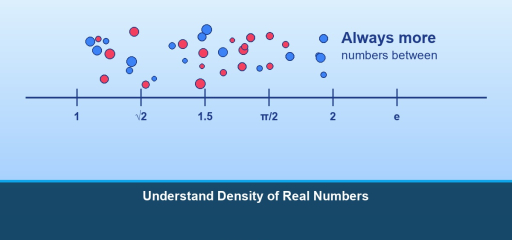
Between any two real numbers, no matter how close they are. There is always another real number you can squeeze in. In fact, there are infinitely many numbers between any two distinct values. This remarkable property is called the density of real numbers, and understanding it is a key stepping-stone for 8th-grade math and beyond.
Whether you are working with fractions, decimals, or irrational numbers, the density property guarantees that the number line never has “gaps.” In this comprehensive guide we will break down exactly what density means, show you three reliable methods for finding numbers between two given values, walk through worked examples, and give you practice problems with full solutions.
What Does “Density” Mean in Math?
A set of numbers is called dense if between every pair of distinct members you can always find another member of the same set. Both the rational numbers (fractions, terminating and repeating decimals) and the irrational numbers (\(\sqrt{2}\), \(\pi\), etc.) are dense on the number line.
- Between any two rational numbers there exists another rational number.
- Between any two real numbers there exists an irrational number.
- This process never stops. You can always find yet another number in between.
Because both the rationals and the irrationals are dense, the real number line has no holes. This is one of the foundational ideas behind calculus and advanced mathematics.
Three Methods for Finding a Number Between Two Values
Method 1, The Average (Midpoint) Method
The simplest technique: add the two numbers and divide by 2.
\(\text{Number between } a \text{ and } b = \dfrac{a + b}{2}\)
This always gives a value exactly halfway between \(a\) and \(b\). For example, a number between \(3\) and \(4\) is \(\frac{3+4}{2} = 3.5\).
Method 2, Decimal Insertion
Write both numbers with additional decimal places, then pick any value that falls between them. For example, between \(0.4\) and \(0.5\) you can write \(0.40\) and \(0.50\), then choose \(0.45\), \(0.42\), or \(0.499\).
Method 3, Common-Denominator Method (Fractions)
Convert both fractions to the same denominator. If no numerator sits between them, multiply numerator and denominator by 10 (or any factor) to create room. For instance, \(\frac{1}{3}=\frac{10}{30}\) and \(\frac{1}{2}=\frac{15}{30}\), so \(\frac{11}{30}, \frac{12}{30}, \frac{13}{30}, \frac{14}{30}\) all lie between them.
Step-by-Step Examples
Example 1, Rational between two fractions
Find a rational number between \(\frac{1}{3}\) and \(\frac{1}{2}\).
Solution: Use the average method.
\(\dfrac{\frac{1}{3}+\frac{1}{2}}{2} = \dfrac{\frac{2}{6}+\frac{3}{6}}{2} = \dfrac{\frac{5}{6}}{2} = \dfrac{5}{12}\)
Check: \(\frac{1}{3} \approx 0.333\) and \(\frac{5}{12} \approx 0.417\) and \(\frac{1}{2} = 0.5\). ✓
Example 2, Rational between two decimals
Find a rational number between \(3.14\) and \(3.15\).
Solution: Use decimal insertion. Add another decimal place: choose \(3.145\) (or any value like \(3.141\), \(3.149\), etc.).
Example 3, Irrational between two integers
Find an irrational number between \(4\) and \(5\).
Solution: We need a square root that is not a perfect square and falls between 4 and 5. Since \(4^{2}=16\) and \(5^{2}=25\), any \(\sqrt{n}\) with \(16 < n < 25\) works. Choose \(\sqrt{20} \approx 4.472\). ✓
Example 4, Number between negative values
Find a number between \(-3\) and \(-2\).
Solution: Average: \(\frac{-3+(-2)}{2} = \frac{-5}{2} = -2.5\). ✓
Video Lesson
Watch this video for additional examples and a step-by-step walkthrough:
Why Does Density Matter?
Density is more than a classroom curiosity. It explains why:
- Measurements can always be more precise. Between 4.37 g and 4.38 g on a lab scale, there are infinitely many possible masses (4.371 g, 4.3754 g, …).
- The number line has no gaps. Every point corresponds to a real number, which is essential for graphing continuous functions.
- Limits work. Calculus relies on the idea that you can get “as close as you like” to a value, density makes that possible.
Key Concepts to Remember
- Between any two distinct real numbers, infinitely many other real numbers exist.
- The average method \(\frac{a+b}{2}\) is the fastest way to find a number between \(a\) and \(b\).
- Both rational and irrational numbers are dense, neither set has gaps on the number line.
- The mediant \(\frac{a+c}{b+d}\) of two fractions \(\frac{a}{b}\) and \(\frac{c}{d}\) always lies between them (provided both fractions are positive and in lowest terms with \(\frac{a}{b}<\frac{c}{d}\)).
Practice Problems
- Find a rational number between \(\frac{1}{4}\) and \(\frac{1}{3}\).
- Find a rational number between \(0\) and \(1\).
- Find a number between \(0.5\) and \(1\).
- Find a number between \(2.01\) and \(2.02\).
- Find a rational number between \(\frac{3}{5}\) and \(\frac{7}{10}\).
- Find a number between \(-3\) and \(-2\).
- Find an irrational number between \(1\) and \(2\).
- Find an irrational number between \(5\) and \(6\).
- Find a rational number between \(\frac{2}{3}\) and \(\frac{5}{6}\).
- Find a number between \(0.45\) and \(0.46\).
Solutions
- \(\frac{7}{24}\) (average of \(\frac{1}{4}\) and \(\frac{1}{3}\))
- \(\frac{1}{2}\) (or 0.5)
- \(0.75\)
- \(2.015\)
- \(\frac{13}{20} = 0.65\)
- \(-2.5\)
- \(\sqrt{2} \approx 1.414\)
- \(\sqrt{26} \approx 5.099\)
- \(\frac{3}{4} = 0.75\)
- \(0.455\)
Real-World Applications
Science: A chemist measures a solution’s pH between 6.8 and 6.9. Density guarantees that a more precise reading (6.85, 6.847, …) always exists, encouraging finer instruments.
Engineering: When a machinist needs a bolt diameter between 12.00 mm and 12.01 mm, infinitely many sizes are theoretically available, guiding tolerance specifications.
Common Mistakes to Avoid
- Thinking there are only a few numbers between two values. There are always infinitely many.
- Confusing density with counting. Between 1 and 2 there is no integer, but there are infinitely many real numbers. The integers are not dense; the reals are.
- Forgetting irrational options. Square roots of non-perfect squares are a great way to produce an irrational number in any interval.
Frequently Asked Questions
Can you always find a number between two numbers?
Yes. As long as the two numbers are different, the average \(\frac{a+b}{2}\) is always strictly between them. You can repeat this process endlessly.
Are whole numbers dense?
No. There is no whole number between 2 and 3. Whole numbers (and integers) are not dense. Rational numbers and real numbers are dense.
How do you find an irrational number between two rationals?
Take the square root of a non-perfect-square integer that falls in the right range, or add a known irrational like \(\frac{\sqrt{2}}{10}\) to the smaller number, adjusting the denominator as needed.

Related to This Article
More math articles
- The ICC, the Sherman Act, and the Limits of Early Regulation
- The Best Grade 4 Math Book for Oregon Students
- Number Patterns and Sequences for 4th Grade
- Standard Deviation Calculator (Free)
- What Level of Math is Tested on the PSAT/NMSQT?
- The Best Grade 3 ELA Practice Tests for New Hampshire Students
- Full-Length 8th Grade Common Core Math Practice Test-Answers and Explanations
- How to Break Fractions and Mixed Numbers Apart to Add or Subtract
- The Ultimate SSAT Middle-Level Math Course (+FREE Worksheets & Tests)
- 6th Grade SBAC Math Practice Test Questions
What people say about "Density Property of Real Numbers: Meaning and Examples"?
No one replied yet.