LEARN · PRACTICE · EXPLORE
North Dakota Grade 8 Math
North Dakota Grade 8 Math: explore grade-level lessons, worksheets, and learning references. Check the curriculum source and choose practice for your next skill.
Focused lessons · Useful practice · Clear next steps
What do North Dakota 8th graders learn in math?
In 8th grade, North Dakota math centers on linear equations and functions, the Pythagorean theorem, exponents and scientific notation, transformations, and volume. Students take the NDSA grade 8 math test in the spring. This page explains each North Dakota grade 8 math standard and pairs it with short lessons, skill quizzes, printable worksheets and a full-length practice test.
Printable North Dakota grade 8 math books:
- 5 North Dakota NDSA Grade 8 Math Practice Tests
- 5 North Dakota NDSA Grade 8 Math Practice Tests
- 6 North Dakota NDSA Grade 8 Math Practice Tests
- 7 North Dakota NDSA Grade 8 Math Practice Tests
- North Dakota NDSA Grade 8 Math Preparation Bundle
- North Dakota NDSA 8th Grade Math Workbook
- North Dakota NDSA Grade 8 Math Made Ridiculously Simple
Standards source: North Dakota Education Content Standards, North Dakota Department of Public Instruction.
Start With a NDSA Practice Test
Six full, timed North Dakota NDSA Grade 8 math practice tests, 40 questions each, instant scoring, a topic-by-topic breakdown, and full step-by-step solutions. Each one opens right here in a popup. Calculator: Scientific calculator (on part).
NDSA Practice Test 1
A full diagnostic across every North Dakota Grade 8 math topic.
Start Test 1 →
NDSA Practice Test 2
Fresh questions and problem types to build accuracy.
Start Test 2 →
NDSA Practice Test 3
New problems to add speed and confidence on every skill.
Start Test 3 →
NDSA Practice Test 4
Another complete, timed exam to build pacing and stamina.
Start Test 4 →
NDSA Practice Test 5
A brand-new mixed set to test your readiness.
Start Test 5 →
NDSA Practice Test 6
A final full-length simulation to confirm you are ready.
Start Test 6 →
North Dakota Grade 8 Math Study Tools
A few minutes of quick review, flip through flashcards or scan every key formula. Both open right here.
North Dakota Grade 8 Math Skill Quizzes
Short, focused quizzes, pick one skill, answer 10 questions, get instant scoring and full solutions, then jump to the matching lesson. Each opens right here.
The Number System & Real Numbers
A quick 10-question check on The Number System & Real Numbers with instant scoring and step-by-step solutions.
Start Quiz →
Exponents & Scientific Notation
A quick 10-question check on Exponents & Scientific Notation with instant scoring and step-by-step solutions.
Start Quiz →
Equations & Inequalities
A quick 10-question check on Equations & Inequalities with instant scoring and step-by-step solutions.
Start Quiz →
Functions
A quick 10-question check on Functions with instant scoring and step-by-step solutions.
Start Quiz →
Geometry & Transformations
A quick 10-question check on Geometry & Transformations with instant scoring and step-by-step solutions.
Start Quiz →
Statistics & Probability
A quick 10-question check on Statistics & Probability with instant scoring and step-by-step solutions.
Start Quiz →
Financial Literacy
A quick 10-question check on Financial Literacy with instant scoring and step-by-step solutions.
Start Quiz →
Mixed Grade 8 Review
A quick 10-question check on Mixed Grade 8 Review with instant scoring and step-by-step solutions.
Start Quiz →
North Dakota NDSA Grade 8 Math Snapshot
North Dakota Grade 8: connect practice to a classroom target
Use North Dakota curriculum source to check the expectation your class is studying. The topic directory provides general lessons; it is not a complete state alignment. These selected learning references give you more precise ideas to compare with an assignment. Common Core-style codes are Common Core references, and other codes come from the existing planning reference. Confirm current state wording and placement before treating either as an official local requirement.
- 8.NO.NS.1
- Compare and classify real numbers within the real number system
- 8.AR.EE.1
- Explain the relationship between repeated multiplication and the properties of integer exponents. Apply a single exponent property to generate equivalent numeric and algebraic expressions that include numerical coefficients
- 8.GM.AV.1
- Apply given formulas to solve problems involving the volume of cones, cylinders, and spheres, including authentic problems
- 8.DPS.D.1
- Interpret scatter plots for bivariate measurement data to investigate patterns such as clustering, outliers, positive or negative association, linear association, and nonlinear association
Choose practice from the explanation
Ask the student to explain one of the ideas above with a drawing, model, table, or short calculation. If the explanation is unclear, open the related lesson before assigning a mixed test. If the idea is understood but the calculation is unreliable, choose a focused worksheet and review the strategy afterward.
Keep the classroom target, the resource used, and the next step together in a study note. A topic quiz can guide review; its score is not an official state performance level. Revisit the skill in a new context after a few days.
North Dakota Grade 8 Math Topics
Student-friendly Grade 8 math skills connected to the North Dakota standards, each tagged with its NDSA standard code and a focused lesson.
Number Sense
- 8.NORational and Irrational NumbersWorksheetsQuiz
- 8.NOTurning Repeating Decimals into FractionsWorksheetsQuiz
- 8.NOEstimating Irrational NumbersWorksheetsQuiz
- 8.NOEstimating Expressions with Irrational NumbersWorksheetsQuiz
- 8.NOPersonal Financial LiteracyWorksheetsQuiz
- 8.NOPrime Factorization with ExponentsWorksheetsQuiz
- 8.NODensity of Real NumbersWorksheetsQuiz
Exponents and Scientific Notation
Equations and Inequalities
- 8.ARGraphing Proportional RelationshipsWorksheetsQuiz
- 8.ARSlope as Rate of ChangeWorksheetsQuiz
- 8.ARSlope and the Equations of a LineWorksheetsQuiz
- 8.ARSolving Linear Equations in One VariableWorksheetsQuiz
- 8.ARSolving Systems of Two EquationsWorksheetsQuiz
- 8.ARSolving Real Problems with SystemsWorksheetsQuiz
- 8.ARSolving Linear InequalitiesWorksheetsQuiz
- 8.ARMultiplying Linear Expressions and FactoringWorksheetsQuiz
- 8.ARGraphing Linear Inequalities in Two VariablesWorksheetsQuiz
- 8.ARParallel and Perpendicular LinesWorksheetsQuiz
- 8.ARPoint Slope and Standard FormWorksheetsQuiz
- 8.ARLiteral EquationsWorksheetsQuiz
- 8.ARAbsolute Value Equations and InequalitiesWorksheetsQuiz
- 8.AREquations with Special SolutionsWorksheetsQuiz
Functions
- 8.ARWhat is a FunctionWorksheetsQuiz
- 8.ARReading Function ValuesWorksheetsQuiz
- 8.ARComparing Two FunctionsWorksheetsQuiz
- 8.ARLinear vs Nonlinear FunctionsWorksheetsQuiz
- 8.ARBuilding Linear FunctionsWorksheetsQuiz
- 8.ARSketching and Describing Function GraphsWorksheetsQuiz
- 8.ARDomain and Range of a FunctionWorksheetsQuiz
- 8.ARArithmetic SequencesWorksheetsQuiz
- 8.ARGeometric SequencesWorksheetsQuiz
Geometry
- 8.GMRotations Reflections and TranslationsWorksheetsQuiz
- 8.GMCongruent FiguresWorksheetsQuiz
- 8.GMTransformations on the Coordinate PlaneWorksheetsQuiz
- 8.GMSimilarity and DilationsWorksheetsQuiz
- 8.GMAngles in Triangles and Parallel LinesWorksheetsQuiz
- 8.GMThe Pythagorean TheoremWorksheetsQuiz
- 8.GMFinding Distance with the Pythagorean TheoremWorksheetsQuiz
- 8.GMVolume of CylindersWorksheetsQuiz
- 8.GMAngle RelationshipsWorksheetsQuiz
- 8.GMSurface Area of Prisms Cylinders and PyramidsWorksheetsQuiz
- 8.GMVolume of PyramidsWorksheetsQuiz
- 8.GMComposite Figures Area and PerimeterWorksheetsQuiz
- 8.GMInterior Angles of PolygonsWorksheetsQuiz
- 8.GMTriangle Inequality TheoremWorksheetsQuiz
- 8.GMSurface Area of SpheresWorksheetsQuiz
- 8.GMArc Length and Area of SectorsWorksheetsQuiz
- 8.GMCross Sections of 3D FiguresWorksheetsQuiz
- 8.GMParallel Lines and TransversalsWorksheetsQuiz
- 8.GM(merged topic)WorksheetsQuiz
- 8.GMVolume of Cones and SpheresWorksheetsQuiz
Statistics and Probability
- 8.DPSScatter Plots and Patterns in DataWorksheetsQuiz
- 8.DPSFitting a Line to DataWorksheetsQuiz
- 8.DPSUsing a Linear ModelWorksheetsQuiz
- 8.DPSTwo Way Tables for Categorical DataWorksheetsQuiz
- 8.DPSMean Absolute DeviationWorksheetsQuiz
- 8.DPSProbability of Simple EventsWorksheetsQuiz
- 8.DPSCounting Principle and PermutationsWorksheetsQuiz
- 8.DPSBox Plots and Interquartile RangeWorksheetsQuiz
- 8.DPSRandom SamplingWorksheetsQuiz
- 8.DPSEffect of Data Changes on StatisticsWorksheetsQuiz
- 8.DPS(merged topic)WorksheetsQuiz
Best North Dakota NDSA Grade 8 Math Books
Each book has a job: start from scratch, drill weak skills, or build pacing with full tests. All of them pair with the free tools on this page.
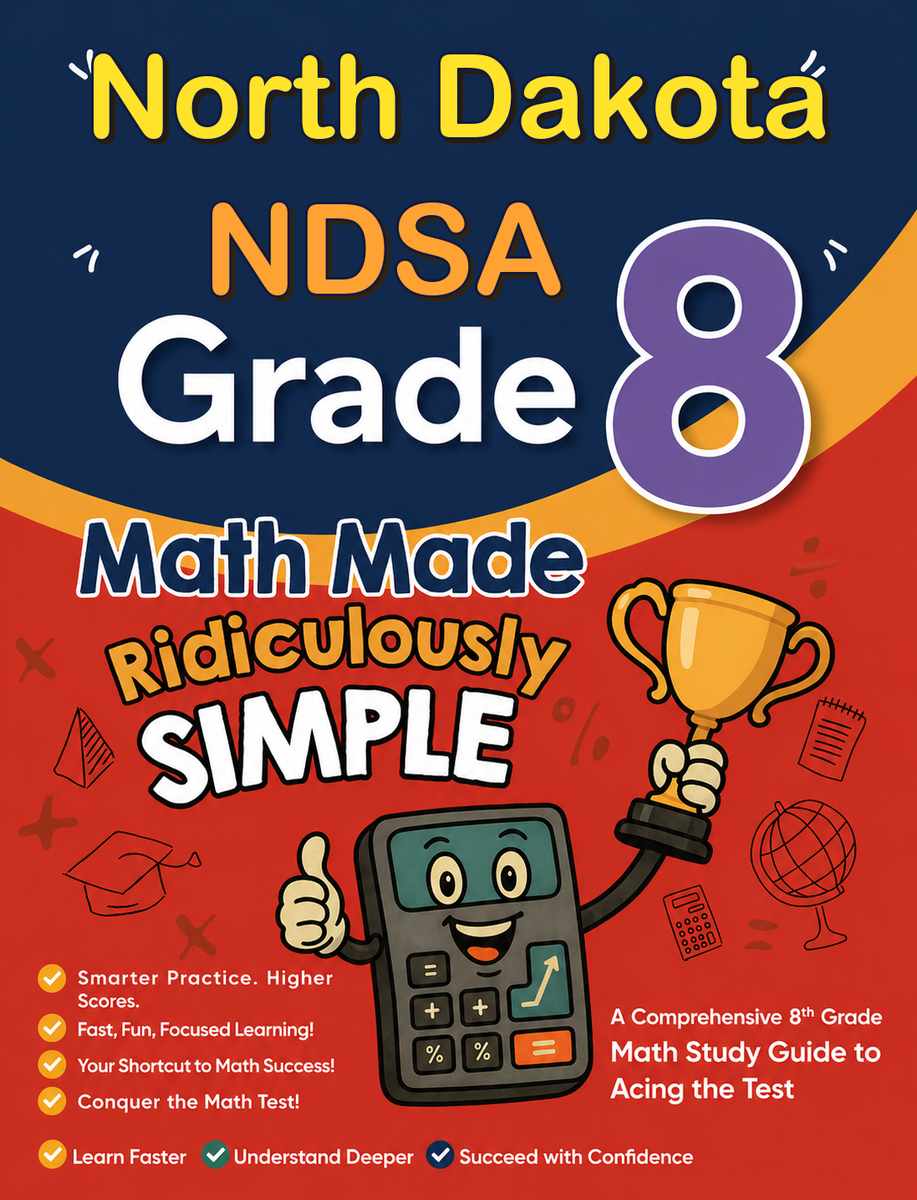
North Dakota NDSA Grade 8 Math Made Ridiculously Simple
A step-by-step NDSA Grade 8 math book that rebuilds every tested skill clearly and in order, built to match the North Dakota standards.
- Best starting point for the NDSA math test
- Pairs with North Dakota flashcards and worksheets
- Use it before full timed practice tests
- Organized for students who need examples before drills
Step-by-step lessons
Short explanations show the move before the student practices it.
✍Worked examples
Examples translate NDSA-style wording into clear math steps.
Targeted practice
Rebuild one skill at a time instead of jumping around.
Test-day bridge
After each topic, connect to formulas, flashcards, and practice questions.
How to use it
- Read one lesson and copy the worked example.
- Do a short worksheet set on the same topic.
- Review the matching flashcards or formulas.
- Try a mixed quiz and mark every miss.
Pair it with free tools
Choose the right North Dakota Grade 8 math book
North Dakota NDSA Grade 8 Math Made Ridiculously Simple
Start here to rebuild NDSA math from the ground up.
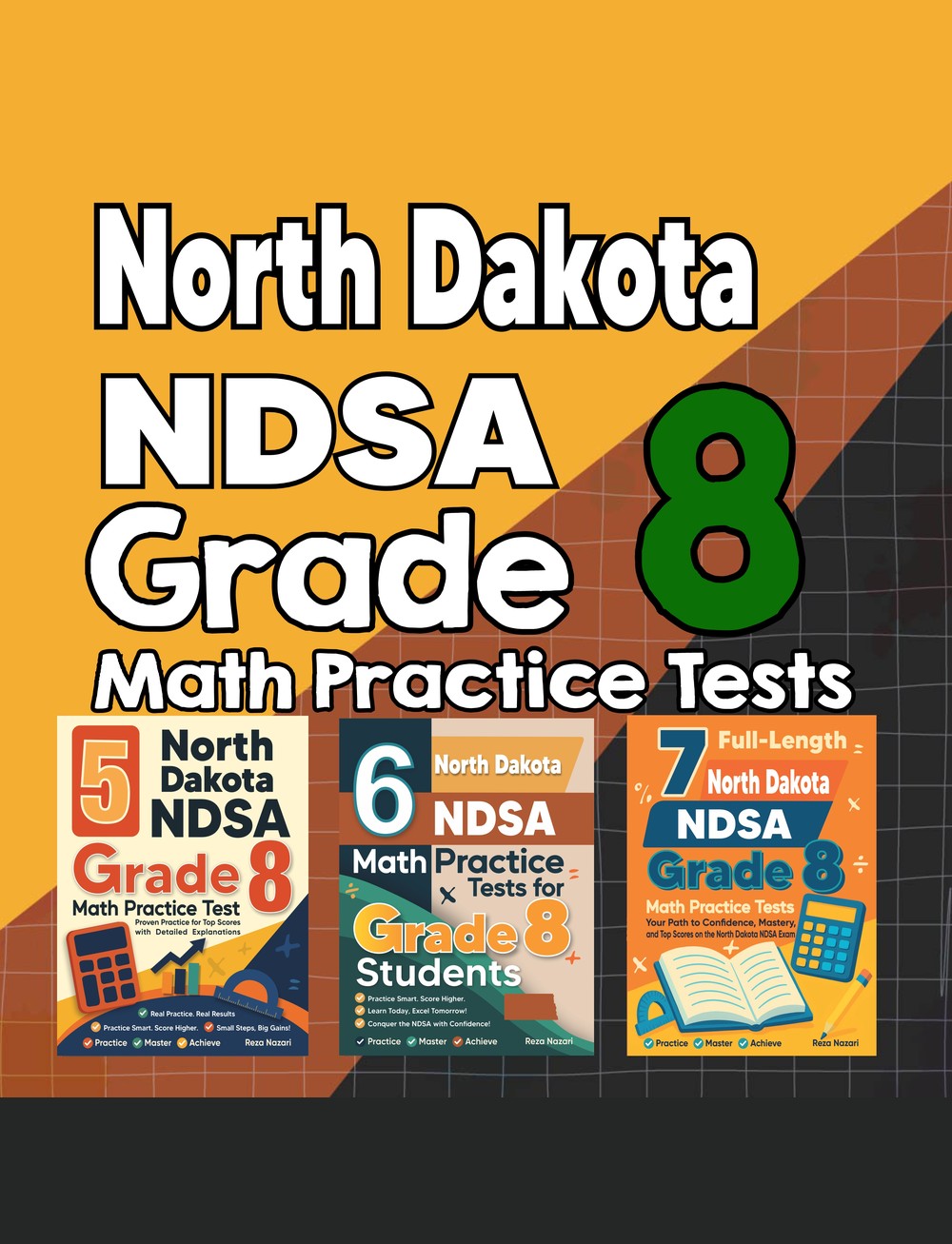
North Dakota NDSA Grade 8 Math Preparation Bundle
The full prep library, study guide, workbook, and practice tests together.
7 North Dakota NDSA Grade 8 Math Practice Tests
Use after topic review to build pacing and test stamina.
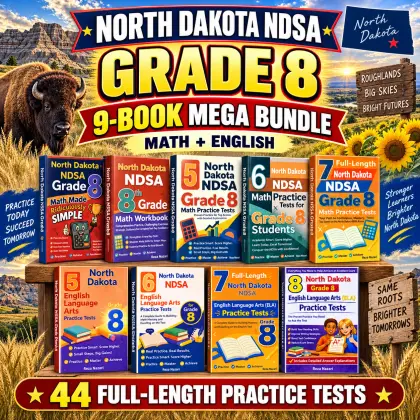
North Dakota NDSA Grade 8 Math & ELA Mega Bundle
9 books and 44 full-length practice tests in one TPT bundle.
North Dakota Grade 8 Math Standards
The official North Dakota Grade 8 math standards, grouped by domain with the exact code and description for each expectation.
8.NO
- 8.NO.NS.1Compare and classify real numbers within the real number system
- 8.NO.NS.2Use rational approximations of irrational numbers to compare the size of irrational numbers, locate them on a number line diagram, and estimate the value of irrational expressions involving one operation
- 8.NO.NS.3Use scientific notation to represent very large or very small quantities. Interpret scientific notation generated by technology. Compare and order numbers in both scientific and standard notation
- 8.NO.O.1Evaluate mentally the square roots of perfect squares up to 225 and cube roots of perfect cubes up to 1000
- 8.NO.O.2Add, subtract, multiply, and divide rational numbers using strategies or procedures
8.AR
- 8.AR.EE.1Explain the relationship between repeated multiplication and the properties of integer exponents. Apply a single exponent property to generate equivalent numeric and algebraic expressions that include numerical coefficients
- 8.AR.EE.2Use square root and cube root symbols to represent solutions to equations of the form x² = p and x³ = p, where p is a non-negative rational number
- 8.AR.EE.3Explain the characteristics of a linear relationship, including identifying the slope and y-intercept in tables, graphs, equations, and descriptions
- 8.AR.EE.4Represent linear relationships using tables, graphs, equations, and descriptions when given a relationship in one of these forms
- 8.AR.EE.5Solve linear equations with rational number coefficients and variables on both sides, including equations that require using the distributive property and/or combining and collecting like terms. Interpret the number of solutions. Give examples of linear equations in one variable with one solution, infinitely many solutions, or no solutions
- 8.AR.EE.6Read, write, and evaluate numerical and algebraic expressions including expressions involving absolute value. Solve and graph equations of the form |x|=rwhereris a nonnegative rational number
- 8.AR.EE.7Solve and graph inequalities in one variable with rational number coefficients and variables on both sides, including inequalities that require using the distributive property and/or combining like terms
- 8.AR.EE.8Graph linear inequalities in two variables on a coordinate plane. Interpret the possible solutions in the context of authentic problems
- 8.AR.F.1Defend whether a relation is a function from various representations using appropriate function language
- 8.AR.F.2Compare and contrast properties of two linear functions, each represented in a different way (algebraically, graphically, numerically in tables, and/or by descriptions)
- 8.AR.F.3Compare and contrast linear and non-linear functions represented in different ways (algebraically, graphically, numerically in tables, and/or by descriptions)
- 8.AR.F.4Model a linear function between two quantities by creating a table, graph, and equation. Interpret the rate of change and initial value of a linear function in terms of the situation it models
- 8.AR.F.5Describe qualitatively the functional relationship between two quantities by analyzing a graph including where the function is constant, increasing, or decreasing; linear or nonlinear; and discrete or continuous. Create a graph that exhibits the qualitative features of a function described
8.GM
- 8.GM.AV.1Apply given formulas to solve problems involving the volume of cones, cylinders, and spheres, including authentic problems
- 8.GM.GF.1Perform single transformations to a figure on the coordinate plane and determine whether the figures are congruent or similar
- 8.GM.GF.2Describe the characteristics of transformations on the coordinate plane using transformation language
- 8.GM.GF.3Name the type of transformation needed to map a pre-image to its image
- 8.GM.GF.4Describe the following angle-pair relationships: interior and exterior angles of triangles and angles formed when a transversal cuts parallel lines or intersecting lines. Solve for an unknown angle in a figure by applying facts about these angles
- 8.GM.GF.5Describe the relationship between the leg lengths and the hypotenuse length of a right triangle. Determine whether a triangle is a right triangle using this relationship
- 8.GM.GF.6Apply the Pythagorean Theorem to determine unknown side lengths in right triangles in two and three dimensions on and off a coordinate plane, including authentic problems
8.DPS
- 8.DPS.D.1Interpret scatter plots for bivariate measurement data to investigate patterns such as clustering, outliers, positive or negative association, linear association, and nonlinear association
- 8.DPS.D.2Draw an informal trend line on a given scatter plot with a linear association and justify its fit by describing the closeness of the data points to the line
- 8.DPS.D.3Solve authentic problems in the context of bivariate measurement data by interpreting the slope and intercept(s) and making predictions using a linear model
- 8.DPS.D.4Construct and interpret a two-way table summarizing bivariate categorical data collected from the same subjects
Standards: North Dakota Content Standards. Official source ↗
North Dakota NDSA Grade 8 Math FAQ
What is the NDSA Grade 8 math test?
The NDSA (North Dakota State Assessment) is North Dakota's Grade 8 mathematics assessment. The linked activities are independent Grade 8 practice. Their question count, timer, scoring, and item types may differ from the official assessment. Use the directions inside each activity.
Can I use a calculator?
Calculator rules depend on the grade, assessment, test segment, and approved accommodations. Follow the current assessment guidance and ask your school which rules apply. A tool available in independent practice does not establish permission on the official test.
How long is each practice test?
Read the timer and question count shown in the practice activity you open. These are practice settings, not a statement of the official assessment’s duration or scoring.
Is it free?
The linked general practice and topic resources are available separately from optional books. Check each activity’s directions and access requirements. The study guide and bundle are optional next steps.
Grade 8 Math in Other States
Explore Grade 8 math standards, practice tests, and worksheets for every state.
- Alabama
- Alaska
- Arizona
- Arkansas
- California
- Colorado
- Connecticut
- Delaware
- Florida
- Georgia
- Hawaii
- Idaho
- Illinois
- Indiana
- Iowa
- Kansas
- Kentucky
- Louisiana
- Maine
- Maryland
- Massachusetts
- Michigan
- Minnesota
- Mississippi
- Missouri
- Montana
- Nebraska
- Nevada
- New Hampshire
- New Jersey
- New Mexico
- New York
- North Carolina
- Ohio
- Oklahoma
- Oregon
- Pennsylvania
- Rhode Island
- South Carolina
- South Dakota
- Tennessee
- Texas
- Utah
- Vermont
- Virginia
- Washington
- West Virginia
- Wisconsin
- Wyoming
- District of Columbia
Make This Your North Dakota NDSA Starting Point
Take a timed practice test, find your weakest topic, and study it with the linked lessons, worksheets, and the NDSA study guide.
Start a practice testA USEFUL NEXT STEP
North Dakota Grade 8 Math: study questions
How should I choose a Grade 8 math study target?
Choose a current classroom target, find the matching learning reference, and use a lesson or available practice resource to check understanding. State documents control local wording and placement; shared reference codes are not a certified crosswalk.
Official source ↗Are these activities official state assessments?
These are independently published learning resources. A practice score does not predict or replace an official state score. Use the directions in each activity and consult your school for official testing and accommodation rules.
Resources from Effortless Math · Editorial standards