Rotations, Reflections, and Translations: Complete Guide with Video and Examples
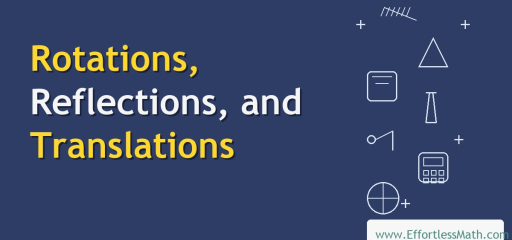
A transformation moves or resizes a figure. Three rigid transformations preserve shape and size (they produce congruent images): a translation slides every point the same distance in the same direction; a reflection flips the figure across a line (the mirror line), reversing orientation; a rotation turns the figure a given angle around a fixed centre of rotation. In all three cases, every side length and every angle is preserved—only position or orientation changes. On the coordinate plane, translations add constants to coordinates, reflections negate one coordinate, and rotations swap and/or negate coordinates depending on the angle.
Understanding rotations, reflections, and translations becomes much easier when you reduce each problem to a repeatable checklist. Start by identifying the important relationship in the problem, then use it consistently: Translation \((a,b)\): \((x,y)\to(x+a, y+b)\) (slide right/left \(a\), up/down \(b\)); Reflection across \(x\)-axis: \((x,y)\to(x, -y)\) Reflection across \(y\)-axis: \((x,y)\to(-x, y)\).
This topic matters because it connects basic skills to more advanced algebra, geometry, statistics, or modeling. When students can explain why a method works instead of memorizing isolated steps, they solve unfamiliar problems with much more confidence.
Watch the Video Lesson
If you want a quick visual walkthrough before practicing on your own, start with this lesson.
Understanding Rotations, Reflections, and Translations
A transformation moves or resizes a figure. Three rigid transformations preserve shape and size (they produce congruent images): a translation slides every point the same distance in the same direction; a reflection flips the figure across a line (the mirror line), reversing orientation; a rotation turns the figure a given angle around a fixed centre of rotation. In all three cases, every side length and every angle is preserved—only position or orientation changes. On the coordinate plane, translations add constants to coordinates, reflections negate one coordinate, and rotations swap and/or negate coordinates depending on the angle.
A strong approach to rotations, reflections, and translations is to slow down just enough to label the important quantities, recognize the governing rule, and check whether the final answer makes sense. That habit keeps small arithmetic mistakes from turning into bigger conceptual mistakes.
Students usually improve fastest when they practice explaining each step aloud. If you can say what the rule means, why it applies, and how the answer should behave, then rotations, reflections, and translations becomes much more manageable on classwork, homework, and tests.
Key Ideas to Remember
- Translation \((a,b)\): \((x,y)\to(x+a, y+b)\) (slide right/left \(a\), up/down \(b\))
- Reflection across \(x\)-axis: \((x,y)\to(x, -y)\) Reflection across \(y\)-axis: \((x,y)\to(-x, y)\)
- Rotation \(90^\circ\) CCW about origin: \((x,y)\to(-y, x)\) \(180^\circ\): \((x,y)\to(-x, -y)\)
- Visual check: The image should keep the same side lengths and angles; only the position or orientation changes.}
Worked Examples
Example 1
Problem: Triangle \(\text{ ABC }\) has vertices \(A(1,2)\), \(B(3,2)\), \(C(2,4)\). Translate by \((-4, 1)\). Find the image vertices.
Solution: Add \((-4,1)\) to each vertex: \(A’=(1-4, 2+1)=(-3,3)\); \(B’=(3-4, 2+1)=(-1,3)\); \(C’=(2-4, 4+1)=(-2,5)\).
Answer: \(A'(-3,3),\ B'(-1,3),\ C'(-2,5)\)

Example 2
Problem: Rotate point \(P(3,-2)\) by \(90^\circ\) counter-clockwise about the origin.
Solution: Rule for \(90^\circ\) CCW: \((x,y)\to(-y, x)\). \(P(3,-2)\to P'(-(-2), 3)=P'(2,3)\).
Answer: \(P'(2, 3)\)
Example 3
Problem: Reflect point \((4,-3)\) across the \(y\)-axis, then translate the image by \((-2, 5)\). What are the final coordinates?
Solution: Reflecting across the \(y\)-axis changes \((x,y)\) to \((-x,y)\), so \((4,-3)\) becomes \((-4,-3)\). Then apply the translation \((-2,5)\): move left 2 and up 5. The new point is \((-4-2, -3+5) = (-6,2)\).
Answer: \((-6,2)\)
Common Mistakes
- Mixing up the rules for reflections across the x-axis and y-axis.
- Changing side lengths during a rigid transformation even though size must stay the same.
- Applying a translation in the wrong direction because the sign of the movement was ignored.
Practice Problems
Try these on your own before checking a textbook or notes. The goal is to explain the method, not just state a final answer.
- Translate \((2,5)\) by \((3,-1)\).
- Translate \((-4,0)\) by \((-2,6)\).
- Reflect \((3,-4)\) across the \(x\)-axis.
- Reflect \((-5,2)\) across the \(y\)-axis.
- Reflect \((4,7)\) across \(y=x\), where \((x,y)\to(y,x)\).
- Rotate \((5,0)\) by \(90^\circ\) CCW.
Study Tips
- Memorise the rotation rules: \(90^\circ\) CCW: \((-y,x)\);\; \(180^\circ\): \((-x,-y)\);\; \(270^\circ\) CCW (=\(90^\circ\) CW): \((y,-x)\). Drawing a quick sketch helps.
- Translation preserves direction; reflection reverses it. A reflected figure and its original mirror each other—like a face and its reflection in water.
- All three rigid transformations preserve the distance between any two points, so the image and pre-image are always congruent.
Final Takeaway
Rotations, Reflections, and Translations is easier when you focus on the structure of the problem instead of chasing isolated tricks. Use the core rule, keep your work organized, and make one quick reasonableness check before you finish.
Once that process becomes automatic, you can move through more challenging questions with much more speed and accuracy. Rework the examples above, solve the practice set, and then come back to rotations, reflections, and translations again after a day or two to make the skill stick.

Related to This Article
More math articles
- Use the market graph before the firm graph
- Public-relations campaigns
- The Best Grade 2 Math Worksheets for New Hampshire Students
- Why So Many Students Struggle with Math Anxiety and How to Deal with It
- Free Grade 4 English Worksheets for Michigan Students
- Candidate characteristics
- Standard, Formal English
- The Best Grade 3 ELA Practice Tests for Vermont Students
- Collective Behavior, Social Movements, and Social Change
- Storage Safety and Environmental Requirements
What people say about "Rotations, Reflections, and Translations"?
No one replied yet.