Critical Points Calculator — Maxima & Minima
CalculusFreeNo sign-up
For f(x) = 2x³ − 3x² − 12x + 5, set f′(x) = 6(x + 1)(x − 2) equal to zero: the critical points are x = −1 and x = 2. f′ changes from + to − at −1 and from − to + at 2, so (−1, 12) is a local maximum and (2, −15) a local minimum. The critical points calculator does this for any function.
f(x) = 2x³ − 3x² − 12x + 5 has 2 critical points: (−1, 12), local maximum; (2, −15), local minimum.
Critical points and their type
| x | f(x) | Why critical | First derivative test | Second derivative test |
|---|---|---|---|---|
| −1 | 12 | f′ = 0 | + to −: local maximum | f″ = −18 (negative): maximum |
| 2 | −15 | f′ = 0 | − to +: local minimum | f″ = 18 (positive): minimum |
Increasing and decreasing intervals
| Interval | Test x | f′(test x) | f is |
|---|---|---|---|
| (−∞, −1) | −2 | 24 (+) | increasing ↗ |
| (−1, 2) | 1 | −12 (−) | decreasing ↘ |
| (2, ∞) | 3 | 24 (+) | increasing ↗ |
Increasing on (−∞, −1) ∪ (2, ∞); decreasing on (−1, 2).
Show steps
- Differentiatef′(x) = 6x2 − 6x − 12Rules used: Sum and difference rule, Constant multiple and power rule, Constant multiple rule, Constant rule. Full working: derivative calculator.
- Solve f′(x) = 0Divide 6x² − 6x − 12 = 0 by 6: x² − x − 2 = 0.Quadratic formula for x² − x − 2 = 0: x = (−b ± √(b² − 4ac))/(2a) with a = 1, b = −1, c = −2. The discriminant is b² − 4ac = 9.√9 = 3, so x = −1 or x = 2.
- Where is f′(x) undefined?f′ is defined at every x where f is defined, so no extra critical points come from this step.
- First derivative testPick a test x in each interval and check the sign of f′: positive means increasing, negative means decreasing. Increasing on (−∞, −1) ∪ (2, ∞); decreasing on (−1, 2).x = −1: f′ goes from + to −, so it is a local maximum with f(−1) = 12.x = 2: f′ goes from − to +, so it is a local minimum with f(2) = −15.
- Second derivative testf″(x) = 12x − 6At x = −1: f″ = −18 (negative): maximum.At x = 2: f″ = 18 (positive): minimum.
- Absolute extrema on the intervalCompare f at the endpoints and at the critical points inside the interval. On [−2, 3]: absolute maximum 12 at x = −1, absolute minimum −15 at x = 2.
Related: derivative with steps · function grapher · Newton’s method
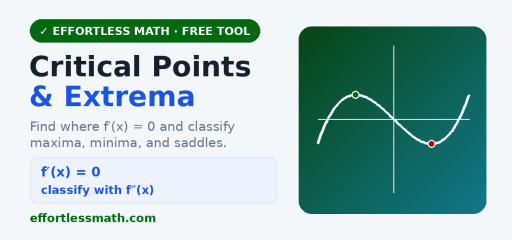
How to use the critical points calculator
- Type the function, for example x^3 – 3x, x/(x^2+1), x^(2/3), |x^2 – 4| or sin(x) + cos(x). Check the “Reads as” line.
- Set the interval. Polynomials and rational functions are solved exactly over all real numbers, so the interval only sets the absolute maximum and minimum. For trig, exponential and log functions, the interval is also where the tool searches numerically.
- Read the critical points, with exact values such as 1 ± √2, π/4 or 1/e when they exist, and the y-value at each point.
- Use the tables: each point’s type by the first and second derivative tests, and the intervals where f is increasing or decreasing.
- Open Show steps for the derivative, the factoring or quadratic formula, the points where f′ is undefined and both tests.
What is a critical point?
A critical point of f is a number c in the domain of f where f′(c) = 0 or f′(c) does not exist. At a point where f′(c) = 0 the tangent line is horizontal. Where f′ is undefined the graph has a corner, a cusp or a vertical tangent, as with |x| or x^(2/3) at 0.
Every local maximum or minimum of a differentiable function sits at a critical point (Fermat’s theorem), but not every critical point is an extremum: f(x) = x³ has f′(0) = 0 and keeps rising on both sides. A value where f itself is undefined, such as x = 0 for 1/x, is not a critical point, although f can change direction across it.
How to find critical points step by step
- Find f′(x), using the derivative calculator if you want each rule shown.
- Solve f′(x) = 0. For a polynomial, factor out common factors, test rational roots ±p/q and use the quadratic formula on what remains. For a fraction, set the numerator equal to 0.
- Find where f′(x) is undefined (zeros of a denominator, the base of a negative power) and keep only values where f is defined.
- Classify each point with the first derivative test (sign of f′ on each side) or the second derivative test (sign of f″ at the point).
- Plug each critical x into f to get the point (c, f(c)).
First and second derivative tests
| Test | Result | Conclusion |
|---|---|---|
| First derivative | f′ changes from + to − | Local maximum |
| First derivative | f′ changes from − to + | Local minimum |
| First derivative | f′ keeps its sign | Not an extremum |
| Second derivative | f″(c) < 0 | Local maximum (concave down) |
| Second derivative | f″(c) > 0 | Local minimum (concave up) |
| Second derivative | f″(c) = 0 or undefined | Inconclusive: use the first derivative test |
The calculator runs both tests and bases the final type on the first derivative test, because it always gives an answer. For x⁴ − 4x³ at x = 0, f″(0) = 0, so the second test says nothing, while the sign chart shows f′ is negative on both sides: x = 0 is not an extremum.
Worked examples
Example 1: a cubic with integer critical points
f(x) = 2x³ − 3x² − 12x + 5 gives f′(x) = 6(x² − x − 2) = 6(x + 1)(x − 2). Test points: f′(−2) = 24 > 0, f′(0) = −12 < 0, f′(3) = 24 > 0. So f increases on (−∞, −1), decreases on (−1, 2) and increases on (2, ∞). With f″(x) = 12x − 6, f″(−1) = −18 confirms the maximum f(−1) = 12, and f″(2) = 18 confirms the minimum f(2) = −15. On [−2, 3], f(−2) = 1 and f(3) = −4, so the absolute maximum is 12 and the absolute minimum is −15.
Example 2: irrational critical points
f(x) = x³ − 3x² − 3x + 2 has f′(x) = 3(x² − 2x − 1). The quadratic formula gives x = 1 ± √2. The local maximum is at x = 1 − √2 ≈ −0.414, where f = −3 + 4√2 ≈ 2.657, and the local minimum is at x = 1 + √2 ≈ 2.414, where f = −3 − 4√2 ≈ −8.657.
Example 3: a point where f′ is undefined
f(x) = x^(2/3) has f′(x) = 2/(3∛x), which is never 0 but is undefined at x = 0, where f(0) = 0. f′ is negative for x < 0 and positive for x > 0, so (0, 0) is a local minimum, at a cusp.
Example 4: a rational function
f(x) = x + 4/x has f′(x) = 1 − 4/x² = (x² − 4)/x². The numerator gives x = ±2. At x = 0, f is undefined, so 0 is not a critical point, but it splits the sign chart. The result is a local maximum (−2, −4) and a local minimum (2, 4).
Critical points of common functions
| f(x) | Critical points | Type |
|---|---|---|
| x² | x = 0 | Minimum |
| x³ | x = 0 | Not an extremum |
| x³ − 3x | x = −1, x = 1 | Max (−1, 2), min (1, −2) |
| |x| | x = 0 (f′ undefined) | Minimum |
| x/(x² + 1) | x = −1, x = 1 | Min (−1, −1/2), max (1, 1/2) |
| x e^(−x) | x = 1 | Max (1, 1/e) |
| sin x on [0, 2π] | x = π/2, 3π/2 | Max, then min |
Common mistakes
- Skipping the points where f′ is undefined. Corners and cusps, as in |x| or x^(2/3), are critical points too.
- Counting a value where f is undefined. For 1/x, x = 0 is a break in the domain, not a critical point.
- Assuming every critical point is a maximum or minimum. Check the sign of f′ on both sides.
- Trusting f″(c) = 0. The second derivative test is inconclusive then; it does not mean “inflection point”.
- Forgetting the endpoints when the question asks for absolute extrema on a closed interval [a, b].
- Dividing f′(x) = 0 by x and losing the solution x = 0. Factor x out instead.
Why the interval matters
Polynomials and rational functions have finitely many critical points, and the tool finds all of them exactly. Functions such as sin x have infinitely many, and equations such as x cos x + 2 sin x = 0 have no algebraic solution, so the calculator scans the interval for sign changes of f′, refines each root by bisection and then checks whether it equals a simple exact value such as π/2 or 1/e. Widen the interval to see more points. For homework, find the derivative and solve f′(x) = 0 by hand first, then compare your list and your sign chart with the tables above.
Critical points practice quiz: 10 questions
Test yourself with 10 multiple-choice questions. Choose an answer and press Submit to see if you are right and why. Your score appears at the end.
f increases up to c and decreases after it, so f(c) is a local maximum.
f′ is −1 for x < 4 and 1 for x > 4, so f′(4) does not exist. Since f(4) = 0 is defined, x = 4 is a critical point (a minimum).
f′(x) = 3x² is positive on both sides of 0, so the sign does not change.
When f″(c) = 0 the second derivative test gives no answer; use the first derivative test. For example x⁴, x³ and −x⁴ all have f″(0) = 0.
f′(x) = e^(−x)(1 − x), and e^(−x) is never 0, so 1 − x = 0 gives x = 1.
The critical point x = 1 gives −1. The endpoints give f(0) = 0 and f(3) = 3, so the largest value is 3.
Quiz complete
Frequently asked questions
What is a critical point?
A number c in the domain of f where f′(c) = 0 or f′(c) is undefined. Critical points are the candidates for local maxima and minima.
How are critical points classified?
With the first derivative test (does f′ change from + to −, from − to +, or not at all?) or the second derivative test (is f″(c) negative, positive or zero?). The calculator shows both.
Is a critical point the same as a stationary point?
A stationary point is a critical point where f′(c) = 0. Critical points also include places where f′ does not exist, such as the corner of |x| at 0.
Why does the calculator ask for an interval?
The interval gives the absolute maximum and minimum on [a, b], and it is the search range for functions that must be solved numerically. Polynomial and rational functions are solved exactly over all real numbers regardless of the interval.
Can a function have no critical points?
Yes. f(x) = x³ + x has f′(x) = 3x² + 1 > 0 for every x, and eˣ has eˣ > 0, so neither has a critical point and both increase everywhere.
Related calculators
- Derivative calculator
- Function grapher
- Quadratic equation solver
- Factoring calculator
- Newton's method calculator
More calculus calculators

Related to This Article
More math articles
- Magnetism
- How Is the SHSAT Test Scored?
- Two-Step Equations Practice — Solve for x (Free Drills)
- Geometry Puzzle – Challenge 75
- Freud, Piaget, Erikson, and Moral Reasoning
- Rates, Fertility, Mortality, and Reader-Friendly Calculations
- The Best Grade 8 ELA Practice Tests for Tennessee Students
- Kinetic Energy Calculator
- Missouri MAP Grade 4 Math Free Worksheets: Printable Practice for Every Fourth-Grade Math Topic
- Area & Perimeter Calculator (All Shapes, with Diagram)


What people say about "Critical Points Calculator: Maxima and Minima, With Steps"?
No one replied yet.