Affirmative Action and Equal Protection
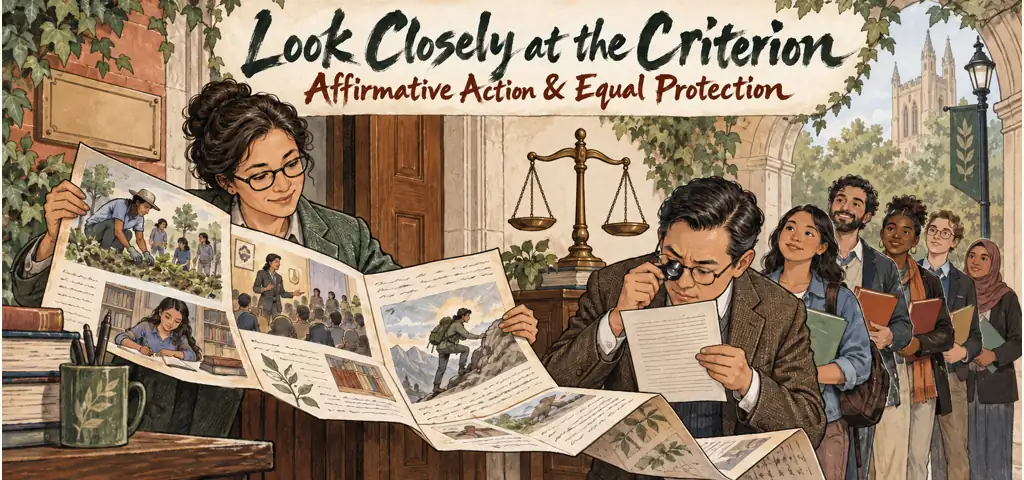
Affirmative action describes policies designed to widen opportunity or address disadvantage, but the legal test depends on what the policy actually does. A governmental program that expressly assigns a benefit or burden according to race creates a racial classification and triggers strict scrutiny. In the 2023 Students for Fair Admissions decisions, the Supreme Court rejected the admissions programs used by Harvard and the University of North Carolina because their racial classifications did not satisfy the governing standard. The decisions did not forbid a school from valuing an applicant’s individual qualities or considering how overcoming discrimination shaped resilience, leadership, or achievement. The evaluation must focus on what the applicant did and learned, not award an advantage because of racial category. An essay may not operate as a proxy for the racial preference the decisions forbade.
A practical reading of affirmative action and equal protection
The source of law also matters. The University of North Carolina is a public institution and therefore subject to equal protection. Harvard is private, but its receipt of federal funds brought the admissions program within Title VI, whose prohibition on racial discrimination supplied the statutory route. a public college recruits heavily in low-income rural and urban schools and gives added consideration to economic disadvantage. Those race-neutral criteria may change the racial composition of the class without classifying applicants by race. A rule automatically adding points because an applicant is a member of a named race is different and receives strict scrutiny. Do not assume that every outreach program is a racial classification or that a well-intended racial classification avoids review. in a practice item, identify the actor, the precise criterion, and the source of law before selecting scrutiny. Admissions, employment, contracting, and remedial orders can involve different doctrines. and classification remain separate. Government may remedy a specific, identified instance of unlawful discrimination, but a remedial label does not justify every racial category, duration, or beneficiary. Narrow tailoring examines the evidence, relationship between remedy and injury, alternatives, flexibility, and endpoint. Race-neutral recruitment or removal of a proven biased procedure may widen opportunity without assigning benefits by race. in a practice item, distinguish individualized experience from mechanical preference and a proven remedy from an open-ended aspiration.
Affirmative Action and Equal Protection: a common mistake
Apply the lesson on affirmative action and equal protection
Pick an institution connected to affirmative action and equal protection and describe one related action it can take, plus one action it cannot take.
Video lesson: Affirmative Action and Equal Protection
CrashCourse gives a focused explanation of this topic in Affirmative Action: Crash Course Government and Politics #32.
If the player does not load, watch this lesson directly on YouTube.
Connect this lesson to the larger course
For a broader map connecting affirmative action and equal protection to civil liberties, civil rights, and equal protection, use the AP U.S. Government and Politics learning hub.

Related to This Article
More math articles
- Top 10 3rd Grade SBAC Math Practice Questions
- 3rd Grade FSA Math Worksheets: FREE & Printable
- Digital SAT Math Answer Entry: Preserve the Requested Value (2027 Prep)
- Pennsylvania Keystone Algebra 1 Free Worksheets: Free Printable Keystone-Ready Algebra 1 PDFs
- AP Business with Personal Finance Exam: How to Study From the Course Framework (2027 Prep)
- CLEP U.S. History I 083: Gold Rush, Migration, and the Compromise of 1850
- Case File: How to Solve Multi-step Problems Involving Percent
- How is the SSAT Test Scored?
- The Grocery Store Challenge: How to Use Unit Rates to Solve Word Problems
- A Comprehensive Collection of Free PERT Math Practice Tests


















What people say about "Affirmative Action and Equal Protection"?
No one replied yet.