


LEARN · PRACTICE · EXPLORE
Ohio Grade 4 English
Compare firsthand and secondhand accounts of an invented Grade 4 event, with Ohio English references, a worked comparison, and printable practice.
State resources · Focused study · Clear next steps
What do Ohio 4th graders learn in ELA?
In 4th grade, Ohio English language arts centers on theme and summary, text structure, figurative language, and multi-paragraph essays. Students take the OST grade 4 ELA test in the spring. This page explains each Ohio grade 4 ELA standard and pairs it with printable worksheets and a full-length practice test.
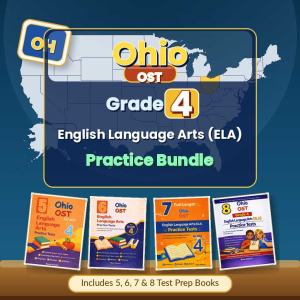
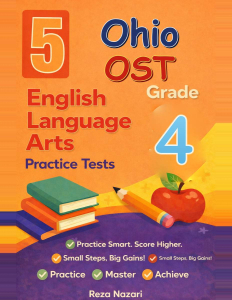
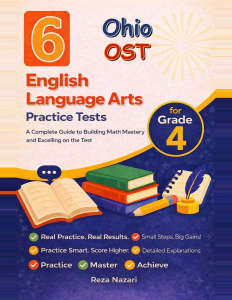
Printable Ohio grade 4 ELA books:
Ohio’s State Test, Grade 4 ELA: Facts and Scores
Ohio 4th graders take Ohio’s State Test in English language arts each spring. A scaled score of 700 is Proficient on every Ohio State Test; the table shows the Grade 4 cut points used in spring 2026.
| Test | Ohio’s State Test, Grade 4 English Language Arts |
|---|---|
| Spring 2027 window | ELA: March 29–April 30, 2027 (15 consecutive school days chosen by the district) |
| Format | Given online, with paper versions available |
| Official information | Ohio DEW testing page |
Grade 4 ELA performance levels
| Performance level | Scaled score |
|---|---|
| Limited | Below 674 |
| Basic | 674 to 699 |
| Proficient | 700 to 724 |
| Accomplished | 725 to 752 |
| Advanced | 753 and above |
Practice on this page: Ohio standards
Facts from the Ohio Department of Education and Workforce, checked November 23, 2026: Ohio DEW: Ohio’s State Tests Spring 2026 statistical summary (scale score cut points); Ohio DEW: 2026–2027 testing dates; Ohio DEW: Testing.
All 43 Ohio Grade 4 English Language Arts Standards
Every Grade 4 standard in Ohio’s Learning Standards for English Language Arts (2017), grouped by strand. Ohio’s State Test in Grade 4 ELA measures these standards. Ohio adopted revised K–8 ELA standards in 2026; 2026–2027 is a transition year, and schools begin using the revised standards in 2027–2028. Open a strand to see its standards.
Reading: Literature (9)
| RL.4.1 | Refer to details and examples in a text when explaining what the text says explicitly and when drawing inferences from the text. |
|---|---|
| RL.4.2 | Analyze literary text development. |
| RL.4.3 | Describe in depth a character, setting, or event in a story or drama, drawing on specific details in the text (e.g., a character’s thoughts, words, or actions). |
| RL.4.4 | Determine the meaning of words and phrases as they are used in a text, including those that allude to significant characters found in mythology (e.g., Herculean). |
| RL.4.5 | Explain major differences between poems, drama, and prose, and refer to the structural elements of poems (e.g., verse, rhythm, meter) and drama (e.g., casts of characters, settings, descriptions, dialogue, stage directions) when writing or speaking about a text. |
| RL.4.6 | Explain the differences in the point(s) of view in a text and different perspectives of the characters. |
| RL.4.7 | Make connections between the text of a story or drama and a visual or oral presentation of the text, identifying where each version reflects specific descriptions and directions in the text. |
| RL.4.9 | Compare and contrast the treatment of similar themes and topics (e.g., opposition of good and evil) and patterns of events (e.g., the quest) in stories, myths, and traditional literature from different cultures. |
| RL.4.10 | By the end of the year, read and comprehend literature, including stories, dramas, and poetry, in the grades 4–5 text complexity band proficiently, with scaffolding as needed at the high end of the range. Activate prior knowledge and draw on previous experiences in order to make text-to-self or text-to-text connections and comparisons. |
Reading: Informational Text (10)
| RI.4.1 | Refer to details and examples in a text when explaining what the text says explicitly and when drawing inferences from the text. |
|---|---|
| RI.4.2 | Analyze informational text development. |
| RI.4.3 | Explain events, procedures, ideas, or concepts in a historical, scientific, or technical text, including what happened and why, based on specific information in the text. |
| RI.4.4 | Determine the meaning of general academic and domain-specific words or phrases in a text relevant to a grade 4 topic or subject area. |
| RI.4.5 | Describe the overall structure (e.g., chronology, comparison, cause/effect, problem/solution) of events, ideas, concepts, or information in a text or part of a text. |
| RI.4.6 | Compare and contrast a firsthand and secondhand account of the same event or topic; describe the differences in perspective and the information provided. |
| RI.4.7 | Interpret information presented visually, orally, or quantitatively (e.g., in charts, graphs, diagrams, time lines, animations, or interactive elements on Web pages) and explain how the information contributes to an understanding of the text in which it appears. |
| RI.4.8 | Explain how an author uses evidence to support particular points in a text. |
| RI.4.9 | Integrate information from two texts on the same topic in order to write or speak about the subject knowledgeably. |
| RI.4.10 | By the end of year, read and comprehend informational texts, including history/social studies, science, and technical texts, in the grades 4–5 text complexity band proficiently, with scaffolding as needed at the high end of the range. |
Reading: Foundational Skills (2)
| RF.4.3 | Know and apply grade-level phonics and word analysis skills in decoding words by using combined knowledge of all letter-sound correspondences, syllabication patterns, and morphology (e.g., roots and affixes) to read accurately unfamiliar multisyllabic words in context and out of context. |
|---|---|
| RF.4.4 | Read with sufficient accuracy and fluency to support comprehension. |
Writing (10)
| W.4.1 | Write opinion pieces on topics or texts, supporting a point of view with reasons and information. |
|---|---|
| W.4.2 | Write informative/explanatory texts to examine a topic and convey ideas and information clearly. |
| W.4.3 | Write narratives to develop real or imagined experiences or events using effective technique, descriptive details, and clear event sequences. |
| W.4.4 | Produce clear and coherent writing in which the development and organization are appropriate to task, purpose, and audience. (Grade-specific expectations for writing types are defined in standards 1–3 above.) |
| W.4.5 | With guidance and support from peers and adults, develop and strengthen writing as needed by planning, revising, and editing. (Editing for conventions should demonstrate command of Language standards 1–3 up to and including grade 4.) |
| W.4.6 | With some guidance and support from adults, use technology, including the Internet, to produce and publish writing as well as to interact and collaborate with others, while demonstrating sufficient command of keyboarding skills. |
| W.4.7 | Conduct short research projects that build knowledge through investigation of different aspects of a topic. |
| W.4.8 | Recall relevant information from experiences or gather relevant information from print and digital sources; take notes and categorize information and provide a list of sources. |
| W.4.9 | Draw evidence from literary or informational texts to support analysis, reflection, and research. |
| W.4.10 | Write routinely over extended time frames time for research, reflection, and revision) and shorter time frames (a single sitting or a day or two) for a range of discipline-specific tasks, purposes, and audiences. |
Speaking and Listening (6)
| SL.4.1 | Engage effectively in a range of collaborative discussions (one-on-one, in groups, and teacher-led) with diverse partners on grade 4 topics and texts, building on others’ ideas and expressing their own clearly. |
|---|---|
| SL.4.2 | Paraphrase portions of a text read aloud or information presented in diverse media and formats, including visually, quantitatively, and orally. |
| SL.4.3 | Identify the reasons and evidence a speaker provides to support particular points. |
| SL.4.4 | Report on a topic or text, tell a story, or recount an experience in an organized manner, using appropriate facts and relevant, descriptive details to support main ideas or themes; speak clearly at an understandable pace. |
| SL.4.5 | Add audio recordings and visual displays to presentations when appropriate to enhance the development of main ideas or themes. |
| SL.4.6 | Differentiate between contexts that call for formal English (e.g., presenting ideas) and situations where informal discourse is appropriate (e.g., smallgroup discussion); use formal English when appropriate to task and situation. (See grade 4 Language standards 1 for specific expectations.) |
Language (6)
| L.4.1 | Demonstrate command of the conventions of standard English grammar and usage when writing or speaking. |
|---|---|
| L.4.2 | Demonstrate command of the conventions of standard English capitalization, punctuation, and spelling when writing. |
| L.4.3 | Use knowledge of language and its conventions when writing, speaking, reading, or listening. |
| L.4.4 | Determine or clarify the meaning of unknown and multiple-meaning words and phrases based on grade 4 reading and content, choosing flexibly from a range of strategies. |
| L.4.5 | Demonstrate understanding of figurative language, word relationships, and nuances in word meanings. |
| L.4.6 | Acquire and use accurately grade-appropriate general academic and domain-specific words and phrases, including those that signal precise actions, emotions, or states of being (e.g., quizzed, whined, stammered) and that are basic to a particular topic (e.g., wildlife, conservation, and endangered when discussing animal preservation). |
Codes and wording from the Ohio DEW 2017 standards document (main statement; lettered parts are in the official document). Checked November 23, 2026: Ohio DEW: Ohio’s Learning Standards for English Language Arts (2017); Ohio DEW: English Language Arts standards page (2026 revision and transition).
Standards source: Ohio adopted content standards.
Compare Two Accounts of One Event
Compare firsthand and secondhand accounts of an invented Grade 4 event, with Ohio English references, a worked comparison, and printable practice. Use the teacher’s course sequence to connect this short activity with wider literacy work.
Curriculum reference: Ohio’s Learning Standards for English Language Arts, 2017 (transition reference), from the Ohio English language arts standards and transition page.
Ohio Grade 4 references for this activity
Ohio adopted revised K–8 English language arts standards in 2026. The state identifies 2026–2027 as a transition year and 2027–2028 as the first implementation year. This activity uses a selected reference from the 2017 standards during that transition. Check the school’s adopted sequence and the state’s transition guidance when deciding which edition to use; reading, writing, speaking, listening, and language work extend beyond this example.
| Selected Ohio reading reference | Activity focus | State-linked standards document |
|---|---|---|
| RI.4.6 | Compare firsthand and secondhand accounts of the same event, including focus and information | Read the state-linked document (PDF page 24) |
For the upcoming implementation, read the 2026 revised K–8 English standards (PDF, with unchanged high-school standards included) and the state’s transition guidance.
These selected reference labels identify an activity focus, with the correct grade and PDF page linked separately. Read the complete standards selected by the school and its learning sequence, including reading, writing, language, speaking, and listening. This short original example does not fulfill the entire curriculum or establish a student’s grade-level proficiency.
The first day of the school garden
This original classroom example is separate from official assessment questions.
Account A — A participant’s note
I carried the tray of seedlings to the garden. My gloves slipped while I held it, so I rested the tray on the path. When we finished planting, I noticed soil on both sleeves.
Account B — A later school report
Two classes planted seedlings in the school garden on Friday. Teachers organized the planting areas, and student volunteers carried trays. The report was prepared afterward from the teachers’ notes.
Try the activity
Both accounts are invented for this activity. Which represents a firsthand account and which a secondhand account? Compare their focus and information. What does each tell you that the other does not?
Follow the reasoning
Account A represents firsthand participation: its writer reports carrying a tray, handling slipping gloves, and noticing soil on sleeves. Its focus is a personal experience during planting. Account B represents a secondhand report prepared from teachers’ notes; it focuses on the broader organization, including two classes, Friday, and the teachers’ planting areas. A supplies sensory and action details absent from B, while B supplies group and scheduling details absent from A. Neither account contradicts the other merely by selecting different information. Compare the stated perspectives and details rather than assume firsthand always means complete or secondhand always means unreliable.
Notice what needs more practice
“I” alone does not prove that a real source is firsthand; here the passage explicitly identifies a fictional participant. Neither account reports the seedlings’ later growth. The school report’s wider view does not establish that every child had the same experience. These are modeled account types, not authentic historical documents.
Grade 4 English worksheets
Choose printable practice that matches the skill being taught. Check the task, reading difficulty, and directions before assigning it; the collection is independently published.
Use the next session to build independence
- Identify how each account was produced.
- Compare its focus and specific information.
- Name a question neither account can answer.
Compare teacher-selected firsthand and secondhand accounts of the same documented event. Check who created each, when, and from what information. Explain differences in focus using actual details.
For more general reading and writing resources, visit the Grade 4 English Online Center.
Ohio Grade 4 English: useful planning questions
Is a secondhand account automatically less useful?
No. It may supply broader context or information collected from several sources. Evaluate its purpose and evidence alongside the firsthand account.
Which standards does the school use?
Ohio adopted revised K–8 English language arts standards in 2026. The state identifies 2026–2027 as a transition year and 2027–2028 as the first implementation year. This activity uses a selected reference from the 2017 standards during that transition. Check the school’s adopted sequence and the state’s transition guidance when deciding which edition to use; reading, writing, speaking, listening, and language work extend beyond this example. The school’s sequence also includes reading, writing, speaking, listening, and language work beyond this example.
Sources checked October 6, 2026. The state’s English assessment overview includes Ohio’s State Tests in Grades 3–8, including Grade 4. The standards directory says test revisions will follow the new standards; it does not establish a specific new-test administration date. Confirm the school’s current test directions, assigned pathway, and accommodations. Read the Ohio English assessment overview and English standards and transition guidance. Independently published practice has its own directions and scoring. Its result does not predict a state performance level, and this original activity is not an official assessment item.
Grade 4 English in other states
When moving between school systems, compare the official curriculum and the school’s learning sequence. Use the national Online Center’s map to find another state’s resources.
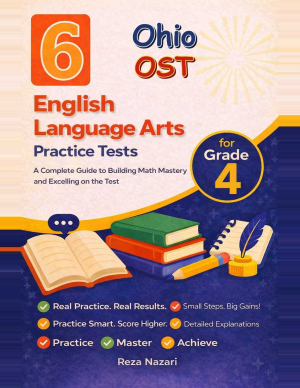
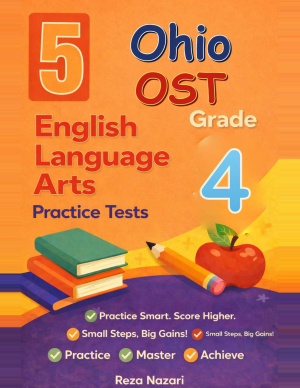
Recommended Ohio Grade 4 resources
Build a Strong Ohio Grade 4 OST English Practice Library
These independently published resources have their own coverage and editions. Check the contents alongside Ohio’s current English standards before choosing assessment preparation.
Use these Ohio Grade 4 resources for reading comprehension, language, writing, and full-length practice where available. Click any cover to open the resource page.
More Grade 4 resources
Ohio Grade 4 English: 10-Question Challenge
Ten questions on reading, grammar, vocabulary, and writing for Ohio 4th graders, each with a short explanation.
They rested because they were tired. The context shows the meaning.
Put a comma after an introductory phrase: After lunch, we played soccer.
A prepositional phrase begins with a preposition, such as under.
Choose another state
Grade 4 English in Every State
Select a state on the map to open its Grade 4 English page. You are viewing Ohio.
All states A–Z
A USEFUL NEXT STEP
Ohio Grade 4 English: study questions
Is a secondhand account automatically less useful?
No. It may supply broader context or information collected from several sources. Evaluate its purpose and evidence alongside the firsthand account.
Where are the complete Ohio Grade 4 requirements?
Ohio adopted revised K–8 English language arts standards in 2026. The state identifies 2026–2027 as a transition year and 2027–2028 as the first implementation year. This activity uses a selected reference from the 2017 standards during that transition. Check the school’s adopted sequence and the state’s transition guidance when deciding which edition to use; reading, writing, speaking, listening, and language work extend beyond this example.
Official source ↗Resources from Effortless Math · Editorial standards