


LEARN · PRACTICE · EXPLORE
Washington Grade 4 English
Explain how cause-and-effect structure shapes understanding. Follow an original Grade 4 reading activity and a selected reference from Washington’s adopted 2026 English standards.
State resources · Focused study · Clear next steps
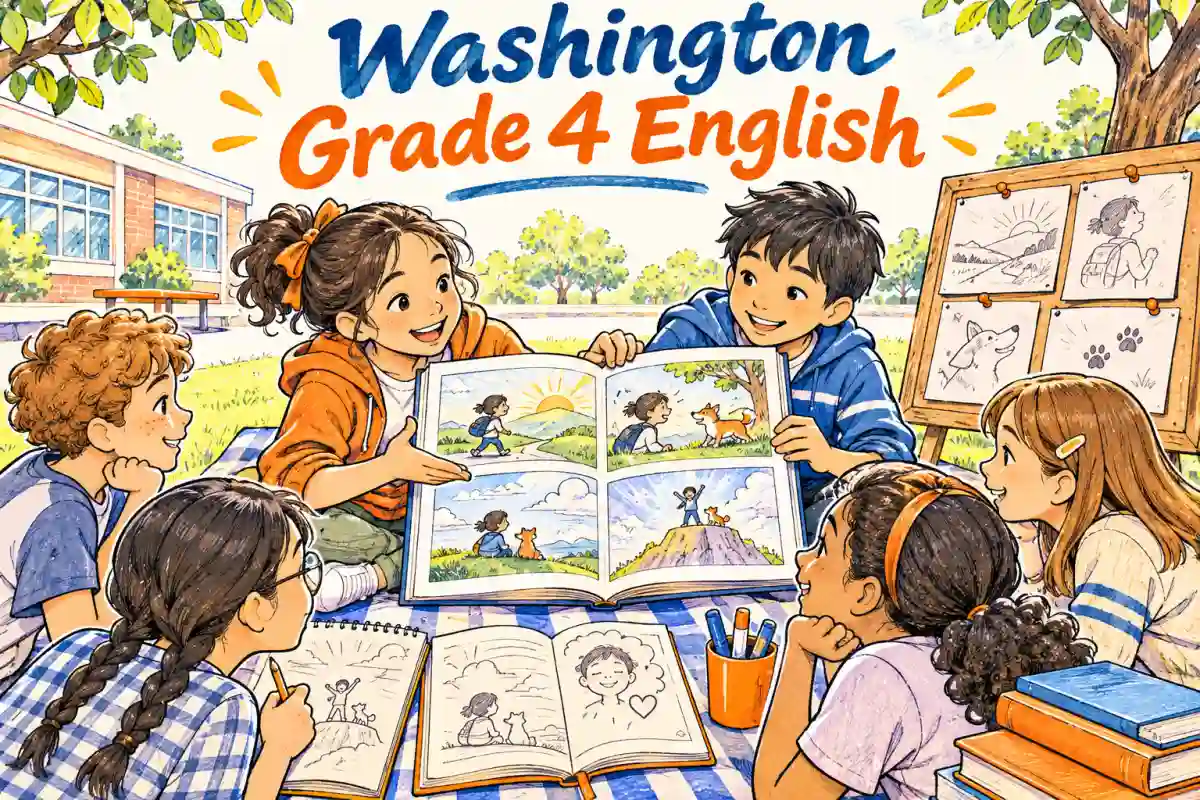
What do Washington 4th graders learn in ELA?
In 4th grade, Washington English language arts centers on theme and summary, text structure, figurative language, and multi-paragraph essays. Students take the Smarter Balanced (SBA) grade 4 ELA test in the spring. This page explains each Washington grade 4 ELA standard and pairs it with printable worksheets and a full-length practice test.
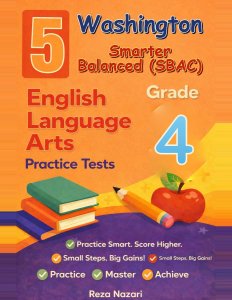
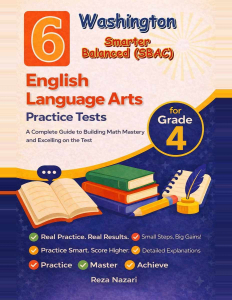
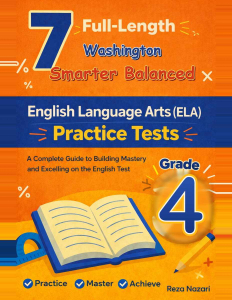
Printable Washington grade 4 ELA books:
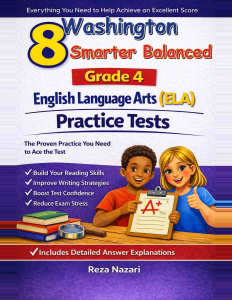
Washington Smarter Balanced Grade 4 ELA: Test Facts and Scores
Washington 4th graders take the Smarter Balanced Assessment (SBA) in English language arts each spring. A scale score of 2473 or higher is Level 3, which meets the state standard for Grade 4.
| Test | Smarter Balanced Assessment, Grade 4 English Language Arts |
|---|---|
| When | Spring |
| Levels | Level 1 to Level 4; Level 3 and 4 meet standard |
Grade 4 ELA scale score ranges
| Achievement level | Scale score |
|---|---|
| Level 1 | Below 2416 |
| Level 2 | 2416 to 2472 |
| Level 3 (meets standard) | 2473 to 2532 |
| Level 4 (exceeds standard) | 2533 and above |
Practice on this page: Washington standards
Washington Grade 4 ELA testing questions
What score does a Washington 4th grader need to meet standard on the ELA SBA?
A scale score of 2473 or higher is Level 3 (meets standard). Level 4 starts at 2533.
When is the next Smarter Balanced ELA test after Grade 4?
The next one is in Grade 5. Washington tests ELA and math in grades 3 to 8 and again in Grade 10.
Does the Grade 4 SBA count toward graduation?
No. Only the high school (Grade 10) SBA can be used as a graduation pathway, with a score of 2548 in ELA.
Facts from the Washington Office of Superintendent of Public Instruction (OSPI), checked November 23, 2026: OSPI: Scale scores for state assessments; OSPI: State testing; OSPI: Graduation pathways.
All 43 Washington Grade 4 English Language Arts Standards
Every Grade 4 standard in the Common Core State Standards for English Language Arts, which Washington uses as its state ELA standards, grouped by strand. Lettered sub-standards sit under each numbered standard in the official document. Open a strand to see its standards.
Reading: Literature (9)
| RL.4.1 | Refer to details and examples in a text when explaining what it says and when drawing inferences. |
|---|---|
| RL.4.2 | Determine a theme of a story, drama or poem from details in the text, and summarize the text. |
| RL.4.3 | Describe a character, setting or event in depth, drawing on specific details such as thoughts, words or actions. |
| RL.4.4 | Determine the meaning of words and phrases, including those that allude to significant characters in mythology. |
| RL.4.5 | Explain major differences between poems, drama and prose, and refer to their structural elements such as verse, meter, cast and stage directions. |
| RL.4.6 | Compare and contrast the point of view from which different stories are narrated, including first- and third-person narration. |
| RL.4.7 | Make connections between the text of a story or drama and a visual or oral presentation of it. |
| RL.4.9 | Compare and contrast the treatment of similar themes and patterns of events in stories, myths and traditional literature from different cultures. |
| RL.4.10 | By the end of the year, read and understand literature in the grades 4–5 complexity band proficiently. |
Reading: Informational Text (10)
| RI.4.1 | Refer to details and examples when explaining what an informational text says and when drawing inferences. |
|---|---|
| RI.4.2 | Determine the main idea of a text, explain how key details support it, and summarize the text. |
| RI.4.3 | Explain events, procedures, ideas or concepts in a historical, scientific or technical text, including what happened and why. |
| RI.4.4 | Determine the meaning of general academic and domain-specific words or phrases in a grade 4 text. |
| RI.4.5 | Describe the overall structure of a text, such as chronology, comparison, cause/effect or problem/solution. |
| RI.4.6 | Compare and contrast a firsthand and secondhand account of the same event or topic. |
| RI.4.7 | Interpret information presented visually, orally or quantitatively, such as charts, graphs, time lines and animations. |
| RI.4.8 | Explain how an author uses reasons and evidence to support particular points. |
| RI.4.9 | Integrate information from two texts on the same topic to write or speak about it knowledgeably. |
| RI.4.10 | By the end of the year, read and understand informational texts in the grades 4–5 complexity band proficiently. |
Reading: Foundational Skills (2)
| RF.4.3 | Know and apply grade-level phonics and word analysis, using letter-sound correspondences, syllable patterns and morphology to read unfamiliar words. |
|---|---|
| RF.4.4 | Read with enough accuracy and fluency to support comprehension, using context to confirm or self-correct. |
Writing (10)
| W.4.1 | Write opinion pieces with a clear opinion, reasons supported by facts and details, linking words and a conclusion. |
|---|---|
| W.4.2 | Write informative texts with grouped information, headings, illustrations, facts, quotations, precise vocabulary and a conclusion. |
| W.4.3 | Write narratives with a situation, narrator or characters, dialogue, description, transitional words, sensory details and a conclusion. |
| W.4.4 | Produce clear and coherent writing in which the development and organization fit the task, purpose and audience. |
| W.4.5 | With guidance, develop and strengthen writing by planning, revising and editing. |
| W.4.6 | With guidance, use technology, including the Internet, to produce and publish writing; show keyboarding skills to type a page in one sitting. |
| W.4.7 | Conduct short research projects that build knowledge through investigation of different aspects of a topic. |
| W.4.8 | Recall or gather relevant information from print and digital sources, take notes, categorize information and give a list of sources. |
| W.4.9 | Draw evidence from literary or informational texts to support analysis, reflection and research. |
| W.4.10 | Write routinely over extended and short time frames for a range of tasks, purposes and audiences. |
Speaking and Listening (6)
| SL.4.1 | Take part in collaborative discussions, coming prepared, following rules, posing and responding to questions, and reviewing key ideas. |
|---|---|
| SL.4.2 | Paraphrase parts of a text read aloud or information presented in diverse media and formats. |
| SL.4.3 | Identify the reasons and evidence a speaker provides to support particular points. |
| SL.4.4 | Report on a topic or text, tell a story or recount an experience in an organized manner, speaking clearly at an understandable pace. |
| SL.4.5 | Add audio recordings and visual displays to presentations when appropriate to enhance main ideas or themes. |
| SL.4.6 | Tell apart contexts that call for formal English and situations where informal discourse is appropriate. |
Language (6)
| L.4.1 | Use standard grammar: relative pronouns and adverbs, progressive verb tenses, modal auxiliaries, adjective order, prepositional phrases and complete sentences. |
|---|---|
| L.4.2 | Use capitalization, punctuation and spelling correctly, including commas and quotation marks for dialogue and quotations. |
| L.4.3 | Use knowledge of language: choose words to convey ideas precisely, choose punctuation for effect, and tell formal from informal contexts. |
| L.4.4 | Find the meaning of unknown words using context, Greek and Latin affixes and roots, and reference materials. |
| L.4.5 | Explain similes, metaphors, idioms, adages and proverbs, and relate words to their antonyms and synonyms. |
| L.4.6 | Acquire and use general academic and domain-specific words, including words that signal precise actions, emotions or states of being. |
Codes follow the Common Core numbering; descriptions are our plain-English summaries. Checked November 23, 2026: OSPI: English Language Arts Learning Standards.
Standards source: Washington adopted content standards.
Explain a Cause-and-Effect Sequence
Explain how cause-and-effect structure shapes understanding. Work through the short reading below, explain your response, and try the skill in a fuller classroom text. The selected reference comes from the adopted 2026 standards; the school’s implementation sequence matters during the transition.
Curriculum reference: Washington State Learning Standards for English Language Arts, adopted 2026, from the Washington English language arts standards page.
Washington Grade 4 references for this activity
Washington OSPI’s English directory links the adopted 2026 standards. The PDF records adoption on August 6, 2026. OSPI says educators can explore, learn about, and begin using them in 2026–27, with required use with students in 2027–28. Ask the school which sequence it is following during that transition. The selected Grade 4 indicator on this page is a focus for this original activity, not a complete curriculum or a certification of every independent resource.
| Selected Washington reading reference | Activity focus | State-linked standards document |
|---|---|---|
| ELA.4.R.4.i | Explain how cause-and-effect structure shapes understanding | Read the state-linked document (PDF page 41) |
These selected reference labels identify an activity focus, with the correct grade and PDF page linked separately. Read the complete standards selected by the school and its learning sequence, including reading, writing, language, speaking, and listening. This short original example does not fulfill the entire curriculum or establish a student’s grade-level proficiency.
Why the return routine changed
This original classroom example is separate from official assessment questions.
The class kept returned folders on a small table beside the door. On Tuesday, the table was moved to make space for a display. Because the return sign stayed above the old location, three students left their folders on the floor beneath it. A helper noticed the mismatch and moved the sign above the new table. At the next return time, the instructions and table pointed to the same place. The account does not report where every folder was left afterward.
Try the activity
Explain the chain from moving the table to moving the sign. What does “because” connect? How does the ending limit a claim that the change solved every return problem?
Follow the reasoning
Moving the table creates a mismatch with the sign that remains at the old location. The “because” sentence connects that mismatch with three students leaving folders beneath the sign. The helper’s action responds to the mismatch by moving the sign above the new table. Presenting the events as causes and responses helps a reader understand why the routine changed, rather than seeing an unrelated list of classroom events. The ending establishes that the directions and table agree in location; it does not supply a complete count of later returns. A claim that every student now returned every folder correctly goes beyond the account.
Notice what needs more practice
This invented passage selects cause-and-effect reasoning. Events occurring in order are not automatically causes; explain the connection that the text actually supplies. The change in sign position should not be reported as a measured improvement in all student behavior.
Grade 4 English worksheets
Choose printable practice that matches the skill being taught. Check the task, reading difficulty, and directions before assigning it; the collection is independently published.
Use the next session to build independence
- Locate the initial change and resulting mismatch.
- Explain the connection supplied by the cause word.
- Separate the reported response from unreported later outcomes.
Use a fuller informational classroom text. Identify how its organization links conditions, effects, and responses. Compare an explanation with a timeline: a timeline records order, while the explanation needs the causal relationships supported by the text.
For more general reading and writing resources, visit the Grade 4 English Online Center.
Washington Grade 4 English: useful planning questions
Does “after” always mean “because of”?
No. Sequence establishes order. A cause-and-effect explanation also needs a supported connection between events.
Which standards does the school use?
Washington OSPI’s English directory links the adopted 2026 standards. The PDF records adoption on August 6, 2026. OSPI says educators can explore, learn about, and begin using them in 2026–27, with required use with students in 2027–28. Ask the school which sequence it is following during that transition. The selected Grade 4 indicator on this page is a focus for this original activity, not a complete curriculum or a certification of every independent resource. The school’s sequence also includes reading, writing, speaking, listening, and language work beyond this example.
Sources checked October 6, 2026. OSPI’s state-testing overview lists Smarter Balanced English and mathematics in Grades 3–8 and 10. Grade 4 is included in that listed English range; follow current school directions and accommodations. OSPI distinguishes standards implementation from assessment updates: changes for new media-literacy, digital-citizenship, and data-science standards are planned no earlier than 2028–29, beginning with pilots. This does not establish a changed current test format, timing, or item count. Read the Washington English assessment overview, English standards guidance, and standards and assessment transition guidance. Independently published practice has its own directions and scoring. Its result does not predict a state performance level, and this original activity is not an official assessment item.
Grade 4 English in other states
When moving between school systems, compare the official curriculum and the school’s learning sequence. Use the national Online Center’s map to find another state’s resources.
Recommended Washington Grade 4 resources
Choose Washington Grade 4 English practice resources
These independently published resources have their own coverage and editions. Check the contents alongside Washington’s current English standards before choosing assessment preparation.
Use these Washington Grade 4 resources for reading comprehension, language, writing, and full-length practice where available. Click any cover to open the resource page.
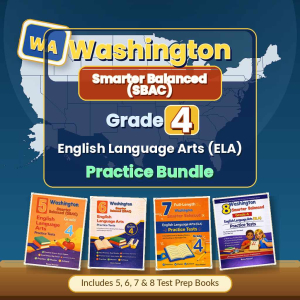 Washington Grade 4 ELA Preparation Bundle
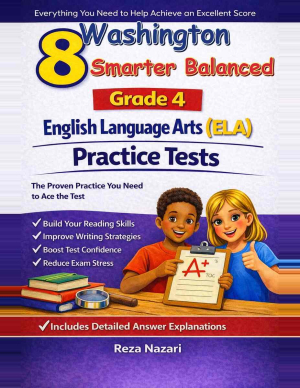 8 Washington Smarter Balanced English Language Arts (ELA) Grade 4: Full Practice Tests
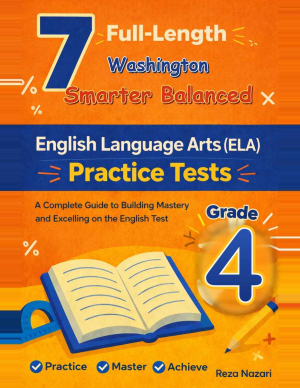 7 Washington Smarter Balanced English Language Arts (ELA) Grade 4: Full Practice Tests
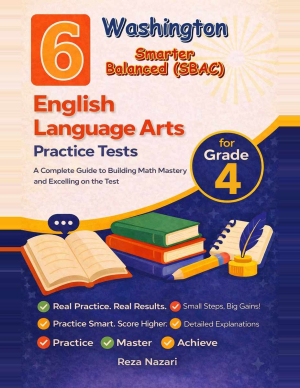 6 Washington Smarter Balanced English Language Arts (ELA) Grade 4: Full Practice Tests
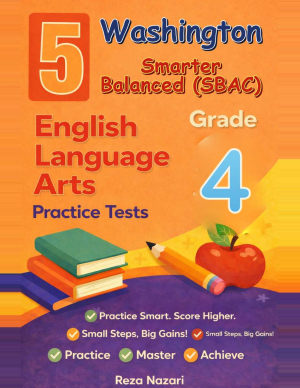 Washington Smarter Balanced ELA Grade 4: 5 Full Practice Tests
More Grade 4 resources
Choose another state
Grade 4 English in Every State
Select a state on the map to open its Grade 4 English page. You are viewing Washington.
All states A–Z
A USEFUL NEXT STEP
Washington Grade 4 English: study questions
Does “after” always mean “because of”?
No. Sequence establishes order. A cause-and-effect explanation also needs a supported connection between events.
Where are the complete Washington Grade 4 requirements?
Washington OSPI’s English directory links the adopted 2026 standards. The PDF records adoption on August 6, 2026. OSPI says educators can explore, learn about, and begin using them in 2026–27, with required use with students in 2027–28. Ask the school which sequence it is following during that transition. The selected Grade 4 indicator on this page is a focus for this original activity, not a complete curriculum or a certification of every independent resource.
Official source ↗Resources from Effortless Math · Editorial standards