LEARN · PRACTICE · EXPLORE
Louisiana Grade 4 English
Compare first- and third-person versions of a classroom scene, explain differences in information, and use current Louisiana Grade 4 English references.
State resources · Focused study · Clear next steps
What do Louisiana 4th graders learn in ELA?
In 4th grade, Louisiana English language arts centers on theme and summary, text structure, figurative language, and multi-paragraph essays. Students take the LEAP grade 4 ELA test in the spring. This page explains each Louisiana grade 4 ELA standard and pairs it with printable worksheets and a full-length practice test.
Printable Louisiana grade 4 ELA books:
- Louisiana LEAP 2025 ELA Grade 4: 5 Full Practice Tests
- 6 Louisiana LEAP 2025 English Language Arts (ELA) Grade 4: Full Practice Tests
- 7 Louisiana LEAP 2025 English Language Arts (ELA) Grade 4: Full Practice Tests
- 8 Louisiana LEAP 2025 English Language Arts (ELA) Grade 4: Full Practice Tests
- Louisiana Grade 4 ELA Preparation Bundle
Standards source: Louisiana English Language Arts, Louisiana Department of Education.
Compare what first- and third-person narrators reveal
Pronouns help identify a narrator, but the useful comparison is what each version lets the reader know. These two original accounts describe the same classroom moment while drawing attention to different information.
Curriculum reference: Louisiana Student Standards for English Language Arts, current document revised March 8, 2019, from the Louisiana Department of Education standards directory.
2027–28 standards transition: Louisiana’s revised English standards take effect in 2027–28. This page uses current classroom references for 2026–27. Read the official implementation notice and the upcoming 2026 standards (PDF) when planning next year.
Louisiana Grade 4 references for this activity
For the 2026–27 school year, use the current Louisiana ELA document linked in the state directory, revised March 8, 2019. The revised 2026 standards take effect in 2027–28. The references below select part of Grade 4 for this activity; use the complete document and the school’s sequence for wider coverage.
| Grade-level expectation | Activity focus | Official requirement |
|---|---|---|
| RL.4.6 | Compare first- and third-person narration | Read the state document (PDF page 23) |
| RL.4.1 | Support explanations with text details | Read the state document (PDF page 23) |
These are selected grade-level expectations from Louisiana’s current English standards. Activity labels describe a teaching focus rather than reproduce complete requirements. Read the linked state document’s complete grade-level expectations, including its grade-specific details, alongside the school’s curriculum sequence.
A worked Grade 4 reading and writing activity
This original classroom example is separate from official assessment questions.
Version A: I reached for the clay tile, then stopped. I had spent all morning carving the bird. If I lifted it too soon, I might bend the wings. I asked Jo to move the tray instead.
Version B: Maya reached for the clay tile, then stopped. Jo watched her hands hover over the table. “Could you move the tray?” Maya asked. Jo slid the whole tray onto the drying shelf.
Try the activity
Who tells each version? Identify one piece of information Version A gives directly and one that Version B adds. Explain what a reader can and cannot conclude about the characters.
Follow the reasoning
Version A uses I to tell the event from Maya’s position. It gives her concern about bending the wings and her memory of the work she put into the carving. Version B names Maya and Jo from outside the action. It shows Jo observing Maya’s hands and then moving the tray to the shelf. A reader learns the completed movement in B, while A stops after the request. The versions share Maya’s hesitation and request, but they distribute information differently. An explanation should name those differences rather than stop at “one has I and the other has she.” Both versions can support the inference that Maya is careful with the tile; only A states her particular worry.
Notice what needs more practice
First person does not automatically make an account true, and third person does not automatically tell every character’s thoughts. Version B shows Jo’s actions but does not state why Jo helps or how Jo feels. Version A tells Maya’s concern, yet it does not describe the tray reaching the shelf. If a student says Maya breaks the tile, ask for the sentence reporting a break. There is none. When comparing, keep the shared event distinct from information added by one narrator. The word clay identifies the material; it does not establish that either character is an expert artist.
Grade 4 English worksheets
Choose printable practice that matches the skill being taught. Check the task, reading difficulty, and directions before assigning it; the collection is independently published.
Use the next session to build independence
- Identify the narrator through the words used to tell the event.
- Mark one shared detail and one detail unique to each account.
- Explain how those differences affect the reader’s understanding.
Ask students to write two or three sentences continuing Version A after Jo moves the tray. Keep first-person narration and use only information Maya could plausibly know. Then try a new pair of teacher-selected stories rather than merely changing the pronouns in this scene. Narration includes choices about access, focus, and detail. These miniature versions are a scaffold for those choices, not a substitute for sustained reading of grade-appropriate texts. Follow the school’s sequence for writing, discussion, language, and other reading expectations.
For more general reading and writing resources, visit the Grade 4 English Online Center.
Louisiana Grade 4 English: useful planning questions
Does a third-person narrator always reveal everyone’s thoughts?
No. Check the actual details. This third-person version reports actions and speech without directly stating Jo’s thoughts.
Where are the complete state requirements?
For the 2026–27 school year, use the current Louisiana ELA document linked in the state directory, revised March 8, 2019. The revised 2026 standards take effect in 2027–28. The references below select part of Grade 4 for this activity; use the complete document and the school’s sequence for wider coverage. The school’s sequence also includes reading, writing, speaking, listening, and language work beyond this example.
Official sources checked October 6, 2026. Grade 4 is within the LEAP Grades 3–8 ELA testing range. Follow the school’s assigned assessment pathway and current directions. Read the Louisiana 2026–27 assessment calendar and guidance. This original activity is independently published classroom practice, not an official LEAP question, a complete curriculum-alignment certification, or a prediction of a performance level. Check books, worksheet collections, and other independent practice against current classroom requirements. Plan the 2027–28 English standards transition with the school using the official implementation notice.
Grade 4 English in other states
When moving between school systems, compare the official curriculum and the school’s learning sequence. Use the national Online Center’s map to find another state’s resources.
Recommended Louisiana Grade 4 resources
Build a Strong Louisiana Grade 4 LEAP English Practice Library
These independently published resources have their own coverage and editions. Check the contents alongside Louisiana’s current English standards before choosing assessment preparation.
Use these Louisiana Grade 4 resources for reading comprehension, language, writing, and full-length practice where available. Click any cover to open the resource page.
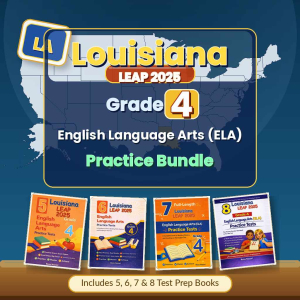 Louisiana Grade 4 ELA Preparation Bundle
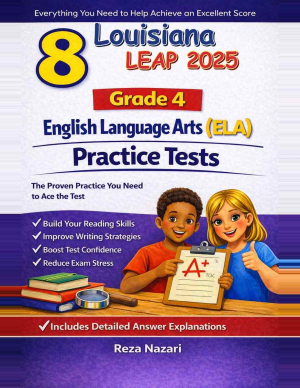 8 Louisiana LEAP English Language Arts (ELA) Grade 4: Full Practice Tests
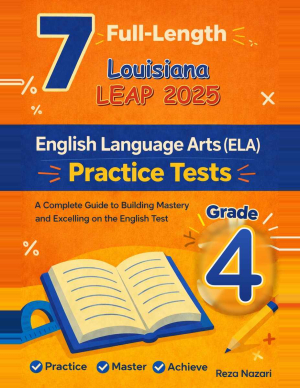 7 Louisiana LEAP English Language Arts (ELA) Grade 4: Full Practice Tests
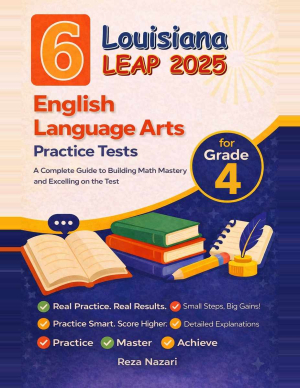 6 Louisiana LEAP English Language Arts (ELA) Grade 4: Full Practice Tests
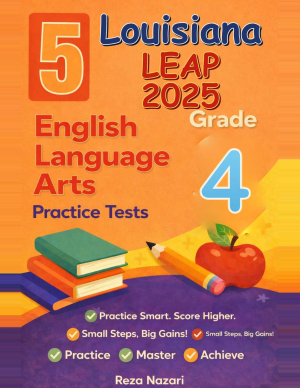 Louisiana LEAP ELA Grade 4: 5 Full Practice Tests
More Grade 4 resources
A USEFUL NEXT STEP
Louisiana Grade 4 English: study questions
Does a third-person narrator always reveal everyone’s thoughts?
No. Check the actual details. This third-person version reports actions and speech without directly stating Jo’s thoughts.
Where are the complete Louisiana Grade 4 requirements?
For the 2026–27 school year, use the current Louisiana ELA document linked in the state directory, revised March 8, 2019. The revised 2026 standards take effect in 2027–28. The references below select part of Grade 4 for this activity; use the complete document and the school’s sequence for wider coverage.
Official source ↗Resources from Effortless Math · Editorial standards