LEARN · PRACTICE · EXPLORE
Connecticut Grade 4 English
Compare an original poem, prose scene, and drama script; explain line breaks and stage directions with Connecticut Grade 4 reading and writing references.
State resources · Focused study · Clear next steps
What do Connecticut 4th graders learn in ELA?
In 4th grade, Connecticut English language arts centers on theme and summary, text structure, figurative language, and multi-paragraph essays. Students take the Smarter Balanced grade 4 ELA test in the spring. This page explains each Connecticut grade 4 ELA standard and pairs it with short lessons, printable worksheets and a full-length practice test.
Printable Connecticut grade 4 ELA books:
- Connecticut Smarter Balanced ELA Grade 4: 5 Full Practice Tests
- 6 Connecticut Smarter Balanced English Language Arts (ELA) Grade 4: Full Practice Tests
- 7 Connecticut Smarter Balanced English Language Arts (ELA) Grade 4: Full Practice Tests
- 8 Connecticut Smarter Balanced English Language Arts (ELA) Grade 4: Full Practice Tests
- Connecticut Grade 4 ELA Preparation Bundle
Standards source: Connecticut ELA resources, Connecticut State Department of Education.
Compare three ways to present a small moment
A poem, a prose scene, and a script can describe a similar event while asking readers to notice different features. These short examples give students concrete language for explaining form, then invite a brief writing revision.
Curriculum source: Common Core State Standards for English Language Arts & Literacy, adopted as Connecticut Core Standards in 2010, from the Connecticut State Department of Education ELA resource directory.
Connecticut Grade 4 references for this activity
Connecticut uses the Core Standards for English language arts, adopted in 2010. The full ELA document contains the Grade 4 expectations across its subject strands. These are two selected references for the activity on this page; use the full document for curriculum planning.
| Core Standards reference | Activity focus | Official requirement |
|---|---|---|
| RL.4.5 | Structural differences in poems, drama, and prose | Read the primary standards document, page 12 |
| W.4.3b | Develop events and responses with dialogue and description | Read the primary standards document, page 20 |
These are selected CCSS references used in Connecticut’s Core Standards. Activity labels describe a teaching focus rather than reproduce the full requirements. Districts develop their own curriculum sequence; use the complete document and the school’s plan for wider coverage.
A worked Grade 4 reading and writing activity
This original classroom example is separate from official assessment questions.
Poem: Rain taps the window.
A pencil waits beside me.
I turn one page.Prose: Rain tapped the window while Maya sat at the desk. She rested her pencil beside the notebook and turned one page.
Drama: [Maya sits at a desk. Rain taps the window.] MAYA: One more page before I begin. [She turns a page.]
Try the activity
Read the poem as three lines. Compare its form with the prose paragraph and the script. Explain what the brackets and the character’s name do in the drama. Then revise the prose by adding a line of dialogue and a descriptive action without changing the setting.
Follow the reasoning
The poem is arranged in lines rather than a prose paragraph. Its line breaks give separate attention to the rain, the waiting pencil, and the page turn; it does not need end rhyme to be a poem. The prose uses a narrator to describe Maya’s actions in connected sentences. The script labels Maya’s spoken line and places instructions for action in brackets. An actor speaks “One more page before I begin,” while the bracketed directions guide the performance. A prose revision could add: “Maya touched the empty first line. ‘I need a place to start,’ she said.” The action and dialogue develop her response.
Notice what needs more practice
If a student says poems must rhyme, reread these three lines and ask what organizes them. If every bracketed sentence is read as Maya’s speech, separate performance instructions from dialogue. A response saying the three texts are identical misses differences in form and wording: the poem does not name Maya, and the script gives a spoken line absent from the original prose. Compare shared details without claiming that every version supplies exactly the same information.
Grade 4 English worksheets
Choose printable practice that matches the skill being taught. Check the task, reading difficulty, and directions before assigning it; the collection is independently published.
Use the next session to build independence
- Identify the lines, paragraph, and speaker labels in the three examples.
- Explain one feature using a detail from the relevant version.
- Read the script with one person speaking and another describing the directions.
- Revise the prose with dialogue and an action that develop a response to the moment.
Ask students to turn their revised prose into a short script. They should decide which words become speech and which become directions. Then compare what a reader learns from the narrator with what an audience can hear or see. For a later lesson, use a longer poem and script so students can discuss stanzas, rhythm, scenes, and other features not fully represented by these small examples. The three samples introduce a comparison; they do not represent every form poetry or drama can take.
For more general reading and writing resources, visit the Grade 4 English Online Center.
Connecticut Grade 4 English: useful planning questions
Does a poem have to rhyme?
No. Discuss how its lines, rhythm, sound, and wording work together. These three original lines use line breaks and focused images without an end-rhyme pattern.
Where are the complete state requirements?
Connecticut uses the Core Standards for English language arts, adopted in 2010. The full ELA document contains the Grade 4 expectations across its subject strands. These are two selected references for the activity on this page; use the full document for curriculum planning. The school’s sequence also includes reading, writing, speaking, listening, and language work beyond this example.
State sources checked October 5, 2026. Grade 4 is within the Connecticut Smarter Balanced English language arts testing range. This original lesson is independent practice. Read the official assessment overview and use the school’s guidance for preparation.
Grade 4 English in other states
When moving between school systems, compare the official curriculum and the school’s learning sequence. Use the national Online Center’s map to find another state’s resources.
Recommended Connecticut Grade 4 resources
Build a Strong Connecticut Grade 4 SBAC English Practice Library
Use these Connecticut Grade 4 resources for reading comprehension, language, writing, and full-length practice where available. Click any cover to open the resource page.
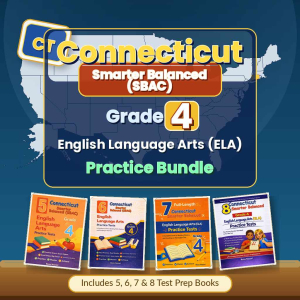 Connecticut Grade 4 ELA Preparation Bundle
 8 Connecticut Smarter Balanced English Language Arts (ELA) Grade 4: Full Practice Tests
 7 Connecticut Smarter Balanced English Language Arts (ELA) Grade 4: Full Practice Tests
 6 Connecticut Smarter Balanced English Language Arts (ELA) Grade 4: Full Practice Tests
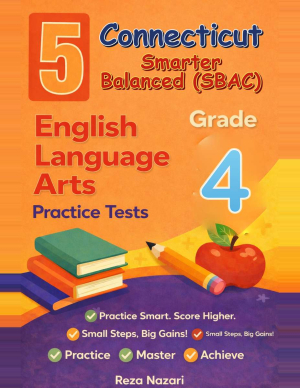 Connecticut Smarter Balanced ELA Grade 4: 5 Full Practice Tests
A USEFUL NEXT STEP
Connecticut Grade 4 English: study questions
Does a poem have to rhyme?
No. Discuss how its lines, rhythm, sound, and wording work together. These three original lines use line breaks and focused images without an end-rhyme pattern.
Where are the complete Connecticut Grade 4 requirements?
Connecticut uses the Core Standards for English language arts, adopted in 2010. The full ELA document contains the Grade 4 expectations across its subject strands. These are two selected references for the activity on this page; use the full document for curriculum planning.
Official source ↗Resources from Effortless Math · Editorial standards