LEARN · PRACTICE · EXPLORE
Maryland Grade 4 English
Connect a character’s choices to the plot in Grade 4, with a worked response, learning resources, and selected Maryland 2025 English standards references.
State resources · Focused study · Clear next steps
What do Maryland 4th graders learn in ELA?
In 4th grade, Maryland English language arts centers on theme and summary, text structure, figurative language, and multi-paragraph essays. Students take the MCAP grade 4 ELA test in the spring. This page explains each Maryland grade 4 ELA standard and pairs it with printable worksheets and a full-length practice test.
Printable Maryland grade 4 ELA books:
- Maryland MCAP ELA Grade 4: 5 Full Practice Tests
- 6 Maryland MCAP English Language Arts (ELA) Grade 4: Full Practice Tests
- 7 Maryland MCAP English Language Arts (ELA) Grade 4: Full Practice Tests
- 8 Maryland MCAP English Language Arts (ELA) Grade 4: Full Practice Tests
- Maryland Grade 4 ELA Preparation Bundle
Standards source: Maryland English Language Arts, Maryland State Department of Education (archived backup).
Connect a character’s choice with the plot
Grade 4 literary discussion can move beyond naming a trait. This original scene asks readers to explain how a character’s words and actions change what happens.
Curriculum reference: 2025 Maryland English standards: selected grade-level strand (archived PDF), from the Maryland State Department of Education standards directory (archived backup).
Maryland Grade 4 references for this activity
The state’s standards directory identifies revised 2025 Maryland College and Career Ready Standards for English Language Arts. Use the Grade 4 column of the selected strand document; neighboring columns show prerequisite and later expectations. These selected references support the activity and do not cover the whole English curriculum.
| Grade-level expectation | Activity focus | Official requirement |
|---|---|---|
| RL.4.3 | Character details and their effect on the plot | Read the archived state document (PDF page 8) |
| RL.4.1 | Details supporting explicit ideas and inferences | Read the archived state document (PDF page 2) |
These are selected grade-level expectations from the revised 2025 Maryland English standards. Activity labels describe a teaching focus rather than reproduce complete requirements. Read the linked state document’s complete grade-level expectations, including its grade-specific details, alongside the school’s curriculum sequence.
A worked Grade 4 reading and writing activity
This original classroom example is separate from official assessment questions.
The model boat sat on the demonstration table. Mira noticed a loose paper sail, but the visiting class was already entering. “I can hold it while you show the hull,” she whispered to Jo. Jo shook his head. “Then nobody will see what we built.” Mira looked at the small repair kit in her bag. She asked the teacher for two minutes, moved the boat to the side table, and fastened the sail again. When she returned, the visitors were drawing predictions about which boats would float. Jo pointed to an empty space beside his drawing. “We saved a spot for ours,” he said.
Try the activity
Describe Mira’s response to the problem in depth, using at least two specific details. Explain how her decision changes the sequence of events. How does Jo’s first response differ from his final response? Separate what the scene says from an inference about a character’s feelings.
Follow the reasoning
Mira initially proposes holding the sail during the demonstration, which would keep the boat on the table but partly hide the work. Jo’s objection leads her to choose repair instead. She asks for a short delay and uses her kit at a side table. These actions change the plot: the boat leaves the demonstration briefly and returns while visitors are still making predictions. Jo first objects to a solution that would hide their model, but later saves room for it. His final words suggest willingness to include the repaired boat. Calling Mira resourceful is defensible when the response connects that description to her kit and her change of plan. A trait label by itself would not explain the effect on events.
Notice what needs more practice
The passage never reports whether the boat floats. A reader should not turn a repair into a successful flotation test. Mira’s request for two minutes also does not establish the exact time the repair took. Her actions suggest concern for the demonstration, but the text does not directly name every feeling. Discussing the setting means explaining its contribution: the arriving visitors create a reason to solve the problem promptly. Simply naming a classroom adds little unless the reader connects that detail with the pressure or available help.
Grade 4 English worksheets
Choose printable practice that matches the skill being taught. Check the task, reading difficulty, and directions before assigning it; the collection is independently published.
Use the next session to build independence
- Select actions or words that reveal the character’s response.
- Connect the choice with the event that follows.
- Label inferences and support them with details.
Return to a longer classroom story or drama. Follow one decision across several events and explain its effect on the plot. Compare an early and later response from the same character. Ask students to revise an unsupported trait label into a sentence with evidence, then continue through the remaining Grade 4 reading and writing expectations.
For more general reading and writing resources, visit the Grade 4 English Online Center.
Maryland Grade 4 English: useful planning questions
How can a student move beyond a character-trait label?
Connect the trait to specific words or actions and explain how a choice affects the story’s events. Keep an inference separate from something the narrator directly states.
Where are the complete state requirements?
The state’s standards directory identifies revised 2025 Maryland College and Career Ready Standards for English Language Arts. Use the Grade 4 column of the selected strand document; neighboring columns show prerequisite and later expectations. These selected references support the activity and do not cover the whole English curriculum. The school’s sequence also includes reading, writing, speaking, listening, and language work beyond this example.
Sources checked October 6, 2026. Grade 4 is in the statewide English assessment grade range. Maryland announced a transition from MCAP to MSTAR beginning in 2026–27. Follow the school’s current assignment and administration directions, including an alternate pathway if assigned. The May 2026 state board report (PDF page 12, archived copy) describes the MSTAR transition. Older MCAP-named books and practice linked here retain their published names and should be checked against current school guidance; they are independent supplements. Their question counts, timers, and scoring are not official MSTAR specifications or predictions of a state performance level. The MSDE website displayed a maintenance notice during review and linked an archived backup. The standards links here use working archived copies of the state’s revised documents, not a claim that the live site was available. Check the MSDE website and school guidance for later updates. This original classroom activity is not an official assessment item.
Grade 4 English in other states
When moving between school systems, compare the official curriculum and the school’s learning sequence. Use the national Online Center’s map to find another state’s resources.
Recommended Maryland Grade 4 resources
Build a Strong Maryland Grade 4 MCAP English Practice Library
These independently published resources have their own coverage and editions. Check the contents alongside Maryland’s current English standards before choosing assessment preparation.
Use these Maryland Grade 4 resources for reading comprehension, language, writing, and full-length practice where available. Click any cover to open the resource page.
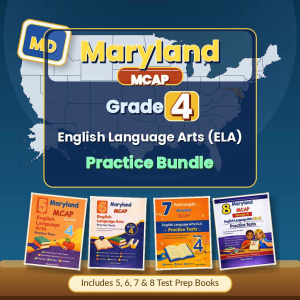 Maryland Grade 4 ELA Preparation Bundle
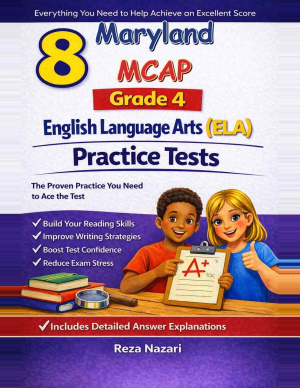 8 Maryland MCAP English Language Arts (ELA) Grade 4: Full Practice Tests
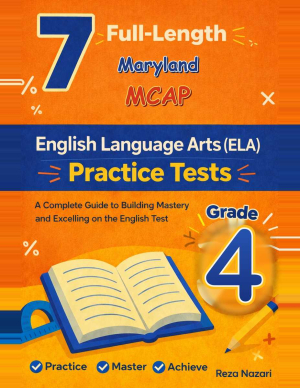 7 Maryland MCAP English Language Arts (ELA) Grade 4: Full Practice Tests
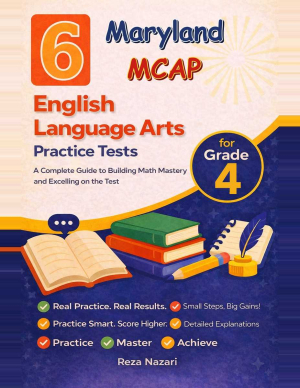 6 Maryland MCAP English Language Arts (ELA) Grade 4: Full Practice Tests
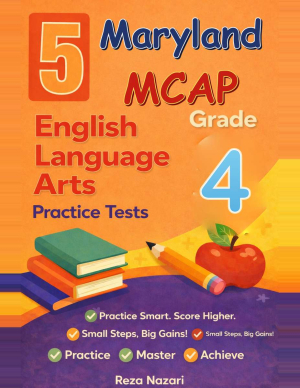 Maryland MCAP ELA Grade 4: 5 Full Practice Tests
More Grade 4 resources
A USEFUL NEXT STEP
Maryland Grade 4 English: study questions
How can a student move beyond a character-trait label?
Connect the trait to specific words or actions and explain how a choice affects the story’s events. Keep an inference separate from something the narrator directly states.
Where are the complete Maryland Grade 4 requirements?
The state’s standards directory identifies revised 2025 Maryland College and Career Ready Standards for English Language Arts. Use the Grade 4 column of the selected strand document; neighboring columns show prerequisite and later expectations. These selected references support the activity and do not cover the whole English curriculum.
Official source ↗Resources from Effortless Math · Editorial standards