


LEARN · PRACTICE · EXPLORE
Indiana Grade 4 English
Break an original compound-word example into recognizable closed syllables, connect the parts with meaning, and practice part of Indiana’s Grade 4 syllable-pattern expectation.
State resources · Focused study · Clear next steps
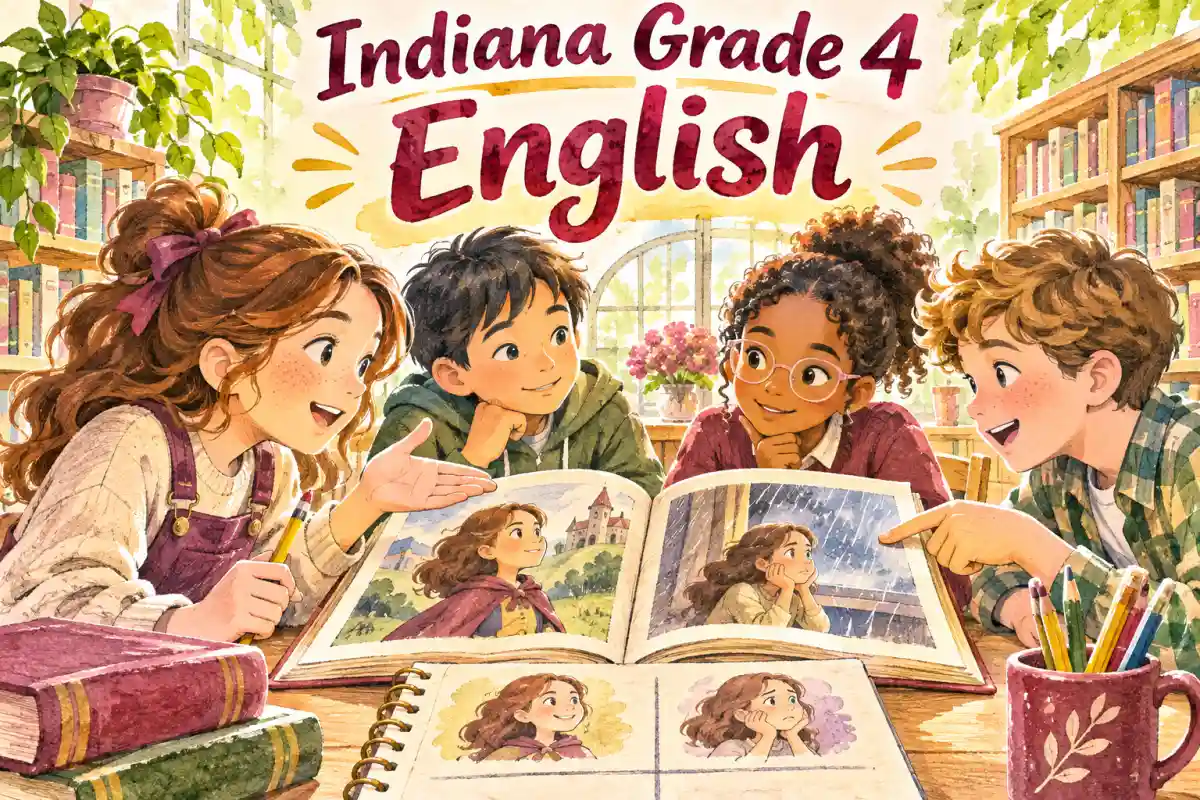
What do Indiana 4th graders learn in ELA?
In 4th grade, Indiana English language arts centers on theme and summary, text structure, figurative language, and multi-paragraph essays. Students take the ILEARN grade 4 ELA test in the spring. This page explains each Indiana grade 4 ELA standard and pairs it with short lessons, printable worksheets and a full-length practice test.
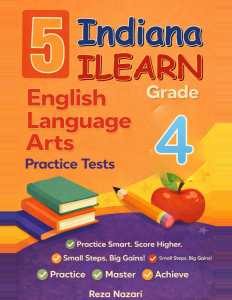
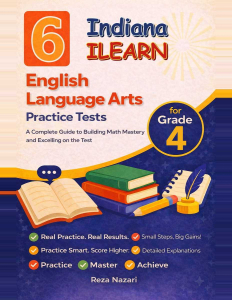
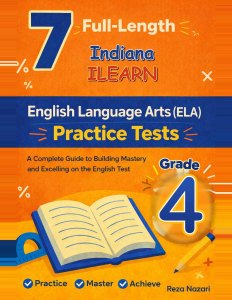
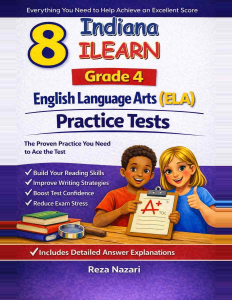
Printable Indiana grade 4 ELA books:
Indiana ILEARN Grade 4 ELA: Test Facts and Scores
Indiana 4th graders take ILEARN in English/language arts. It is a through-year test: three Checkpoints during the year and one summative test in spring. On the spring 2026 scale, 434 or higher is At Proficiency for Grade 4.
| Test | ILEARN Grade 4 English/Language Arts (computer adaptive) |
|---|---|
| Structure | Three Checkpoints plus a spring summative |
| Standards | 2023 Indiana Academic Standards |
Grade 4 ELA scale scores (updated spring 2026)
| Achievement level | Scale score |
|---|---|
| Below Proficiency | 302 to 387 |
| Approaching Proficiency | 388 to 433 |
| At Proficiency | 434 to 483 |
| Above Proficiency | 484 to 546 |
Practice on this page: Indiana standards
Indiana Grade 4 ELA testing questions
What ILEARN score is At Proficiency in Grade 4 ELA?
434. Above Proficiency starts at 484, and Approaching Proficiency starts at 388.
What are ILEARN Checkpoints?
Three shorter tests during the school year that each cover part of the standards. They inform teaching; the spring summative covers the full year.
Can Indiana ELA ILEARN scores be compared with earlier years?
Use care. IDOE updated the ELA and math performance standards starting with spring 2026, so the cut scores changed.
Facts from the Indiana Department of Education (IDOE), checked November 23, 2026: IDOE: ILEARN reporting scale, performance levels, and cut scores (published August 11, 2026); IDOE: ILEARN Through Year Assessment.
All 29 Indiana Grade 4 English/Language Arts Standards
Every Grade 4 standard in the 2023 Indiana Academic Standards for English/Language Arts, grouped by domain. ILEARN Grade 4 ELA measures these standards. Open a group to see its standards.
Reading Foundations (3)
| 4.RF.1 | Use the six major syllable patterns (CVC, CVr, V, VV, VCe, Cle) to read unknown words. |
|---|---|
| 4.RF.2 | Use knowledge of all letter-sound correspondences, syllabication patterns, and morphology (e.g., roots and affixes) to accurately read unfamiliar, multisyllabic words in context. |
| 4.RF.3 | Orally read grade-level appropriate or higher texts smoothly and accurately with expression that connotes comprehension. |
Reading Comprehension (13)
| 4.RC.1 | Refer to details and examples in a text when explaining what a text says explicitly and when drawing inferences from the text. |
|---|---|
| 4.RC.2 | Paraphrase or summarize the main events in a story, myth, legend, or novel; identify the theme and provide evidence for the interpretation. |
| 4.RC.3 | Describe a character, setting, or event in a story or play, drawing on specific details in the text, and how that impacts the plot. |
| 4.RC.4 | Compare and contrast the point of view from which different stories are narrated, including the difference between first- and third-person narrations. |
| 4.RC.5 | Determine the main idea of a text and explain how it is supported by key details; summarize the text. |
| 4.RC.6 | Apply knowledge of text features to locate information and gain meaning from a text (e.g., charts, tables, graphs, headings, subheadings, font/format). |
| 4.RC.7 | Describe the organizational structure (e.g., chronological, problem-solution, comparison/contrast, procedural, cause/effect, sequential, description) of events, ideas, concepts, or information in a text or part of a text. |
| 4.RC.8 | Distinguish between fact and opinion; explain how an author uses reasons and evidence to support a statement or position (claim) in a text. |
| 4.RC.9 | Combine information from two texts on the same topic in order to demonstrate knowledge about the subject. |
| 4.RC.10 | Apply context clues (e.g., word, phrase, sentence, and paragraph context) and text features (e.g., charts, headings/subheadings, font/format) to determine the meanings of unknown words. |
| 4.RC.11 | Identify relationships among words, including more complex homographs, homonyms, synonyms, antonyms, and multiple meanings. |
| 4.RC.12 | Apply knowledge of word structure elements (e.g., suffixes, prefixes, common Greek and Latin affixes and roots), known words, and word patterns to determine meaning. |
| 4.RC.13 | Determine how words and phrases provide meaning to works of literature, including figurative language (e.g., similes, metaphors, or hyperbole). |
Writing (6)
| 4.W.2 | a. Provide an introductory paragraph with a clear main idea. b. Provide supporting paragraphs with topic and summary sentences. c. Provide facts, specific details, and examples from various sources and texts to support ideas and extend explanations. d. Connect ideas using words and phrases. e. Include text features (e.g., formatting, photographs, maps) and multimedia when useful to aid comprehension. f. Use language and vocabulary appropriate to the audience and topic. g. Provide a concluding statement or section. Write narrative compositions in a variety of forms that:. |
|---|---|
| 4.W.3 | a. Establish an introduction with context to allow the reader to imagine the world of the event or experience. b. Organize events that unfold naturally, using meaningful paragraphing and transitional words and phrases. c. Use dialogue and descriptive details to develop events and reveal characters’ personalities, feelings, and responses to situations. d. Employ vocabulary with sufficient sensory (i.e., sight, sound, smell, touch, taste) details to give clear pictures of ideas and events. e. Provide an ending that follows the narrated experiences or events. |
| 4.W.4 | a. Generate a draft by developing, selecting, and organizing ideas relevant to topic, purpose, and genre; revise to improve writing, using appropriate reference materials (e.g., quality of ideas, organization, sentence fluency, word choice); edit writing for format and conventions (e.g., spelling, capitalization, usage, punctuation). b. Use technology to interact and collaborate with others to produce and publish legible documents. |
| 4.W.5 | a. Identify a specific question to address (e.g., What is the history of the Indy 500?). b. Use organizational features of print and digital sources to efficiently locate further information. c. Determine the reliability of the sources. d. Summarize and organize information in their own words, giving credit to the source. e. Present the research information, choosing from a variety of formats. Demonstrate command of English grammar and usage, focusing on:. |
| 4.W.6 | a. Nouns/Pronouns – Writing sentences that include relative pronouns (e.g., who, which) and reflexive pronouns (e.g., myself, ourselves) and explaining their functions in the sentence. b. Verbs – I. Writing sentences that use progressive verb tenses. II. Recognizing and correcting inappropriate shifts in verb tense. III. Using modal auxiliaries (e.g., can, may, must). c. Adjectives/Adverbs – Writing sentences using relative adverbs (e.g., where, when), explaining their functions in the sentence. d. Prepositions – Writing sentences that include prepositions, explaining their functions in the sentence. e. Usage – Writing complete simple, compound, and complex declarative, interrogative, imperative, and exclamatory sentences, using coordinating and subordinating conjunctions (e.g., yet, nor, so) correctly. Demonstrate command of capitalization, punctuation, and spelling, focusing on:. |
| 4.W.7 | a. Capitalization – Capitalizing names of magazines, newspapers, works of art, musical compositions, organizations, and the first word in quotations, when appropriate. b. Punctuation – I. Correctly using apostrophes to form possessives and contractions. II. Correctly using quotation marks and commas to mark direct speech. III. Using a comma before a coordinating conjunction in a compound sentence. c. Spelling – Using spelling patterns and generalizations (e.g., word families, position-based spellings, syllable patterns, ending rules, meaningful word parts, homophones/homographs) in writing single and multisyllable words. |
Communication and Collaboration (7)
| 4.CC.1 | Engage effectively in a range of collaborative discussions (one-on-one, in groups, and teacher-led) on grade-appropriate topics and texts, building on others’ ideas and expressing personal ideas clearly. |
|---|---|
| 4.CC.2 | Pose and respond to specific questions to clarify or follow up on information, and make comments that contribute to the discussion and link to the remarks of others. |
| 4.CC.3 | Summarize major ideas and supportive evidence from text read aloud or information presented in diverse media and formats, including visually, quantitatively, and orally. |
| 4.CC.4 | Identify and use evidence a speaker provides to support particular points. |
| 4.CC.5 | Use appropriate language to report on a topic or text, or provide a narrative that organizes ideas appropriately using effective introductions and conclusions. Use appropriate structure, facts, and relevant, descriptive details to support main ideas or themes, speaking at an understandable pace in a clear and concise manner. |
| 4.CC.6 | Create oral presentations that maintain a clear focus, using multimedia to enhance the development of main ideas and themes that engage the audience. |
| 4.CC.7 | Recognize claims in print, image, and multimedia and identify evidence used to support these claims. |
Codes and wording from the IDOE standards document (examples and “E” essential markers are in the official document). Checked November 23, 2026: IDOE: 2023 Indiana Academic Standards, Grade 4 English/Language Arts; IDOE: Indiana Academic Standards for English/Language Arts (2023).
Standards source: Indiana English Language Arts, Indiana Department of Education.
Use familiar syllable patterns to read a longer word
A longer word can contain smaller parts with familiar spelling patterns. In this example, dividing a compound word helps the reader connect sound with meaning. The task selects the closed-syllable pattern rather than claiming to teach all six patterns in one lesson.
Curriculum reference: 2023 Indiana Academic Standards: Grade 4 English/Language Arts, from the Indiana Department of Education standards directory.
Indiana Grade 4 references for this activity
Indiana’s 2023 English document includes Grade 4 expectations in the grade’s reading, writing, and communication domains. The expectations selected here support this activity; use the whole document and the school’s sequence for wider coverage.
| Grade-level expectation | Activity focus | Official requirement |
|---|---|---|
| 4.RF.1 | Use major syllable patterns to read unfamiliar words | Read the state document (PDF page 4) |
These are selected grade-level expectations from Indiana’s current English standards. Activity labels describe a teaching focus rather than reproduce complete requirements. Read the linked state document’s complete grade-level expectations, including its marked essential standards, alongside the school’s curriculum sequence.
A worked Grade 4 reading and writing activity
This original classroom example is separate from official assessment questions.
At sunset, the walkers packed their bags and left the trail.
| Written part | Pattern in this example | Contribution |
|---|---|---|
| sun | Closed syllable; short u | First part of sunset |
| set | Closed syllable; short e | Second part of sunset |
| sunset | Two-part compound | Time referred to in the sentence |
Try the activity
Read sunset in the sentence. Divide it into sun and set, explain the vowel pattern in each part, and use the sentence to check the resulting word’s meaning.
Follow the reasoning
Sun and set each have a single vowel followed by a consonant within a closed syllable. In these words, u and e represent their familiar short-vowel sounds. Blending the two parts gives sunset, a compound word naming the time when the sun goes below the horizon. The sentence describes leaving a trail at that time, so the decoded word fits the context. Context checks the reading; it should not replace looking at the letters and syllable parts.
Notice what needs more practice
A compound-word division and a syllable-pattern explanation answer related but different questions. Sun and set are meaningful words as well as the two syllables here. Not every longer word divides into two stand-alone words, and not every written vowel always has a short sound. The Indiana document lists six patterns: CVC, CVr, V, VV, VCe, and Cle. Read its complete expectation when planning the wider sequence. This example explores only CVC, so teaching the remaining patterns still requires additional work.
Grade 4 English worksheets
Choose printable practice that matches the skill being taught. Check the task, reading difficulty, and directions before assigning it; the collection is independently published.
Use the next session to build independence
- Find the written parts sun and set.
- Connect each closed syllable with its vowel sound.
- Blend the parts and check the word in the sentence.
Compare sunset with another familiar compound such as bathtub. Identify bath and tub, while noticing that th represents one consonant sound even though it uses two letters. Ask the student to explain the parts rather than merely count written letters. Next, use teacher-selected examples of a different syllable pattern and state what changes about the vowel spelling. Keep a record of whether difficulty lies in recognizing a pattern, blending the syllables, or understanding the whole word; those observations lead to different next tasks.
For more general reading and writing resources, visit the Grade 4 English Online Center.
Indiana Grade 4 English: useful planning questions
Does the sunset example teach every Grade 4 syllable pattern?
No. It practices two closed syllables. Indiana’s complete expectation also lists other patterns that need separate examples.
Where are the complete state requirements?
Indiana’s 2023 English document includes Grade 4 expectations in the grade’s reading, writing, and communication domains. The expectations selected here support this activity; use the whole document and the school’s sequence for wider coverage. The school’s sequence also includes reading, writing, speaking, listening, and language work beyond this example.
Official sources checked October 6, 2026. Grade 4 is within the ILEARN English language arts testing range. This original lesson is independent practice. Read the Indiana assessment overview and use the school’s guidance for preparation. ILEARN’s through-year system measures English language arts and mathematics in Grades 3–8 with checkpoints and an end-of-year summative assessment. Follow the school’s current assessment assignment, accommodations, and guidance; this classroom activity is independent practice and does not predict a state performance level. This site’s practice and books are independently published. Check their editions and contents against current standards and assessment guidance.
Grade 4 English in other states
When moving between school systems, compare the official curriculum and the school’s learning sequence. Use the national Online Center’s map to find another state’s resources.
Recommended Indiana Grade 4 resources
Build a Strong Indiana Grade 4 ILEARN English Practice Library
These independently published resources have their own coverage and editions. Check the contents alongside Indiana’s current English standards before choosing assessment preparation.
Use these Indiana Grade 4 resources for reading comprehension, language, writing, and full-length practice where available. Click any cover to open the resource page.
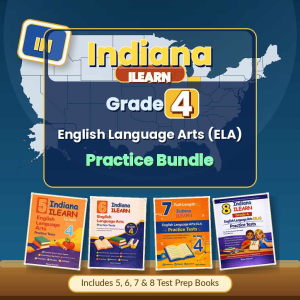 Indiana Grade 4 ELA Preparation Bundle
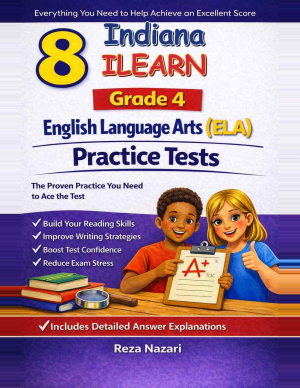 8 Indiana ILEARN English Language Arts (ELA) Grade 4: Full Practice Tests
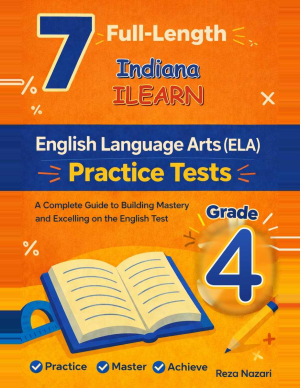 7 Indiana ILEARN English Language Arts (ELA) Grade 4: Full Practice Tests
 6 Indiana ILEARN English Language Arts (ELA) Grade 4: Full Practice Tests
 Indiana ILEARN ELA Grade 4: 5 Full Practice Tests
More Grade 4 resources
Choose another state
Grade 4 English in Every State
Select a state on the map to open its Grade 4 English page. You are viewing Indiana.
All states A–Z
A USEFUL NEXT STEP
Indiana Grade 4 English: study questions
Does the sunset example teach every Grade 4 syllable pattern?
No. It practices two closed syllables. Indiana’s complete expectation also lists other patterns that need separate examples.
Where are the complete Indiana Grade 4 requirements?
Indiana’s 2023 English document includes Grade 4 expectations in the grade’s reading, writing, and communication domains. The expectations selected here support this activity; use the whole document and the school’s sequence for wider coverage.
Official source ↗Resources from Effortless Math · Editorial standards