LEARN · PRACTICE · EXPLORE
Kansas Grade 4 English
Compare three original versions of a missing mitten scene, explain lines, narration, dialogue and stage directions, and study a selected Kansas Grade 4 literature expectation.
State resources · Focused study · Clear next steps
What do Kansas 4th graders learn in ELA?
In 4th grade, Kansas English language arts centers on theme and summary, text structure, figurative language, and multi-paragraph essays. Students take the KAP grade 4 ELA test in the spring. This page explains each Kansas grade 4 ELA standard and pairs it with short lessons, printable worksheets and a full-length practice test.
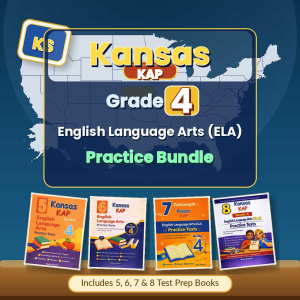
Printable Kansas grade 4 ELA books:
Standards source: Kansas English Language Arts, Kansas State Department of Education.
Compare prose, a poem, and a short drama about the same event
Texts about the same event can give readers information through different structures. These three original miniatures concern a missing mitten. Use their visible features to explain differences rather than decide that subject matter determines the form.
Curriculum reference: 2023 Kansas English Language Arts Standards, updated February 2025, from the Kansas State Department of Education standards directory.
Kansas Grade 4 references for this activity
Kansas’s current directory links the 2023 English Language Arts standards, updated February 2025. Read the Grade 4 expectations in the full state document. The selected reference supports this activity; use the school’s sequence and the remaining expectations for wider coverage.
| Grade-level expectation | Activity focus | Official requirement |
|---|---|---|
| RL.4.5 | Explain differences among poems, drama, and prose using structural features | Read the state document (PDF page 34) |
These are selected grade-level expectations from Kansas’s current English standards. Activity labels describe a teaching focus rather than reproduce complete requirements. Read the linked state document’s complete grade-level expectations, including its grade-specific details, alongside the school’s curriculum sequence.
A worked Grade 4 reading and writing activity
This original classroom example is separate from official assessment questions.
PROSE
Nia checked the bench for her mitten. It was under the sketchbook, where she had left it before drawing.
POEM
A mitten hides beneath a page;
Its woolly thumb escapes the stage.
DRAMA
Characters: Nia, Jo. Setting: a bench.
[Nia lifts a sketchbook.]
NIA: Here is my mitten!
JO: Your drawing kept it company.
| Form | Visible feature | Contribution |
|---|---|---|
| Prose | Narrated sentences | Explains the search and why the mitten is there |
| Poem | Two verse lines; page/stage rhyme | Creates a brief playful image and sound pattern |
| Drama | Character labels and bracketed direction | Separates performed action from spoken dialogue |
Try the activity
Identify one structural feature of each version. Explain how the drama supplies an action and speech without a narrator’s prose sentence. What do the poem’s line endings contribute? Compare what each version actually reveals about the event.
Follow the reasoning
The prose uses sentences and narration to describe Nia’s search and explain why the mitten is there. The poem uses two verse lines whose final words, page and stage, rhyme. It presents the mitten through a playful image rather than reproduce every fact in the prose. The drama names characters and a setting, places Nia’s action in a bracketed stage direction, and assigns spoken lines to Nia and Jo. A performer uses the direction to lift the sketchbook. A reader or performer distinguishes that action from words spoken aloud. Each structural choice shapes how the event is presented.
Notice what needs more practice
A short line is not sufficient evidence that a text is a poem; line breaks can also come from narrow page width. Here the intended verse lines and rhyme provide stronger evidence. Conversely, poems need not always rhyme. The poem’s use of stage is part of its playful wording and rhyme; it does not turn the verse into a drama. The prose gives a reason for the mitten’s location that the other versions do not state directly. Do not claim that all three texts provide exactly the same information merely because they concern the same object.
Grade 4 English worksheets
Choose printable practice that matches the skill being taught. Check the task, reading difficulty, and directions before assigning it; the collection is independently published.
Use the next session to build independence
- Identify narration, intentional verse lines, and script features.
- Explain how each feature conveys information.
- Compare one detail that is present in one version but absent from another.
Convert the prose into a longer script with two characters, at least one clear stage direction, and dialogue that conveys why the mitten was left there. Then write a separate stanza about the discovery, choosing deliberate line breaks and a sound pattern if useful. Ask a partner to explain the structural evidence for each form. The brief poem offers rhyme without establishing a complete metrical analysis. Read longer poems and scripts later to explore rhythm, meter, casts, settings, and scenes in more depth. This selected Kansas expectation is part of broader literature reading and discussion.
For more general reading and writing resources, visit the Grade 4 English Online Center.
Kansas Grade 4 English: useful planning questions
Must a poem rhyme to be a poem?
No. These two verse lines rhyme, but poems can use other patterns. Consider intentional verse structure and other features instead of applying one rule to every poem.
Where are the complete state requirements?
Kansas’s current directory links the 2023 English Language Arts standards, updated February 2025. Read the Grade 4 expectations in the full state document. The selected reference supports this activity; use the school’s sequence and the remaining expectations for wider coverage. The school’s sequence also includes reading, writing, speaking, listening, and language work beyond this example.
Official sources checked October 6, 2026. Grade 4 is within the Kansas Assessment Program general summative English language arts testing range. This original lesson is independent practice. Read the Kansas assessment overview and use the school’s guidance for preparation. Read the 2026–27 Kansas assessment overview (PDF). Kansas’s 2026–27 assessment overview lists general summative English language arts and mathematics in Grades 3–8 and 10, and science in Grades 5, 8, and 11. The HGSS classroom-based assessment applies in Grades 4, 7, and one district-selected grade among 10, 11, and 12. The optional Grade 2 reading assessment is separate from the general summative ELA range. Eligible students use their assigned alternate-assessment pathway. Follow the school’s current assessment assignment, accommodations, and guidance; this classroom activity is independent practice and does not predict a state performance level. This site’s practice and books are independently published. Check their editions and contents against current standards and assessment guidance.
Grade 4 English in other states
When moving between school systems, compare the official curriculum and the school’s learning sequence. Use the national Online Center’s map to find another state’s resources.
Recommended Kansas Grade 4 resources
Build a Strong Kansas Grade 4 KAP English Practice Library
These independently published resources have their own coverage and editions. Check the contents alongside Kansas’s current English standards before choosing assessment preparation.
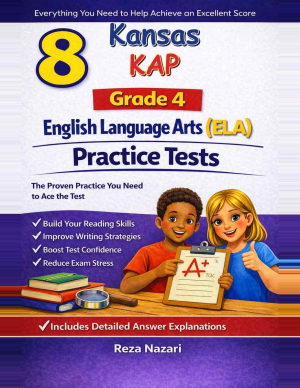
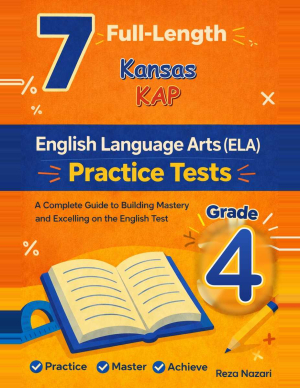
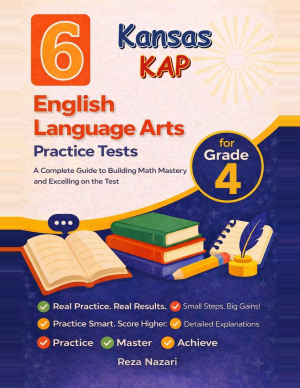
Use these Kansas Grade 4 resources for reading comprehension, language, writing, and full-length practice where available. Click any cover to open the resource page.
More Grade 4 resources
A USEFUL NEXT STEP
Kansas Grade 4 English: study questions
Must a poem rhyme to be a poem?
No. These two verse lines rhyme, but poems can use other patterns. Consider intentional verse structure and other features instead of applying one rule to every poem.
Where are the complete Kansas Grade 4 requirements?
Kansas’s current directory links the 2023 English Language Arts standards, updated February 2025. Read the Grade 4 expectations in the full state document. The selected reference supports this activity; use the school’s sequence and the remaining expectations for wider coverage.
Official source ↗Resources from Effortless Math · Editorial standards