LEARN · PRACTICE · EXPLORE
Michigan Grade 4 English
Compare two original accounts of the same rehearsal, explain first-person and third-person narration, and use Michigan Grade 4 English resources.
State resources · Focused study · Clear next steps
What do Michigan 4th graders learn in ELA?
In 4th grade, Michigan English language arts centers on theme and summary, text structure, figurative language, and multi-paragraph essays. Students take the M-STEP grade 4 ELA test in the spring. This page explains each Michigan grade 4 ELA standard and pairs it with printable worksheets and a full-length practice test.
Printable Michigan grade 4 ELA books:
- Michigan M-STEP ELA Grade 4: 5 Full Practice Tests
- 6 Michigan M-STEP English Language Arts (ELA) Grade 4: Full Practice Tests
- 7 Michigan M-STEP English Language Arts (ELA) Grade 4: Full Practice Tests
- 8 Michigan M-STEP English Language Arts (ELA) Grade 4: Full Practice Tests
- Michigan Grade 4 ELA Preparation Bundle
Standards source: Michigan English Language Arts, Michigan Department of Education.
Compare first-person and third-person accounts
Two versions of one moment can reveal different information. Compare the storytelling perspective as well as the pronouns.
Curriculum reference: Michigan K–12 English Language Arts Standards, from the Michigan Department of Education academic standards directory.
Michigan Grade 4 references for this activity
The state’s academic standards directory links the Michigan K–12 English Language Arts Standards, adopted by the State Board of Education in 2010. Read the individual Grade 4 requirements and the school’s sequence. These selected references support this activity; they do not cover the whole English curriculum.
| Grade-level expectation | Activity focus | Official requirement |
|---|---|---|
| RL.4.6 | Compare first-person and third-person narrations | Read the state framework (PDF page 12) |
| RL.4.1 | Details supporting explanations and inferences | Read the state framework (PDF page 12) |
These are selected grade-level expectations from the currently linked Michigan English standards adopted in 2010. Activity labels describe a teaching focus rather than reproduce complete requirements. Read the linked state document’s complete grade-level expectations, including its grade-specific details, alongside the school’s curriculum sequence.
A worked Grade 4 reading and writing activity
This original classroom example is separate from official assessment questions.
VERSION A: I stood behind the stage curtain and counted my first three words. My hands felt cold. When the teacher nodded, I stepped forward, hoping my voice would reach the last row.
VERSION B: Lena stood behind the stage curtain. She looked at her note card and rubbed her hands together. When the teacher nodded, she stepped forward. The students in the last row leaned toward the stage.
Try the activity
Compare who tells each version and the information available. Identify the first-person and third-person forms, then explain a detail that one account supplies and the other does not. Do not assume the versions report the same inner thoughts.
Follow the reasoning
Version A uses I and my to let the performer tell the moment. It directly supplies the performer’s cold hands and hope about being heard. Version B names Lena and uses she; a narrator describes her actions and the audience’s movement. It supplies the last-row students leaning forward, a detail absent from Version A. Version B does not explicitly tell Lena’s hope, while Version A does not name the performer. The accounts concern the same kind of rehearsal moment, but their information differs. A useful comparison explains these details in addition to identifying pronouns.
Notice what needs more practice
Third-person narration does not automatically reveal every character’s thoughts. This version describes observable actions and does not state why the last row leans forward. First person also does not prove that the author personally experienced the event; these are invented accounts. The pronouns identify perspective, but a response consisting only of I versus she misses how that perspective shapes what is described. Keep the performer’s unnamed identity in Version A separate from the name supplied in Version B unless a task explicitly establishes they are the same person.
Grade 4 English worksheets
Choose printable practice that matches the skill being taught. Check the task, reading difficulty, and directions before assigning it; the collection is independently published.
Use the next session to build independence
- Identify the storyteller’s pronouns in each version.
- Find one detail unique to each account.
- Explain how the perspective and information shape the moment.
Add a sentence to Version B that explicitly states Lena’s thought, and discuss how that changes the information the narrator supplies while leaving the third-person pronouns intact. Then compare teacher-selected first-person and third-person stories. Look at which experiences, observations, and thoughts are available rather than rely on a single pronoun test. These short accounts introduce the contrast; longer works may shift viewpoint or use a narrator whose knowledge is limited in different ways. Follow the school’s wider reading and writing sequence.
For more general reading and writing resources, visit the Grade 4 English Online Center.
Michigan Grade 4 English: useful planning questions
Does a third-person narrator always know every character’s thoughts?
No. Check what the particular text supplies. This third-person version describes actions without stating Lena’s private hope or why the audience leans forward.
Where are the complete state requirements?
The state’s academic standards directory links the Michigan K–12 English Language Arts Standards, adopted by the State Board of Education in 2010. Read the individual Grade 4 requirements and the school’s sequence. These selected references support this activity; they do not cover the whole English curriculum. The school’s sequence also includes reading, writing, speaking, listening, and language work beyond this example.
Sources checked October 6, 2026. The currently linked 2025–26 state guide identifies M-STEP English language arts and mathematics in Grades 3–7, including Grade 4. Follow the school’s current assigned assessment pathway and directions. Read the state assessment guide, PDF page 24, and MDE assessment updates for later guidance. Independently published practice may use its own timer, question count, and scoring; those features are not official administration specifications or a prediction of a state performance level. Use the complete standards and the school’s learning sequence to choose further reading, writing, speaking, listening, and language work. This original classroom activity is not an official assessment item.
Grade 4 English in other states
When moving between school systems, compare the official curriculum and the school’s learning sequence. Use the national Online Center’s map to find another state’s resources.
Recommended Michigan Grade 4 resources
Build a Strong Michigan Grade 4 M-STEP English Practice Library
These independently published resources have their own coverage and editions. Check the contents alongside Michigan’s current English standards before choosing assessment preparation.
Use these Michigan Grade 4 resources for reading comprehension, language, writing, and full-length practice where available. Click any cover to open the resource page.
 Michigan Grade 4 ELA Preparation Bundle
 8 Michigan M-STEP English Language Arts (ELA) Grade 4: Full Practice Tests
 7 Michigan M-STEP English Language Arts (ELA) Grade 4: Full Practice Tests
 6 Michigan M-STEP English Language Arts (ELA) Grade 4: Full Practice Tests
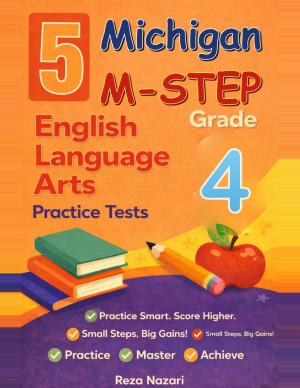 Michigan M-STEP ELA Grade 4: 5 Full Practice Tests
More Grade 4 resources
A USEFUL NEXT STEP
Michigan Grade 4 English: study questions
Does a third-person narrator always know every character’s thoughts?
No. Check what the particular text supplies. This third-person version describes actions without stating Lena’s private hope or why the audience leans forward.
Where are the complete Michigan Grade 4 requirements?
The state’s academic standards directory links the Michigan K–12 English Language Arts Standards, adopted by the State Board of Education in 2010. Read the individual Grade 4 requirements and the school’s sequence. These selected references support this activity; they do not cover the whole English curriculum.
Official source ↗Resources from Effortless Math · Editorial standards