LEARN · PRACTICE · EXPLORE
Massachusetts Grade 4 English
Compare three original versions of one moment, name their structural features, and read Massachusetts Grade 4 English references and learning resources.
State resources · Focused study · Clear next steps
What do Massachusetts 4th graders learn in ELA?
In 4th grade, Massachusetts English language arts centers on theme and summary, text structure, figurative language, and multi-paragraph essays. Students take the MCAS grade 4 ELA test in the spring. This page explains each Massachusetts grade 4 ELA standard and pairs it with printable worksheets and a full-length practice test.
Printable Massachusetts grade 4 ELA books:
- Massachusetts MCAS ELA Grade 4: 5 Full Practice Tests
- 6 Massachusetts MCAS English Language Arts (ELA) Grade 4: Full Practice Tests
- 7 Massachusetts MCAS English Language Arts (ELA) Grade 4: Full Practice Tests
- 8 Massachusetts MCAS English Language Arts (ELA) Grade 4: Full Practice Tests
- Massachusetts Grade 4 ELA Preparation Bundle
Standards source: Massachusetts English Language Arts, Massachusetts Department of Elementary and Secondary Education.
Compare prose, poetry, and drama through their structures
The same moment can be presented in different literary forms. Compare how paragraphs, verse lines, and stage directions organize what the reader encounters.
Curriculum reference: 2017 Massachusetts English Language Arts and Literacy Framework, from the Massachusetts Department of Elementary and Secondary Education current frameworks directory.
Massachusetts Grade 4 references for this activity
The state’s current frameworks directory links the 2017 Massachusetts English Language Arts and Literacy Framework, adopted in March 2017. Read the individual Grade 4 requirements and the school’s sequence. These selected references support this activity; they do not cover the whole English curriculum.
| Grade-level expectation | Activity focus | Official requirement |
|---|---|---|
| RL.4.5 | Differences and structural elements of prose, poetry, and drama | Read the state framework (PDF page 61) |
| RL.4.1 | Details supporting explanations | Read the state framework (PDF page 61) |
These are selected grade-level expectations from the current 2017 Massachusetts English framework. Activity labels describe a teaching focus rather than reproduce complete requirements. Read the linked state document’s complete grade-level expectations, including its grade-specific details, alongside the school’s curriculum sequence.
A worked Grade 4 reading and writing activity
This original classroom example is separate from official assessment questions.
PROSE: At the school gate, Leo found a yellow glove. He lifted it toward the arriving students and asked who had lost it.
POEM: A yellow glove waits by the gate. / One small hand has arrived too late.
DRAMA: [Leo stands beside the gate holding a yellow glove.] LEO: Has anyone lost this? [Students turn toward him.]
Try the activity
Compare how these three brief versions are organized. Identify a paragraph or prose account, the poem’s two verse lines, and the drama’s spoken line and stage directions. Explain what each version tells the reader or performer. The slash marks a line break in the poem.
Follow the reasoning
The prose version presents events in continuous sentences organized as a short paragraph. The poem is arranged as two verse lines; gate and late rhyme, and the wording pictures a waiting glove and a missing hand. The drama separates a character’s spoken words from bracketed stage directions describing position and movement. Those directions guide a performance rather than belong to Leo’s speech. All versions include the glove and gate, but they emphasize different information: the prose describes Leo’s action, the poem compresses the moment into an image, and the drama provides something to stage. Naming the forms is only the start; structural details support the comparison.
Notice what needs more practice
Rhyming is a feature of this poem, not a rule that all poetry must rhyme. Drama can include more than dialogue, and prose can include quoted speech without becoming a play. Ask students to point to the actual verse arrangement and the stage directions before relying on shortcuts. The poem does not explicitly name Leo, so that detail should not be attributed to all three versions. These tiny examples are an introduction, not evidence that every prose work, poem, or drama has exactly these features.
Grade 4 English worksheets
Choose printable practice that matches the skill being taught. Check the task, reading difficulty, and directions before assigning it; the collection is independently published.
Use the next session to build independence
- Mark the structural features that distinguish each version.
- Explain what belongs to narration, verse, speech, or stage directions.
- Write a comparison supported by at least one detail from each form.
Read a teacher-selected poem without rhyme and a prose passage that includes dialogue. Revise any rule that would misclassify them. Then turn the prose moment into a longer short scene with a cast list and stage directions, keeping those additions separate from the original examples. Refer to paragraphs or chapters, stanzas or verse, and scenes or directions as appropriate to the actual works. The school’s wider reading sequence should include complete texts from varied genres and perspectives; these snippets prepare students to notice structure in that reading.
For more general reading and writing resources, visit the Grade 4 English Online Center.
Massachusetts Grade 4 English: useful planning questions
Does every poem rhyme, and does quoted speech always mean drama?
No. This poem rhymes, but many do not. Prose can contain dialogue; compare the whole organization and the actual structural features rather than one shortcut.
Where are the complete state requirements?
The state’s current frameworks directory links the 2017 Massachusetts English Language Arts and Literacy Framework, adopted in March 2017. Read the individual Grade 4 requirements and the school’s sequence. These selected references support this activity; they do not cover the whole English curriculum. The school’s sequence also includes reading, writing, speaking, listening, and language work beyond this example.
Sources checked October 6, 2026. Grade 4 is within the MCAS English language arts testing range. The state overview identifies English language arts and mathematics testing in Grades 3–8 and 10. Follow the school’s assigned pathway and current administration directions. The official MCAS overview states that MCAS is untimed within a regular school day. Independently published practice may use its own timer, question count, and scoring; those features are not official MCAS specifications or a prediction of a state performance level. Use the complete framework and the school’s learning sequence to choose further reading, writing, speaking, listening, and language work. This original classroom activity is not an official assessment item.
Grade 4 English in other states
When moving between school systems, compare the official curriculum and the school’s learning sequence. Use the national Online Center’s map to find another state’s resources.
Recommended Massachusetts Grade 4 resources
Build a Strong Massachusetts Grade 4 MCAS English Practice Library
These independently published resources have their own coverage and editions. Check the contents alongside Massachusetts’s current English standards before choosing assessment preparation.
Use these Massachusetts Grade 4 resources for reading comprehension, language, writing, and full-length practice where available. Click any cover to open the resource page.
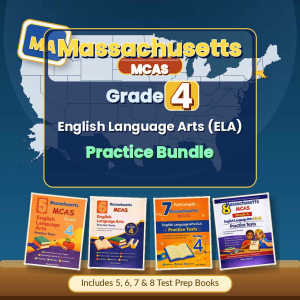 Massachusetts Grade 4 ELA Preparation Bundle
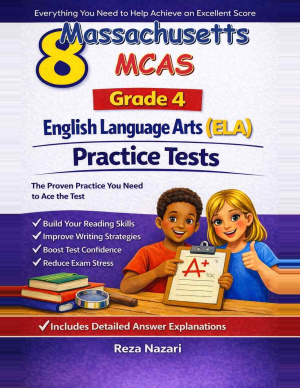 8 Massachusetts MCAS English Language Arts (ELA) Grade 4: Full Practice Tests
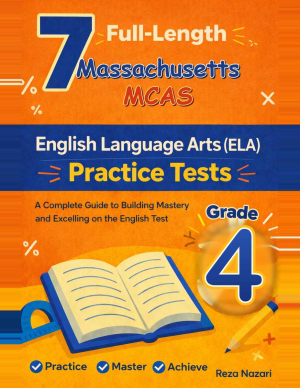 7 Massachusetts MCAS English Language Arts (ELA) Grade 4: Full Practice Tests
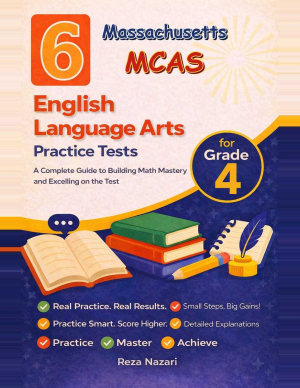 6 Massachusetts MCAS English Language Arts (ELA) Grade 4: Full Practice Tests
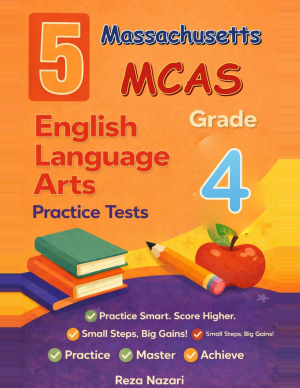 Massachusetts MCAS ELA Grade 4: 5 Full Practice Tests
More Grade 4 resources
A USEFUL NEXT STEP
Massachusetts Grade 4 English: study questions
Does every poem rhyme, and does quoted speech always mean drama?
No. This poem rhymes, but many do not. Prose can contain dialogue; compare the whole organization and the actual structural features rather than one shortcut.
Where are the complete Massachusetts Grade 4 requirements?
The state’s current frameworks directory links the 2017 Massachusetts English Language Arts and Literacy Framework, adopted in March 2017. Read the individual Grade 4 requirements and the school’s sequence. These selected references support this activity; they do not cover the whole English curriculum.
Official source ↗Resources from Effortless Math · Editorial standards