LEARN · PRACTICE · EXPLORE
North Dakota Grade 4 English
Support a theme with specific events in an original Grade 4 story, with North Dakota English references, a worked interpretation, and printable practice.
State resources · Focused study · Clear next steps
What do North Dakota 4th graders learn in ELA?
In 4th grade, North Dakota English language arts centers on theme and summary, text structure, figurative language, and multi-paragraph essays. Students take the NDSA grade 4 ELA test in the spring. This page explains each North Dakota grade 4 ELA standard and pairs it with printable worksheets and a full-length practice test.
Printable North Dakota grade 4 ELA books:
- North Dakota NDSA ELA Grade 4: 5 Full Practice Tests
- 6 North Dakota NDSA English Language Arts (ELA) Grade 4: Full Practice Tests
- 7 North Dakota NDSA English Language Arts (ELA) Grade 4: Full Practice Tests
- 8 North Dakota NDSA English Language Arts (ELA) Grade 4: Full Practice Tests
- North Dakota Grade 4 ELA Preparation Bundle
Standards source: North Dakota adopted content standards.
Support a Theme with Events
Support a theme with specific events in an original Grade 4 story, with North Dakota English references, a worked interpretation, and printable practice. Connect this activity with the school’s wider literacy sequence.
Curriculum reference: North Dakota English Language Arts Content Standards, June 2023, from the NDDPI English Language Arts standards page.
North Dakota Grade 4 references for this activity
NDDPI’s current English Language Arts page links the June 2023 K–12 standards. The document organizes literacy through foundations, communication, reading, writing, and inquiry/research; foundations apply through Grade 6, while later grades extend reading, writing, communication, and inquiry. Selected references here use the state document’s own grade and strand codes. Read the school’s complete course sequence alongside the full standards rather than treat one activity as an entire literacy program.
| Selected North Dakota reading reference | Activity focus | State-linked standards document |
|---|---|---|
| 4.R.4 | Identify a theme using textual evidence | Read the state-linked document (PDF page 23) |
These selected reference labels identify an activity focus, with the correct grade and PDF page linked separately. Read the complete standards selected by the school and its learning sequence, including reading, writing, language, speaking, and listening. This short original example does not fulfill the entire curriculum or establish a student’s grade-level proficiency.
The extra step in the game
This original classroom example is separate from official assessment questions.
At the class game, Tessa counted every beanbag that landed in a basket. When Luis threw from his floor mark, his beanbag stopped just short. “My basket is farther away than yours,” he said. Tessa checked the floor marks. She had placed his basket one step beyond the others. She moved it back and offered him another turn. At the next round, she checked every distance before anyone began.
Try the activity
Suggest a theme supported by the events. Use Tessa’s discovery, correction, and later action as evidence. How is your theme different from the topic “a beanbag game”?
Follow the reasoning
A supported theme is that fairness requires checking conditions and correcting mistakes. Tessa initially counts results without noticing unequal distances. Luis’s observation leads her to check the marks; she moves the basket and offers another turn. Her later check before the round shows that she uses the mistake to improve the game’s conditions. These events support a general idea that readers can apply beyond this game. “A beanbag game” names the topic but does not state that idea. Other carefully supported formulations are possible, such as noticing a problem can help someone act more fairly. The text does not make winning the evidence of fairness.
Notice what needs more practice
A theme should grow out of the whole pattern of events, not a single attractive saying. The story does not establish that Tessa cheated intentionally or that Luis won after the correction. Describe the mistake and response without inventing motives or a score. This fictional scene supports a focused interpretation, not every aspect of literary study.
Grade 4 English worksheets
Choose printable practice that matches the skill being taught. Check the task, reading difficulty, and directions before assigning it; the collection is independently published.
Use the next session to build independence
- Trace the mistake, discovery, and correction.
- State a general idea supported by that pattern.
- Explain its connection with several specific events.
Read a teacher-selected story with a decision and its consequence. Propose a theme, then test it against the beginning and ending. Revise a statement that ignores an important event.
For more general reading and writing resources, visit the Grade 4 English Online Center.
North Dakota Grade 4 English: useful planning questions
Can readers suggest different themes?
Yes, when each interpretation is supported by the text’s events. Explain the evidence and avoid a theme that contradicts them.
Which standards does the school use?
NDDPI’s current English Language Arts page links the June 2023 K–12 standards. The document organizes literacy through foundations, communication, reading, writing, and inquiry/research; foundations apply through Grade 6, while later grades extend reading, writing, communication, and inquiry. Selected references here use the state document’s own grade and strand codes. Read the school’s complete course sequence alongside the full standards rather than treat one activity as an entire literacy program. The school’s sequence also includes reading, writing, speaking, listening, and language work beyond this example.
Sources checked October 6, 2026. The official 2026–2027 assessment-window page lists general ND A+ summative English language arts in Grades 3–8 and 10, including Grade 4, within March 15–May 7, 2027. Confirm the school’s actual day, the learner’s assigned assessment pathway, and accommodations. Read the NDDPI 2026–2027 assessment windows and current ELA standards resources. Independently published practice has its own directions and scoring. Its result does not predict a state performance level, and this original activity is not an official assessment item.
Grade 4 English in other states
When moving between school systems, compare the official curriculum and the school’s learning sequence. Use the national Online Center’s map to find another state’s resources.
Recommended North Dakota Grade 4 resources
Build a Strong North Dakota Grade 4 NDSA English Practice Library
These independently published resources have their own coverage and editions. Check the contents alongside North Dakota’s current English standards before choosing assessment preparation.
Use these North Dakota Grade 4 resources for reading comprehension, language, writing, and full-length practice where available. Click any cover to open the resource page.
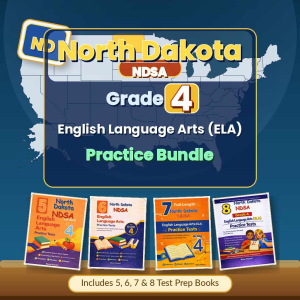 North Dakota Grade 4 ELA Preparation Bundle
 8 North Dakota NDSA English Language Arts (ELA) Grade 4: Full Practice Tests
 7 North Dakota NDSA English Language Arts (ELA) Grade 4: Full Practice Tests
 6 North Dakota NDSA English Language Arts (ELA) Grade 4: Full Practice Tests
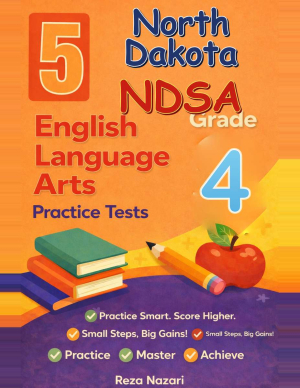 North Dakota NDSA ELA Grade 4: 5 Full Practice Tests
More Grade 4 resources
A USEFUL NEXT STEP
North Dakota Grade 4 English: study questions
Can readers suggest different themes?
Yes, when each interpretation is supported by the text’s events. Explain the evidence and avoid a theme that contradicts them.
Where are the complete North Dakota Grade 4 requirements?
NDDPI’s current English Language Arts page links the June 2023 K–12 standards. The document organizes literacy through foundations, communication, reading, writing, and inquiry/research; foundations apply through Grade 6, while later grades extend reading, writing, communication, and inquiry. Selected references here use the state document’s own grade and strand codes. Read the school’s complete course sequence alongside the full standards rather than treat one activity as an entire literacy program.
Official source ↗Resources from Effortless Math · Editorial standards