


LEARN · PRACTICE · EXPLORE
North Carolina Grade 4 English
Use specific details to describe a character’s habits and choices in an original Grade 4 story, with North Carolina English references and practice.
State resources · Focused study · Clear next steps
What do North Carolina 4th graders learn in ELA?
In 4th grade, North Carolina English language arts centers on theme and summary, text structure, figurative language, and multi-paragraph essays. Students take the EOG grade 4 ELA test in the spring. This page explains each North Carolina grade 4 ELA standard and pairs it with printable worksheets and a full-length practice test.
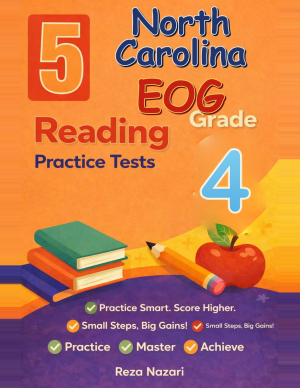
Printable North Carolina grade 4 ELA books:
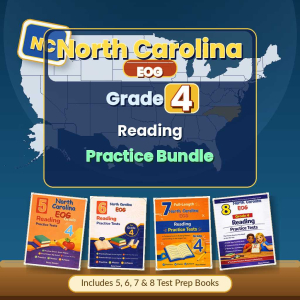
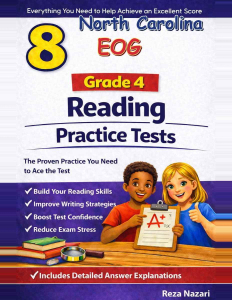
North Carolina EOG Grade 4 Reading: Test Facts
North Carolina 4th graders take the End-of-Grade (EOG) test in reading during the last ten days of the school year. Results are reported in four achievement levels; Level 3 or higher is grade-level proficient, and Levels 4 and 5 are on track for college and career readiness.
| Test | North Carolina End-of-Grade, Grade 4 Reading |
|---|---|
| When | Last ten days of the school year |
| Format | Online (paper only for a documented accessibility need) |
| Time | Most students finish in about 120 minutes; up to 180 minutes allowed, in one school day |
Achievement levels
| Level | What it means |
|---|---|
| Level 5 | Comprehensive understanding; on track for college and career readiness |
| Level 4 | Thorough understanding; on track for college and career readiness |
| Level 3 | Sufficient understanding; grade-level proficient |
| Not Proficient | Inconsistent understanding |
Practice on this page: North Carolina standards
Facts from the North Carolina Department of Public Instruction, checked November 23, 2026: NCDPI: End-of-Grade Tests Assessment Brief (2025–26); NCDPI: 2024–25 Technical Guide for Accountability and Testing Results (achievement levels); NCDPI: End-of-Grade (EOG) tests.
All 39 North Carolina Grade 4 English Language Arts Standards
Every Grade 4 standard in North Carolina’s 2017 English Language Arts Standard Course of Study, grouped by strand. The 2017 standards stay in place through 2026–2027; the 2026 standards start in 2027–2028. The Grade 4 EOG reading test measures these standards. Open a strand to see its standards.
Reading: Literature (9)
| RL.4.1 | Refer to details and examples in a text when explaining what the text says explicitly and when drawing inferences from the text. |
|---|---|
| RL.4.2 | Determine a theme of a story, drama, or poem from details in the text; summarize the text. |
| RL.4.3 | Describe in depth a character, setting, or event in a story or drama, drawing on specific details in the text. |
| RL.4.4 | Determine the meaning of words and phrases as they are used in a text, including words that affect meaning and tone. |
| RL.4.5 | Explain major differences between poems, drama, and prose, and refer to the structural elements of poems and drama when writing or speaking about a text. |
| RL.4.6 | Compare and contrast the point of view from which different stories are narrated, including the difference between first- and third-person narrations. |
| RL.4.7 | Make connections between the text of a story or drama and a visual or oral presentation of the text, identifying where each version reflects specific descriptions and directions in the text. |
| RL.4.9 | Compare and contrast the use of similar themes and topics and patterns of events in stories, myths, and traditional literature from different cultures. |
| RL.4.10 | By the end of grade 4, read and understand literature within the 4-5 text complexity band proficiently and independently for sustained periods of time. Connect prior knowledge and experiences to text. |
Reading: Informational Text (10)
| RI.4.1 | Refer to details and examples in a text when explaining what the text says explicitly and when drawing inferences from the text. |
|---|---|
| RI.4.2 | Determine the main idea of a text and explain how it is supported by key details; summarize the text. |
| RI.4.3 | Explain events, procedures, ideas, or concepts in a historical, scientific, or technical text, including what happened and why, based on specific information in the text. |
| RI.4.4 | Determine the meaning of general academic and domain-specific words or phrases in a text relevant to a grade 4 topic or subject area. |
| RI.4.5 | Describe the overall structure of events, ideas, concepts, or information in a text or part of a text. |
| RI.4.6 | Compare and contrast a firsthand and secondhand account of the same event or topic; describe the differences in focus and the information provided. |
| RI.4.7 | Interpret information presented visually, orally, or quantitatively and explain how the information contributes to an understanding of the text in which it appears. |
| RI.4.8 | Explain how an author uses reasons and evidence to support particular points in a text. |
| RI.4.9 | Integrate information from two texts on the same topic in order to write or speak about the subject knowledgeably. |
| RI.4.10 | By the end of grade 4, read and understand informational texts within the 4-5 text complexity band proficiently and independently for sustained periods of time. Connect prior knowledge and experiences to text. |
Reading: Foundational Skills (3)
| RF.4.2 | Create readable documents through legible handwriting (cursive). |
|---|---|
| RF.4.4 | Know and apply grade-level phonics and word analysis skills in decoding words. |
| RF.4.5 | Read with sufficient accuracy and fluency to support comprehension. |
Writing (6)
| W.4.1 | Write opinion pieces on topics or texts, supporting a point of view with reasons and information. |
|---|---|
| W.4.2 | Write informative /explanatory texts to examine a topic and convey ideas and information clearly. |
| W.4.3 | Write narratives to develop real or imagined experiences or events using effective technique, descriptive details, and clear event sequences. |
| W.4.4 | With some guidance and support from adults, use digital tools and resources to produce and publish writing as well as to interact and collaborate with others; demonstrate sufficient command of word processing skills. |
| W.4.5 | Conduct short research projects that build knowledge through investigation of different aspects of a topic. |
| W.4.6 | Recall relevant information from experiences or gather relevant information from print and digital sources; take notes and categorize information, and provide a list of sources. |
Speaking and Listening (5)
| SL.4.1 | Engage effectively in a range of collaborative discussions (one-on-one, in groups, and teacher-led) with diverse partners on grade 4 topics and texts, building on others’ ideas and expressing their own clearly. |
|---|---|
| SL.4.2 | Paraphrase portions of a text read aloud or information presented in diverse media and formats, including visually, quantitatively, and orally. |
| SL.4.3 | Identify the reasons and evidence a speaker provides to support particular points. |
| SL.4.4 | Report on a topic or text, tell a story, or recount an experience in an organized manner, using appropriate facts and relevant, descriptive details to support main ideas or themes; adjust speech as appropriate to formal and informal discourse. |
| SL.4.5 | Add audio recordings and visual displays to presentations when appropriate to enhance the development of main ideas or themes. |
Language (6)
| L.4.1 | Demonstrate command of the conventions of standard English grammar and usage when writing or speaking; demonstrate proficiency within the 4-5 grammar continuum. |
|---|---|
| L.4.2 | Demonstrate command of the conventions of standard English capitalization, punctuation, and spelling when writing; demonstrate proficiency within the 4-5 conventions continuum. |
| L.4.3 | Use knowledge of language and its conventions when writing, speaking, reading, or listening. |
| L.4.4 | Determine and/or clarify the meaning of unknown and multiple-meaning words and phrases based on grade 4 reading and content, choosing flexibly from a range of strategies: context clues, word parts, word relationships, and reference materials. |
| L.4.5 | Demonstrate understanding of figurative language and nuances in word meanings. |
| L.4.6 | Acquire and use accurately grade-appropriate general academic and domain-specific words and phrases,. |
Codes and wording from the NCDPI 2017 ELA Standard Course of Study (main statement; lettered parts are in the official document). Checked November 23, 2026: NCDPI: 2017 English Language Arts Standard Course of Study; NCDPI: ELA Standard Course of Study and supporting resources (2026 standards start in 2027–2028).
Standards source: North Carolina adopted content standards.
Describe a Character in Depth
Use specific details to describe a character’s habits and choices in an original Grade 4 story, with North Carolina English references and practice. Use this focused activity alongside the school’s wider reading, writing, speaking, listening, and language sequence.
Curriculum reference: 2017 North Carolina English Language Arts Standard Course of Study, from the North Carolina English Language Arts standards page.
North Carolina Grade 4 references for this activity
NCDPI identifies the 2017 English Language Arts Standard Course of Study as the current instructional reference for 2026–2027. Its newly adopted 2026 standards begin implementation in 2027–2028. The selected references here use the current 2017 document; consult the school’s wider reading, writing, speaking, listening, and language sequence and check the state resources page when planning for the transition.
| Selected North Carolina reading reference | Activity focus | State-linked standards document |
|---|---|---|
| RL.4.3 | Describe a character in depth using specific story details | Read the state-linked document (PDF page 8) |
These selected reference labels identify an activity focus, with the correct grade and PDF page linked separately. Read the complete standards selected by the school and its learning sequence, including reading, writing, language, speaking, and listening. This short original example does not fulfill the entire curriculum or establish a student’s grade-level proficiency.
The last piece of the display
This original classroom example is separate from official assessment questions.
Inez tested each cardboard panel before the exhibition opened. When one corner bent, she put a spare strip behind it and tested again. “It looks fine from here,” said Theo. Inez walked to the other side. “The visitors will stand there, too.” She found that the label was hidden by the strip. She moved the label and asked Theo to read it from the doorway. Only then did she put away the tape.
Try the activity
Describe Inez in depth using at least three specific details. Explain what her actions suggest about how she works and whom she considers. Which broad claim about her would go beyond this scene?
Follow the reasoning
Inez works carefully and checks a repair’s effects rather than stop when it looks acceptable from one position. Testing each panel and retesting the bent corner show attention to stability. Walking to the visitor side reveals concern for another reader’s viewpoint. Moving the hidden label and asking Theo to read from the doorway show that she checks communication as well as appearance. These details build a description of her approach in this scene. Saying she is always perfect or never overlooks anything goes further: the label becomes hidden during her own repair, and the text shows her noticing and correcting that problem.
Notice what needs more practice
A character trait is an interpretation supported by actions and words, not a fact obtained from a label such as “careful.” Explain how each detail supports the description. The scene does not identify a career, a diagnosis, or a lifelong personality. These fictional details address one selected literary-analysis skill.
Grade 4 English worksheets
Choose printable practice that matches the skill being taught. Check the task, reading difficulty, and directions before assigning it; the collection is independently published.
Use the next session to build independence
- Choose several details from different moments.
- Connect each detail with a supported description.
- State the scene’s limits and avoid absolute claims.
Find a teacher-selected longer story in which the same character makes another choice. Add or revise the description using evidence from both scenes. Explain any change rather than force all details into one adjective.
For more general reading and writing resources, visit the Grade 4 English Online Center.
North Carolina Grade 4 English: useful planning questions
Can one scene prove a character always behaves a certain way?
No. Describe the behavior supported by this scene and use further evidence before making a broader claim.
Which standards does the school use?
NCDPI identifies the 2017 English Language Arts Standard Course of Study as the current instructional reference for 2026–2027. Its newly adopted 2026 standards begin implementation in 2027–2028. The selected references here use the current 2017 document; consult the school’s wider reading, writing, speaking, listening, and language sequence and check the state resources page when planning for the transition. The school’s sequence also includes reading, writing, speaking, listening, and language work beyond this example.
Sources checked October 6, 2026. NCDPI’s March 2026 assessment brief describes reading EOG tests in Grades 3–8, including Grade 4. This is a scope reference, not a claim about every 2026–2027 administration detail. Confirm current school directions, the learner’s assigned assessment pathway, and accommodations. Read the March 2026 EOG assessment brief (PDF), NCDPI assessment briefs page, and current and upcoming ELA standards resources. Independently published practice has its own directions and scoring. Its result does not predict a state performance level, and this original activity is not an official assessment item.
Grade 4 English in other states
When moving between school systems, compare the official curriculum and the school’s learning sequence. Use the national Online Center’s map to find another state’s resources.
Recommended North Carolina Grade 4 resources
Build a Strong North Carolina Grade 4 EOG English Practice Library
These independently published resources have their own coverage and editions. Check the contents alongside North Carolina’s current English standards before choosing assessment preparation.
Use these North Carolina Grade 4 resources for reading comprehension, language, writing, and full-length practice where available. Click any cover to open the resource page.
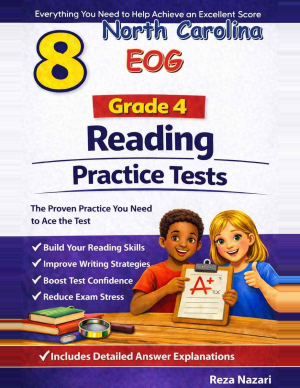
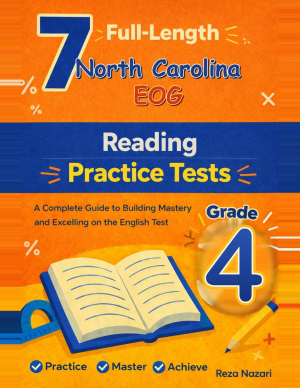
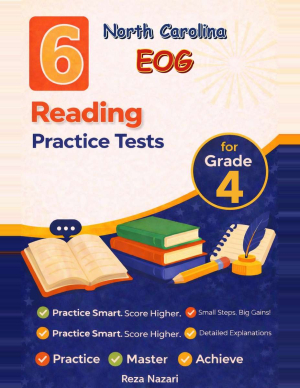
More Grade 4 resources
North Carolina Grade 4 English: 10-Question Challenge
Ten questions on reading, grammar, vocabulary, and writing for North Carolina 4th graders, each with a short explanation.
They rested because they were tired. The context shows the meaning.
Put a comma after an introductory phrase: After lunch, we played soccer.
Choose another state
Grade 4 English in Every State
Select a state on the map to open its Grade 4 English page. You are viewing North Carolina.
All states A–Z
A USEFUL NEXT STEP
North Carolina Grade 4 English: study questions
Can one scene prove a character always behaves a certain way?
No. Describe the behavior supported by this scene and use further evidence before making a broader claim.
Where are the complete North Carolina Grade 4 requirements?
NCDPI identifies the 2017 English Language Arts Standard Course of Study as the current instructional reference for 2026–2027. Its newly adopted 2026 standards begin implementation in 2027–2028. The selected references here use the current 2017 document; consult the school’s wider reading, writing, speaking, listening, and language sequence and check the state resources page when planning for the transition.
Official source ↗Resources from Effortless Math · Editorial standards