LEARN · PRACTICE · EXPLORE
California Grade 4 English
Compare a pupil’s firsthand account with a school report and read a collection table. Includes a worked response and California Grade 4 reading references.
State resources · Focused study · Clear next steps
What do California 4th graders learn in ELA?
In 4th grade, California English language arts centers on theme and summary, text structure, figurative language, and multi-paragraph essays. Students take the CAASPP grade 4 ELA test in the spring. This page explains each California grade 4 ELA standard and pairs it with short lessons, printable worksheets and a full-length practice test.
Printable California grade 4 ELA books:
- California CAASPP ELA Grade 4: 5 Full Practice Tests
- 6 California CAASPP English Language Arts (ELA) Grade 4: Full Practice Tests
- 7 California CAASPP English Language Arts (ELA) Grade 4: Full Practice Tests
- 8 California CAASPP English Language Arts (ELA) Grade 4: Full Practice Tests
- California Grade 4 ELA Preparation Bundle
Standards source: Content Standards, California Department of Education.
Separate what a witness noticed from what a report explains
A person at an event and a person reporting on it may focus on different details. Neither account becomes complete just because it sounds confident. Use this invented school collection to compare the information each gives, then check a small table before writing a response.
Curriculum source: California Common Core State Standards for ELA/Literacy (modified March 2013), from the California Department of Education resource directory.
California Grade 4 references for this activity
California’s official English language arts document contains the Grade 4 expectations across its subject strands. These are two selected references for the activity below; use the full document for curriculum planning.
| California code | Activity focus | Official requirement |
|---|---|---|
| RI.4.6 | Accounts and their focus | Read the state document, page 21 |
| RI.4.7 | Table and text together | Read the state document, page 22 |
California additions are marked CA in the official document. The labels here identify the activity’s focus; they do not reproduce the complete requirements. For teaching support, consult the state ELA/ELD Framework.
A worked Grade 4 reading and writing activity
This original classroom example is separate from official assessment questions.
Pupil’s account: “I carried our class’s box to the collection table. It felt heavy, and I saw another class arrive just after us.” School report: “Three classes collected supplies for the art room. The school office counted 18 packs from Class A, 12 from Class B, and 15 from Class C.”
| Class | Supply packs |
|---|---|
| A | 18 |
| B | 12 |
| C | 15 |
Try the activity
Identify the firsthand account and the secondhand account, explaining the clues. Read the collection table. Write a short comparison that includes one detail unique to each account and one fact supported by the table.
Follow the reasoning
The pupil describes carrying the box and seeing another class, which places that speaker at the collection. The report summarizes counts recorded by the school office rather than describing a personal experience. The table shows that Class A collected more packs than either B or C, and all three collected 45 in total. A useful comparison connects personal experience with the broader count. It does not assume the pupil belongs to Class A; the account never says which class the speaker represents.
Notice what needs more practice
Firsthand does not mean perfectly accurate, and secondhand does not mean unreliable. Ask what each account can establish and what it leaves unanswered. The pupil’s feeling that a box was heavy cannot tell us how many packs it held. The table supplies quantities, but it cannot tell us how carrying the box felt.
Grade 4 English worksheets
Choose printable practice that matches the skill being taught. Check the task, reading difficulty, and directions before assigning it; the collection is independently published.
Use the next session to build independence
- Mark the actions that show the pupil was present.
- Underline the report’s counted details and match them to the table.
- Write the comparison, then remove any class identity or observation the sources do not establish.
Try the same distinction with an age-appropriate diary excerpt and a later historical account chosen by the teacher. Record who produced each source, when, and what information it contributes. Return to the actual text whenever a claim begins to depend on an assumption.
For more general reading and writing resources, visit the Grade 4 English Online Center.
California Grade 4 English: useful planning questions
Is a firsthand account always the better source?
It depends on the question. A witness can describe a personal experience, while a report may combine information the witness did not have. Compare the evidence each offers rather than choosing by source type alone.
Where are the complete state requirements?
California’s official English language arts document contains the Grade 4 expectations across its subject strands. These are two selected references for the activity below; use the full document for curriculum planning. The school’s sequence also includes reading, writing, speaking, listening, and language work beyond this example.
State sources checked October 5, 2026. Grade 4 is within the Smarter Balanced summative ELA testing range. This original lesson is independent practice. Read the official assessment overview and use the school’s guidance for preparation.
Grade 4 English in other states
When moving between school systems, compare the official curriculum and the school’s learning sequence. Use the national Online Center’s map to find another state’s resources.
Recommended California Grade 4 resources
Build a Strong California Grade 4 CAASPP English Practice Library
Use these California Grade 4 resources for reading comprehension, language, writing, and full-length practice where available. Click any cover to open the resource page.
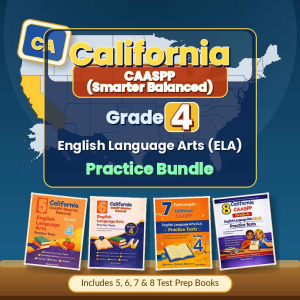 California Grade 4 ELA Preparation Bundle
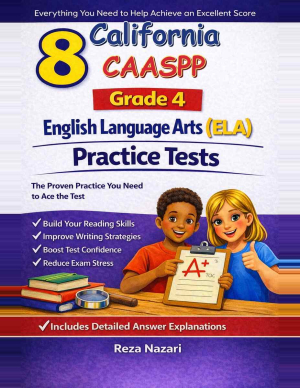 8 California CAASPP English Language Arts (ELA) Grade 4: Full Practice Tests
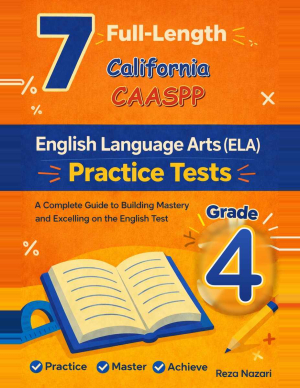 7 California CAASPP English Language Arts (ELA) Grade 4: Full Practice Tests
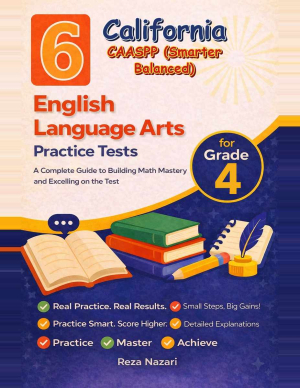 6 California CAASPP English Language Arts (ELA) Grade 4: Full Practice Tests
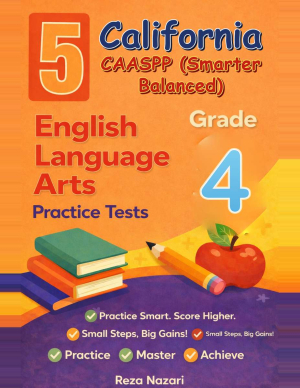 California CAASPP ELA Grade 4: 5 Full Practice Tests
A USEFUL NEXT STEP
California Grade 4 English: study questions
Is a firsthand account always the better source?
It depends on the question. A witness can describe a personal experience, while a report may combine information the witness did not have. Compare the evidence each offers rather than choosing by source type alone.
Where are the complete California Grade 4 requirements?
California’s official English language arts document contains the Grade 4 expectations across its subject strands. These are two selected references for the activity below; use the full document for curriculum planning.
Official source ↗Resources from Effortless Math · Editorial standards