LEARN · PRACTICE · EXPLORE
West Virginia Grade 6 Math
West Virginia Grade 6 Math: explore grade-level lessons, worksheets, and learning references. Check the curriculum source and choose practice for your next skill.
Focused lessons · Useful practice · Clear next steps
Standards source: College- and Career-Readiness Standards, West Virginia Department of Education.
Start With a WVGSA Practice Test
Six full, timed West Virginia WVGSA Grade 6 math practice tests, 40 questions each, instant scoring, a topic-by-topic breakdown, and full step-by-step solutions. Each one opens right here in a popup. Calculator: Scientific calculator.
WVGSA Practice Test 1
A full diagnostic across every West Virginia Grade 6 math topic.
Start Test 1 →
WVGSA Practice Test 2
Fresh questions and problem types to build accuracy.
Start Test 2 →
WVGSA Practice Test 3
New problems to add speed and confidence on every skill.
Start Test 3 →
WVGSA Practice Test 4
Another complete, timed exam to build pacing and stamina.
Start Test 4 →
WVGSA Practice Test 5
A brand-new mixed set to test your readiness.
Start Test 5 →
WVGSA Practice Test 6
A final full-length simulation to confirm you are ready.
Start Test 6 →
West Virginia Grade 6 Math Study Tools
A few minutes of quick review, flip through flashcards or scan every key formula. Both open right here.
West Virginia Grade 6 Math Skill Quizzes
Short, focused quizzes, pick one skill, answer 10 questions, get instant scoring and full solutions, then jump to the matching lesson. Each opens right here.
Ratios, Rates & Proportions
A quick 10-question check on Ratios, Rates & Proportions with instant scoring and step-by-step solutions.
Start Quiz →
Fractions & Decimals
A quick 10-question check on Fractions & Decimals with instant scoring and step-by-step solutions.
Start Quiz →
Integers & the Coordinate Plane
A quick 10-question check on Integers & the Coordinate Plane with instant scoring and step-by-step solutions.
Start Quiz →
Factors, Multiples & Percents
A quick 10-question check on Factors, Multiples & Percents with instant scoring and step-by-step solutions.
Start Quiz →
Expressions, Equations & Inequalities
A quick 10-question check on Expressions, Equations & Inequalities with instant scoring and step-by-step solutions.
Start Quiz →
Geometry: Area, Surface Area & Volume
A quick 10-question check on Geometry: Area, Surface Area & Volume with instant scoring and step-by-step solutions.
Start Quiz →
Statistics & Data
A quick 10-question check on Statistics & Data with instant scoring and step-by-step solutions.
Start Quiz →
Mixed Grade 6 Review
A quick 10-question check on Mixed Grade 6 Review with instant scoring and step-by-step solutions.
Start Quiz →
West Virginia WVGSA Grade 6 Math Snapshot
West Virginia Grade 6 Math Topics
Student-friendly Grade 6 math skills connected to the West Virginia standards, each tagged with its WVGSA standard code and a focused lesson.
Ratios And Proportional Relationships
- M.6.1Understanding RatiosWorksheetsQuiz
- M.6.2Writing Ratios in Different FormsWorksheetsQuiz
- M.6.3Equivalent RatiosWorksheetsQuiz
- M.6.3Ratio TablesWorksheetsQuiz
- M.6.2Unit RatesWorksheetsQuiz
- M.6.2Comparing Unit RatesWorksheetsQuiz
- M.6.3Solving Ratio ProblemsWorksheetsQuiz
- M.6.3Proportions and Cross MultiplicationWorksheetsQuiz
The Number System, Fractions
- M.6.7Simplifying FractionsWorksheetsQuiz
- M.6.4Adding Fractions with Unlike DenominatorsWorksheetsQuiz
- M.6.4Subtracting Fractions with Unlike DenominatorsWorksheetsQuiz
- M.6.6Adding and Subtracting Mixed NumbersWorksheetsQuiz
- M.6.4Multiplying FractionsWorksheetsQuiz
- M.6.7Multiplying Mixed NumbersWorksheetsQuiz
- M.6.4Dividing FractionsWorksheetsQuiz
- M.6.4Dividing Mixed NumbersWorksheetsQuiz
The Number System, Decimals
- M.6.6Decimal Place ValueWorksheetsQuiz
- M.6.10Comparing and Ordering DecimalsWorksheetsQuiz
- M.6.6Adding and Subtracting DecimalsWorksheetsQuiz
- M.6.6Multiplying DecimalsWorksheetsQuiz
- M.6.7Dividing Decimals by Whole NumbersWorksheetsQuiz
- M.6.6Dividing Decimals by DecimalsWorksheetsQuiz
- M.6.4Converting Fractions to DecimalsWorksheetsQuiz
- M.6.4Converting Decimals to Fractions (resource currently unavailable)WorksheetsQuiz
The Number System, Integers And The Coordinate Plane
- M.6.8Understanding Positive and Negative NumbersWorksheetsQuiz
- M.6.9Integers on a Number LineWorksheetsQuiz
- M.6.10Opposites and Absolute ValueWorksheetsQuiz
- M.6.10Comparing and Ordering IntegersWorksheetsQuiz
- M.6.11Graphing on the Coordinate PlaneWorksheetsQuiz
- M.6.11Reflecting Points on the Coordinate PlaneWorksheetsQuiz
The Number System, Factors And Multiples
Ratios And Percents
Expressions And Equations
- M.6.13Writing Algebraic ExpressionsWorksheetsQuiz
- M.6.13Evaluating Algebraic ExpressionsWorksheetsQuiz
- M.6.12Order of OperationsWorksheetsQuiz
- M.6.14The Distributive PropertyWorksheetsQuiz
- M.6.14Combining Like TermsWorksheetsQuiz
- M.6.3Writing Equations from Word ProblemsWorksheetsQuiz
- M.6.20Solving One-Step Addition and Subtraction EquationsWorksheetsQuiz
- M.6.4Solving One-Step Multiplication and Division EquationsWorksheetsQuiz
- M.6.19Writing and Graphing InequalitiesWorksheetsQuiz
- M.6.19Solving One-Step InequalitiesWorksheetsQuiz
Geometry, Area
Geometry, 3D Figures, Surface Area, And Volume
Statistics
- M.6.25Statistical QuestionsWorksheetsQuiz
- M.6.26MeanWorksheetsQuiz
- M.6.26Median and ModeWorksheetsQuiz
- M.6.25RangeWorksheetsQuiz
- M.6.25Mean Absolute DeviationWorksheetsQuiz
- M.6.28Dot PlotsWorksheetsQuiz
- M.6.28HistogramsWorksheetsQuiz
- M.6.28Box PlotsWorksheetsQuiz
- M.6.26Summarizing and Describing DistributionsWorksheetsQuiz
Best West Virginia WVGSA Grade 6 Math Books
Each book has a job: start from scratch, drill weak skills, or build pacing with full tests. All of them pair with the free tools on this page.
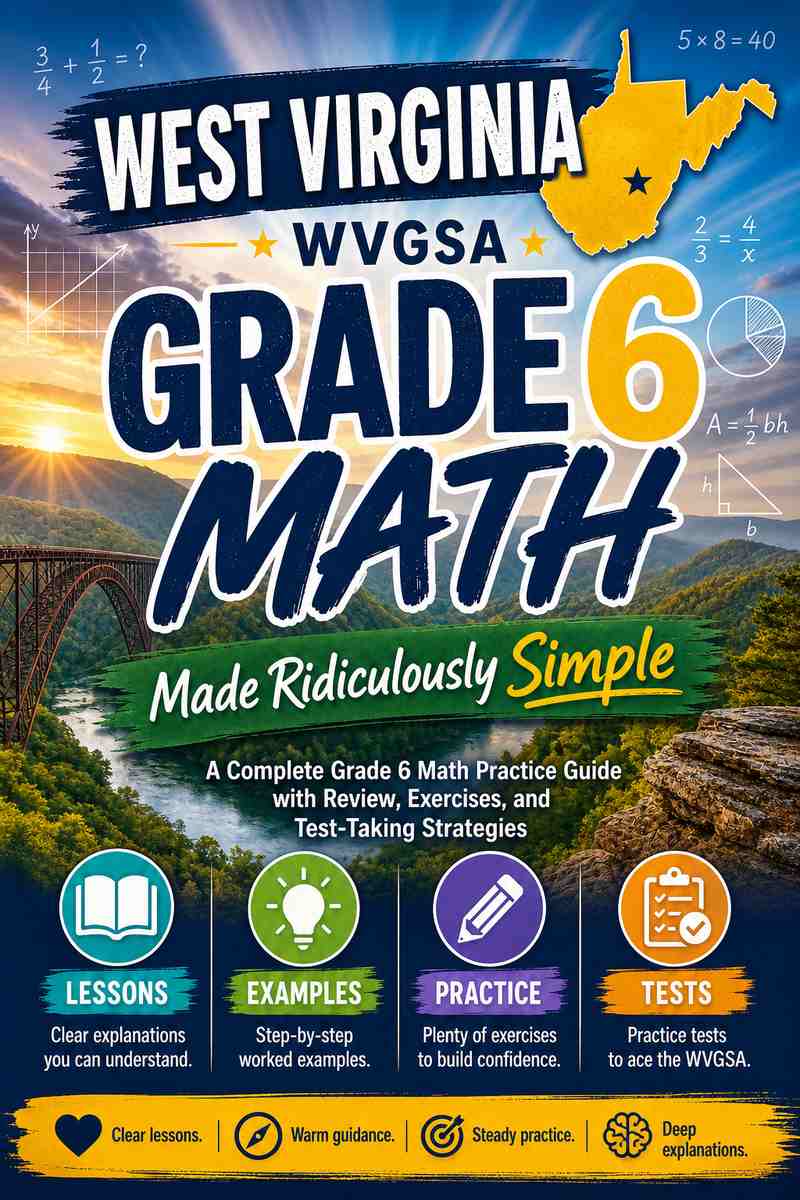
West Virginia WVGSA Grade 6 Math Made Ridiculously Simple
A step-by-step WVGSA Grade 6 math book that rebuilds every tested skill clearly and in order, built to match the West Virginia standards.
- Best starting point for the WVGSA math test
- Pairs with West Virginia flashcards and worksheets
- Use it before full timed practice tests
- Organized for students who need examples before drills
Step-by-step lessons
Short explanations show the move before the student practices it.
✍Worked examples
Examples translate WVGSA-style wording into clear math steps.
Targeted practice
Rebuild one skill at a time instead of jumping around.
Test-day bridge
After each topic, connect to formulas, flashcards, and practice questions.
How to use it
- Read one lesson and copy the worked example.
- Do a short worksheet set on the same topic.
- Review the matching flashcards or formulas.
- Try a mixed quiz and mark every miss.
Pair it with free tools
Choose the right West Virginia Grade 6 math book
West Virginia WVGSA Grade 6 Math Made Ridiculously Simple
Start here to rebuild WVGSA math from the ground up.
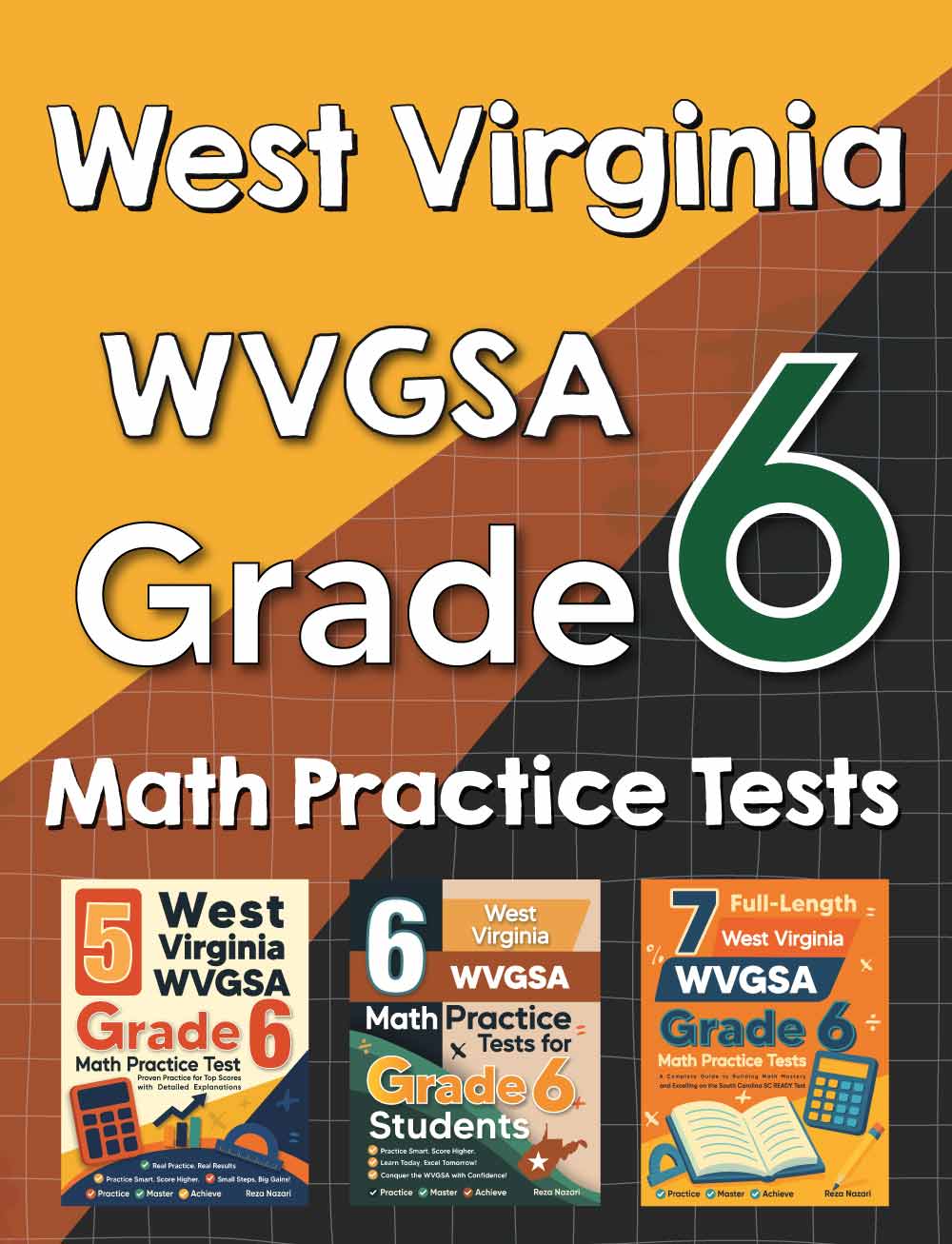
West Virginia WVGSA Grade 6 Math Preparation Bundle
The full prep library, study guide, workbook, and practice tests together.
7 West Virginia WVGSA Grade 6 Math Practice Tests
Use after topic review to build pacing and test stamina.
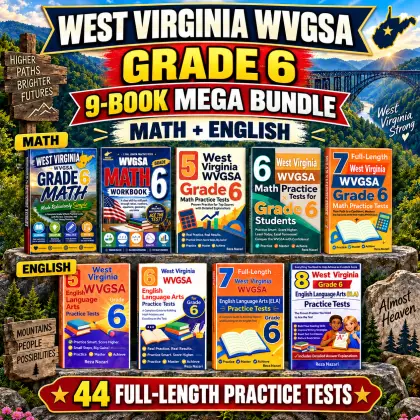
West Virginia WVGSA Grade 6 Math & ELA Mega Bundle
9 books and 44 full-length practice tests in one TPT bundle.
West Virginia Grade 6 Math Standards
The official West Virginia Grade 6 math standards, grouped by domain with the exact code and description for each expectation.
M.6
- M.6.1Understand the concept of a ratio and use ratio language to describe a ratio relationship between two quantities (e.g., "The ratio of wings to beaks in the bird house at the zoo was 2:1, because for every 2 wings there was 1 beak." "For every vote candidate A received, candidate C received nearly three votes.")
- M.6.2Understand the concept of a unit ratea/bassociated with a ratioa:bwithb≠ 0 and use rate language in the context of a ratio relationship (e.g., "This recipe has a ratio of 3 cups of flour to 4 cups of sugar, so there is3/4cup of flour for each cup of sugar." "We paid $75 for 15 hamburgers, which is a rate of $5 per hamburger.")
- M.6.3Use ratio and rate reasoning to solve real-world and mathematical problems, e.g., by reasoning about tables of equivalent ratios, tape diagrams, double number line diagrams, or equations
- M.6.4Interpret and compute quotients of fractions and solve word problems involving division of fractions by fractions by using visual fraction models and equations to represent the problem (e.g., create a story context for (2/3) ÷ (3/4) and use a visual fraction model to show the quotient; use the relationship between multiplication and division to explain that (2/3) ÷ (3/4) =8/9because3/4of8/9is2/3. [In general, (a/b) ÷ (c/d) =ad/be.] How much chocolate will each person get if 3 people share ½ lb or11/2lb of chocolate equally? How many3/4-cup servings are in2/3of a cup or5/3of a cup of yogurt? How wide is a rectangular strip of land with length3/4mi and area1/2square mi?)
- M.6.5Fluently (efficiently and accurately) divide multi-digit numbers using the standard algorithm
- M.6.6Fluently (efficiently and accurately) add, subtract, multiply and divide multi-digit decimals using the standard algorithm for each operation
- M.6.7Find the greatest common factor of two whole numbers less than or equal to 100 and the least common multiple of two whole numbers less than or equal to 12. Use the distributive property to express a sum of two whole numbers 1 to 100 with a common factor as a multiple of a sum of two whole numbers with no common factor (e.g., express 36 + 8 as 4 (9 + 2))
- M.6.8Understand that positive and negative numbers are used together to describe quantities having opposite directions or values (e.g., temperature above/below zero, elevation above/below sea level, credits/debits, positive/negative electric charge); use positive and negative numbers to represent quantities in real-world contexts, explaining the meaning of 0 in each situation
- M.6.9Understand a rational number as a point on the number line. Extend number line diagrams and coordinate axes familiar from previous grades to represent points on the line and in the plane with negative number coordinates
- M.6.10Understand ordering and absolute value of rational numbers
- M.6.11Solve real-world and mathematical problems by graphing points in all four quadrants of the coordinate plane. Include use of coordinates and absolute value to find distances between points with the same first coordinate or the same second coordinate
- M.6.12Write and evaluate numerical expressions involving whole-number exponents
- M.6.13Write, read and evaluate expressions in which letters stand for numbers
- M.6.14Apply the properties of operations to generate equivalent expressions (e.g., apply the distributive property to the expression 3 (2 +x) to produce the equivalent expression 6 + 3x; apply the distributive property to the expression 24x+ 18yto produce the equivalent expression 6 (4x+ 3y); apply properties of operations toy+y+yto produce the equivalent expression 3y)
- M.6.15Identify when two expressions are equivalent; i.e., when the two expressions name the same number regardless of which value is substituted into them (e.g., the expressionsy+y+yand 3yare equivalent because they name the same number regardless of which numberystands for)
- M.6.16Understand solving an equation or inequality as a process of answering a question: which values from a specified set, if any, make the equation or inequality true? Use substitution to determine whether a given number in a specified set makes an equation or inequality true
- M.6.17Use variables to represent numbers and write expressions when solving a real-world or mathematical problem; understand that a variable can represent an unknown number or depending on the purpose at hand, any number in a specified set
- M.6.18Solve real-world and mathematical problems by writing and solving
- M.6.19Write and identify an inequality of the formx>c,x<c,x≥c, orx≤c, to represent a constraint or condition in a real-world or mathematical problem. Recognize that inequalities of the formx>c,x<c,x≥c, orx≤c, have infinitely many solutions; represent solutions of such inequalities on number line diagrams
- M.6.20Use variables to represent two quantities in a real-world problem that change in relationship to one another; write an equation to express one quantity, thought of as the dependent variable, in terms of the other quantity, thought of as the independent variable. Analyze the relationship between the dependent and independent variables using graphs and tables, and relate these to the equation (e.g., in a problem involving motion at constant speed, list and graph ordered pairs of distances and times; write the equationd= 65tto represent the relationship between distance and time)
- M.6.21Find the area of right triangles, other triangles, special quadrilaterals and polygons by composing into rectangles or decomposing into triangles and other shapes; apply these techniques in the context of solving real-world and mathematical problems
- M.6.22Find the volume of a right rectangular prism with fractional edge lengths by packing it with unit cubes of the appropriate unit fraction edge lengths and show that the volume is the same as would be found by multiplying the edge lengths of the prism. Apply the formulas V =lwhand V = Bhto find volumes of right rectangular prisms with fractional edge lengths in the context of solving real-world and mathematical problems
- M.6.23Draw polygons in the coordinate plane given coordinates for the vertices; use coordinates to find the length of a side joining points with the same first coordinate or the same second coordinate. Apply these techniques in the context of solving real-world and mathematical problems
- M.6.24Represent three-dimensional figures using nets made up of rectangles and triangles and use the nets to find the surface area of these figures. Apply these techniques in the context of solving real-world and mathematical problems
- M.6.25Recognize a statistical question as one that anticipates variability in the data related to the question and accounts for it in the answers (e.g., "How old am I?" is not a statistical question, but "How old are the students in my school?" is a statistical question because one anticipates variability in students' ages)
- M.6.26Through informal observation, understand that a set of data collected to answer a statistical question has a distribution which can be described by its center (mean/median), spread (range), and overall shape
- M.6.27Recognize that a measure of center for a numerical data set summarizes all of its values with a single number
- M.6.28Display numerical data in plots on a number line, including dot plots, histograms, and box plots
- M.6.29Summarize numerical data sets in relation to their context, such as by:
Standards: West Virginia College- and Career-Readiness Standards. Official source ↗
West Virginia WVGSA Grade 6 Math FAQ
What is the WVGSA Grade 6 math test?
The WVGSA (West Virginia General Summative Assessment) is West Virginia's Grade 6 mathematics assessment. The linked activities are independent Grade 6 practice. Their question count, timer, scoring, and item types may differ from the official assessment. Use the directions inside each activity.
Can I use a calculator?
Calculator rules depend on the grade, assessment, test segment, and approved accommodations. Follow the current assessment guidance and ask your school which rules apply. A tool available in independent practice does not establish permission on the official test.
How long is each practice test?
Read the timer and question count shown in the practice activity you open. These are practice settings, not a statement of the official assessment’s duration or scoring.
Is it free?
The linked general practice and topic resources are available separately from optional books. Check each activity’s directions and access requirements. The study guide and bundle are optional next steps.
Grade 6 Math in Other States
Explore Grade 6 math standards, practice tests, and worksheets for every state.
- Alabama
- Alaska
- Arizona
- Arkansas
- California
- Colorado
- Connecticut
- Delaware
- Florida
- Georgia
- Hawaii
- Idaho
- Illinois
- Indiana
- Iowa
- Kansas
- Kentucky
- Louisiana
- Maine
- Maryland
- Massachusetts
- Michigan
- Minnesota
- Mississippi
- Missouri
- Montana
- Nebraska
- Nevada
- New Hampshire
- New Jersey
- New Mexico
- New York
- North Carolina
- North Dakota
- Ohio
- Oklahoma
- Oregon
- Pennsylvania
- Rhode Island
- South Carolina
- South Dakota
- Tennessee
- Texas
- Utah
- Vermont
- Virginia
- Washington
- Wisconsin
- Wyoming
- District of Columbia
Make This Your West Virginia WVGSA Starting Point
Take a timed practice test, find your weakest topic, and study it with the linked lessons, worksheets, and the WVGSA study guide.
Start a practice testA USEFUL NEXT STEP
West Virginia Grade 6 Math: study questions
How should I choose a Grade 6 math study target?
Choose a current classroom target, find the matching learning reference, and use a lesson or available practice resource to check understanding. State documents control local wording and placement; shared reference codes are not a certified crosswalk.
Are these activities official state assessments?
These are independently published learning resources. A practice score does not predict or replace an official state score. Use the directions in each activity and consult your school for official testing and accommodation rules.
Resources from Effortless Math · Editorial standards