Price discrimination requires separation and limited resale
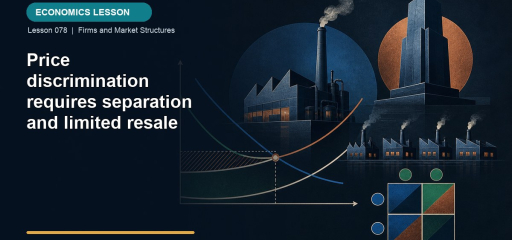
Price discrimination requires separation and limited resale: this Effortless Math guide explains the topic in plain language, shows how it works through solved examples, and gives you free practice to try immediately, so the idea sticks instead of staying abstract.
Different elasticities allow different markups.
Successful price discrimination requires market power, identifiable buyer groups, and
- constant marginal cost
- government ownership
- a perfectly elastic demand curve
- free entry
- limits on resale between groups
limits on resale between groups If low-price buyers can resell to high-price buyers, the price differences collapse. Separation and resale limits are therefore necessary.
A movie theater charges lower prices to students when resale is impossible. This is most directly an example of
- first-degree price discrimination
- third-degree price discrimination
- peak-load pricing only
- average-cost regulation
- two-part tariff pricing
third-degree price discrimination The theater separates an observable group with different demand and charges that group a distinct price.
A cinema can verify student status, prevent ticket resale, and observes that students are more price sensitive than other adults. Which pricing plan can increase profit through separation?
- Charge students more than adults
- Offer a lower verified student price
- Set one price equal to marginal cost for everyone
- Allow unrestricted resale
- Charge each group its average cost
Offer a lower verified student price A lower price for the more elastic student group can expand sales without forcing the same discount for less elastic buyers. Verification separates the groups, and resale control prevents low-price tickets from being transferred to the high-price market.
Watch the idea in action
A focused video lesson from Alvin Chiang.
Price discrimination charges different prices not explained by cost. It requires market power, a way to identify or sort buyers, and limited resale. A firm charges a higher markup to a group with less elastic demand. Student discounts, advance-purchase fares, and quantity pricing can fit the idea when cost differences do not explain the price.
Cost-based price differences are not discrimination in the economic definition. Charging more to deliver a heavy package farther may reflect added cost. Charging two otherwise similar buyers different markups because one group has fewer alternatives is discrimination. The question normally states that cost differences do not explain the prices.
Market separation prevents low-price buyers from reselling to high-price buyers. Identification can use age, purchase timing, location, coupons, or self-selection through product versions. Without separation, arbitrage undermines the price difference by moving units from the low-price group to the high-price group.
For third-degree discrimination, the firm allocates output so marginal revenue is equal across groups and equals common marginal cost. The less elastic group receives the higher markup. This is the inverse-elasticity logic: buyers with fewer alternatives reduce quantity less in response to price.
Perfect first-degree discrimination charges each unit at willingness to pay. Output expands until demand meets MC, eliminating deadweight loss in the ideal model while transferring consumer surplus to the seller. Imperfect discrimination can increase or decrease output relative to single pricing. Do not assume every discrimination scheme is efficient.
Under perfect discrimination, each buyer pays a unit-specific reservation price. There is no single price that must be lowered on earlier units, so the seller captures the area under demand above MC. Output reaches Q_e, where the next buyer’s willingness to pay equals marginal cost. Efficiency rises while distribution shifts strongly toward the seller.
| Pricing method | Output tendency | Surplus implication |
|---|---|---|
| Single price | Q_m<Q_e |
Profit plus deadweight loss |
| Perfect first degree | Q_e |
Seller captures nearly all surplus. No static DWL |
| Third degree | Separate group prices | Higher markup to less elastic group. Efficiency depends on total output |
| Second degree | Price varies with quantity or version | Buyers self-select. Outcome depends on schedule |
Why resale matters
An airline charges business travelers more than vacation travelers for the same seat when cost is equal. Advance-purchase and change restrictions help separate the groups. If vacation travelers could freely resell tickets to business travelers, the low fare would undermine the high-fare market.
Price discrimination can expand service to low-value buyers by using revenue from high-markup groups, but it can also reallocate output or reduce some groups’ consumption. Without information about total output and cost, do not claim it always raises or lowers welfare.
The economics exam often tests conditions rather than welfare: market power, ability to separate, different elasticities, and limited resale. An answer missing any one can be incomplete.
Self-selection can separate buyers without asking their identity. Refund restrictions, versions, coupons, and quantity blocks induce people with different values or flexibility to choose different offers. The price difference is discriminatory only to the extent it exceeds relevant cost differences.
If arbitrage is easy, low-price buyers resell to the high-price group and collapse the scheme. This is why services, personalized tickets, and time-sensitive products are common examples. Market power is also essential. A price taker cannot maintain group-specific markups against identical rivals.

Reza is an experienced Math instructor and a test-prep expert who has been tutoring students since 2008. He has helped many students raise their standardized test scores--and attend the colleges of their dreams. He works with students individually and in group settings, he tutors both live and online Math courses and the Math portion of standardized tests. He provides an individualized custom learning plan and the personalized attention that makes a difference in how students view math.
Related to This Article
More math articles
- SSAT Upper Level Math Flashcards (Free Online: Formulas, Terms & Concepts)
- Free Grade 3 English Worksheets for North Dakota Students
- Media as a Social Institution
- Use current concentration thresholds cautiously
- How to Teach Math in Elementary Grades
- Free Grade 5 English Worksheets for Rhode Island Students
- The Muscular System
- CLEP U.S. History I 056: Roads, Canals, Steamboats, Railroads, and Telegraph
- The Ultimate ACCUPLACER Math Formula Cheat Sheet
- Total revenue follows elasticity






















What people say about "Price Discrimination Needs Separation"?
No one replied yet.