LEARN · PRACTICE · EXPLORE
Washington Grade 5 English
Explain how a narrator’s viewpoint affects an account. Follow an original Grade 5 reading activity and a selected reference from Washington’s adopted 2026 English standards.
Focused lessons · Useful practice · Clear next steps
What do Washington 5th graders learn in ELA?
In 5th grade, Washington English language arts centers on comparing texts, quoting accurately, point of view, and essays supported with evidence. Students take the Smarter Balanced (SBA) grade 5 ELA test in the spring. This page explains each Washington grade 5 ELA standard and pairs it with short lessons and printable worksheets.
Printable Washington grade 5 ELA books:
- 5 Washington Smarter Balanced English Language Arts (ELA) Grade 5: Full Practice Tests
- 6 Washington Smarter Balanced English Language Arts (ELA) Grade 5: Full Practice Tests
- 7 Washington Smarter Balanced English Language Arts (ELA) Grade 5: Full Practice Tests
- 8 Washington Smarter Balanced English Language Arts (ELA) Grade 5: Full Practice Tests
- Washington Grade 5 ELA Preparation Bundle
Standards source: Washington adopted content standards.
Trace How a Narrator Shapes a Scene
Explain how a narrator’s viewpoint affects an account. Work through the short reading below, explain your response, and try the skill in a fuller classroom text. The selected reference comes from the adopted 2026 standards; the school’s implementation sequence matters during the transition.
Curriculum reference: Washington State Learning Standards for English Language Arts, adopted 2026, from the Washington English language arts standards page.
Washington Grade 5 references for this activity
Washington OSPI’s English directory links the adopted 2026 standards. The PDF records adoption on August 6, 2026. OSPI says educators can explore, learn about, and begin using them in 2026–27, with required use with students in 2027–28. Ask the school which sequence it is following during that transition. The selected Grade 5 indicator on this page is a focus for this original activity, not a complete curriculum or a certification of every independent resource.
| Selected Washington reading reference | Activity focus | State-linked standards document |
|---|---|---|
| ELA.5.R.4.g | Explain how a narrator’s viewpoint affects an account | Read the state-linked document (PDF page 48) |
These selected reference labels identify an activity focus, with the correct grade and PDF page linked separately. Read the complete standards selected by the school and its learning sequence, including reading, writing, language, speaking, and listening. This short original example does not fulfill the entire curriculum or establish a student’s grade-level proficiency.
Waiting for the reading turn
This original classroom example is separate from official assessment questions.
I watched the clock while Sam read the last paragraph. Every sentence seemed to take forever. My own page was ready, and I had practiced its first line three times. When Sam paused to find his place, I tightened my grip on the paper. Finally, the teacher nodded to me. I began so quickly that I nearly skipped my opening word.
Try the activity
Identify the narrator’s viewpoint and explain how it shapes the description of Sam’s reading. Which details suggest eagerness or impatience? Does “forever” establish an actual reading time?
Follow the reasoning
The first-person narrator is waiting to read and is strongly focused on getting a turn. Watching the clock, having a practiced opening ready, tightening a grip during Sam’s pause, and beginning quickly support eagerness with impatience. From that viewpoint, Sam’s sentences seem to take “forever.” The phrase conveys the narrator’s experience of waiting; it is not a measured duration or proof that Sam reads unusually slowly. The narration gives direct access to the waiting reader’s actions and impressions, while Sam’s thoughts are not supplied. Explain how the perspective colors an event before judging the other character’s performance.
Notice what needs more practice
This scene is invented. The narrator’s account does not establish what Sam feels or whether he has read accurately. A different narrator could describe the same pause differently. That possibility is a comparison for discussion, not missing information that can be asserted as fact.
Grade 5 English worksheets
Choose printable practice that matches the skill being taught. Check the task, reading difficulty, and directions before assigning it; the collection is independently published.
Use the next session to build independence
- Identify who tells the scene.
- Link the waiting reader’s impressions with particular details.
- Explain what the viewpoint reveals and what it leaves unknown.
Read a fuller story with a clear narrator. Explain how the viewpoint affects which details receive attention and how events are described. Rewrite one sentence from another character’s possible view, clearly marking that sentence as an imagined comparison.
For more general reading and writing resources, visit the Grade 5 English Online Center.
Washington Grade 5 English: useful planning questions
Can a narrator’s description be meaningful without being a measurement?
Yes. Language can convey a character’s experience. Distinguish that meaning from a literal claim about elapsed time or another character’s thoughts.
Which standards does the school use?
Washington OSPI’s English directory links the adopted 2026 standards. The PDF records adoption on August 6, 2026. OSPI says educators can explore, learn about, and begin using them in 2026–27, with required use with students in 2027–28. Ask the school which sequence it is following during that transition. The selected Grade 5 indicator on this page is a focus for this original activity, not a complete curriculum or a certification of every independent resource. The school’s sequence also includes reading, writing, speaking, listening, and language work beyond this example.
Sources checked October 6, 2026. OSPI’s state-testing overview lists Smarter Balanced English and mathematics in Grades 3–8 and 10. Grade 5 is included in that listed English range; follow current school directions and accommodations. OSPI distinguishes standards implementation from assessment updates: changes for new media-literacy, digital-citizenship, and data-science standards are planned no earlier than 2028–29, beginning with pilots. This does not establish a changed current test format, timing, or item count. Read the Washington English assessment overview, English standards guidance, and standards and assessment transition guidance. Independently published practice has its own directions and scoring. Its result does not predict a state performance level, and this original activity is not an official assessment item.
Grade 5 English in other states
When moving between school systems, compare the official curriculum and the school’s learning sequence. Use the national Online Center’s map to find another state’s resources.
Recommended Washington Grade 5 resources
Choose Washington Grade 5 English practice resources
These independently published resources have their own coverage and editions. Check the contents alongside Washington’s current English standards before choosing assessment preparation.
Use these Washington Grade 5 resources for reading comprehension, language, writing, and full-length practice where available. Click any cover to open the resource page.
 Washington Grade 5 ELA Preparation Bundle
 8 Washington Smarter Balanced English Language Arts (ELA) Grade 5: Full Practice Tests
 7 Washington Smarter Balanced English Language Arts (ELA) Grade 5: Full Practice Tests
 6 Washington Smarter Balanced English Language Arts (ELA) Grade 5: Full Practice Tests
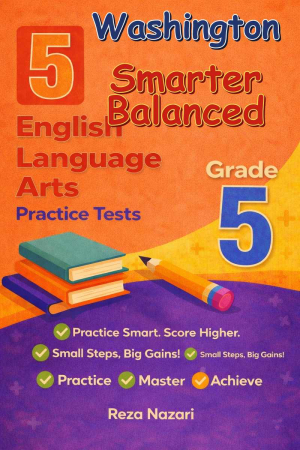 5 Washington Smarter Balanced English Language Arts (ELA) Grade 5: Full Practice Tests
More Grade 5 resources
A USEFUL NEXT STEP
Washington Grade 5 English: study questions
Can a narrator’s description be meaningful without being a measurement?
Yes. Language can convey a character’s experience. Distinguish that meaning from a literal claim about elapsed time or another character’s thoughts.
Where are the complete Washington Grade 5 requirements?
Washington OSPI’s English directory links the adopted 2026 standards. The PDF records adoption on August 6, 2026. OSPI says educators can explore, learn about, and begin using them in 2026–27, with required use with students in 2027–28. Ask the school which sequence it is following during that transition. The selected Grade 5 indicator on this page is a focus for this original activity, not a complete curriculum or a certification of every independent resource.
Official source ↗Resources from Effortless Math · Editorial standards