LEARN · PRACTICE · EXPLORE
California Grade 5 English
Find two main ideas in an invented school-garden proposal, match evidence to each point, and explain what the evidence cannot prove. California references included.
Focused lessons · Useful practice · Clear next steps
What do California 5th graders learn in ELA?
In 5th grade, California English language arts centers on comparing texts, quoting accurately, point of view, and essays supported with evidence. Students take the CAASPP grade 5 ELA test in the spring. This page explains each California grade 5 ELA standard and pairs it with short lessons and printable worksheets.
Printable California grade 5 ELA books:
- 5 California CAASPP English Language Arts (ELA) Grade 5: Full Practice Tests
- 6 California CAASPP English Language Arts (ELA) Grade 5: Full Practice Tests
- 7 California CAASPP English Language Arts (ELA) Grade 5: Full Practice Tests
- 8 California CAASPP English Language Arts (ELA) Grade 5: Full Practice Tests
- California Grade 5 ELA Preparation Bundle
Standards source: Content Standards, California Department of Education.
Track two main ideas and the evidence supporting a proposal
A passage can develop more than one important idea. Students sometimes select the most memorable number and call it the main idea, or list evidence without explaining which point it supports. This short proposal gives readers two connected issues to keep separate: learning opportunities and ongoing care.
Curriculum source: California Common Core State Standards for ELA/Literacy (modified March 2013), from the California Department of Education resource directory.
California Grade 5 references for this activity
California’s official English language arts document contains the Grade 5 expectations across its subject strands. These are two selected references for the activity below; use the full document for curriculum planning.
| California code | Activity focus | Official requirement |
|---|---|---|
| RI.5.2 | Two main ideas | Read the state document, page 21 |
| RI.5.8 | Evidence for specific points | Read the state document, page 22 |
California additions are marked CA in the official document. The labels here identify the activity’s focus; they do not reproduce the complete requirements. For teaching support, consult the state ELA/ELD Framework.
A worked Grade 5 reading and writing activity
This original classroom example is separate from official assessment questions.
A school garden could give classes a place to record plant changes. During a six-week container trial, pupils made drawings and measurements every Friday. Teachers used those records for writing and discussion. A larger garden would also need regular care. In the trial, two watering turns were missed when the responsible group was absent. The proposal suggests a backup group and a shared care chart before adding more containers.
Try the activity
Write one main idea for each part of the proposal. Select a detail supporting each idea. Then explain why the six-week trial supports a modest proposal but does not prove that a larger garden will work without extra planning.
Follow the reasoning
One main idea is that a garden can support observation and classroom learning. The Friday records and their use in writing and discussion support that point. Another is that expanding the garden requires a dependable care plan. The missed watering turns support the need for a backup group. The proposed chart is a response to the problem, not evidence that the problem has already been solved. A summary should include both the learning opportunity and the care requirement.
Notice what needs more practice
“Pupils measured plants” is a detail, not a summary of the whole passage. “Gardens are the best way to teach every subject” goes beyond the evidence. Ask students to put each quoted or paraphrased detail beside the exact point it supports. If a detail supports neither point, decide whether it belongs in the response.
Grade 5 English worksheets
Choose printable practice that matches the skill being taught. Check the task, reading difficulty, and directions before assigning it; the collection is independently published.
Use the next session to build independence
- Divide notes into learning opportunities and care needs.
- Match each detail to a point and explain the connection in a sentence.
- Write a brief summary and distinguish the trial’s observations from the plan’s untested solution.
Choose a longer informational text with two developed ideas. Keep a separate evidence column for each one. When discussing a proposal, ask what has been observed, what is suggested, and what would need to be checked next. Students can disagree with a proposal while still summarizing it accurately.
For more general reading and writing resources, visit the Grade 5 English Online Center.
California Grade 5 English: useful planning questions
Can a proposed solution count as evidence that it works?
A proposal tells us what someone wants to try. Evidence of success requires information about what happened when it was tried. In this passage, the care chart is a suggested next step, not a tested result.
Where are the complete state requirements?
California’s official English language arts document contains the Grade 5 expectations across its subject strands. These are two selected references for the activity below; use the full document for curriculum planning. The school’s sequence also includes reading, writing, speaking, listening, and language work beyond this example.
State sources checked October 5, 2026. Grade 5 is within the Smarter Balanced summative ELA testing range. This original lesson is independent practice. Read the official assessment overview and use the school’s guidance for preparation.
Grade 5 English in other states
When moving between school systems, compare the official curriculum and the school’s learning sequence. Use the national Online Center’s map to find another state’s resources.
Recommended California Grade 5 resources
Build a Strong California Grade 5 CAASPP English Practice Library
Use these California Grade 5 resources for reading comprehension, language, writing, and full-length practice where available. Click any cover to open the resource page.
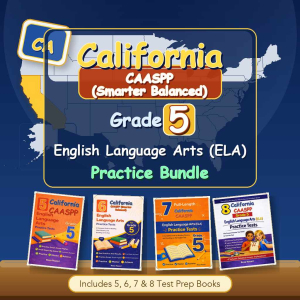 California Grade 5 ELA Preparation Bundle
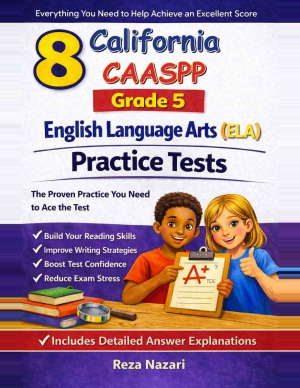 8 California CAASPP English Language Arts (ELA) Grade 5: Full Practice Tests
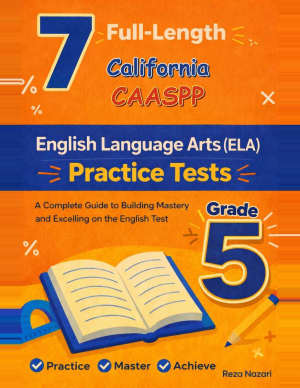 7 California CAASPP English Language Arts (ELA) Grade 5: Full Practice Tests
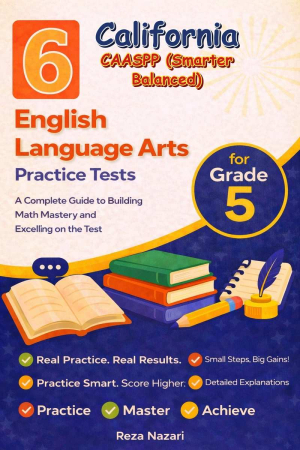 6 California CAASPP English Language Arts (ELA) Grade 5: Full Practice Tests
 5 California CAASPP English Language Arts (ELA) Grade 5: Full Practice Tests
A USEFUL NEXT STEP
California Grade 5 English: study questions
Can a proposed solution count as evidence that it works?
A proposal tells us what someone wants to try. Evidence of success requires information about what happened when it was tried. In this passage, the care chart is a suggested next step, not a tested result.
Where are the complete California Grade 5 requirements?
California’s official English language arts document contains the Grade 5 expectations across its subject strands. These are two selected references for the activity below; use the full document for curriculum planning.
Official source ↗Resources from Effortless Math · Editorial standards