LEARN · PRACTICE · EXPLORE
New York Grade 5 English
Analyze how a narrator’s perspective shapes an original Grade 5 story, distinguish actions from assumptions, and find New York English practice and references.
Focused lessons · Useful practice · Clear next steps
What do New York 5th graders learn in ELA?
In 5th grade, New York English language arts centers on comparing texts, quoting accurately, point of view, and essays supported with evidence. Students take the New York State grade 5 ELA test in the spring. This page explains each New York grade 5 ELA standard and pairs it with short lessons, printable worksheets and a full-length practice test.
Printable New York grade 5 ELA books:
- 5 New York NYSTP English Language Arts (ELA) Grade 5: Full Practice Tests
- 6 New York NYSTP English Language Arts (ELA) Grade 5: Full Practice Tests
- 7 New York NYSTP English Language Arts (ELA) Grade 5: Full Practice Tests
- 8 New York NYSTP English Language Arts (ELA) Grade 5: Full Practice Tests
- New York Grade 5 ELA Preparation Bundle
Standards source: New York adopted content standards.
Narrator’s Point of View
Analyze how a narrator’s perspective shapes an original Grade 5 story, distinguish actions from assumptions, and find New York English practice and references. Use this focused activity alongside the school’s wider reading, writing, speaking, listening, and language sequence.
Curriculum reference: 2017 New York State Next Generation English Language Arts Learning Standards, from the New York English Language Arts standards page.
New York Grade 5 references for this activity
New York’s English Language Arts page links the 2017 Next Generation ELA Learning Standards. The state’s implementation timeline places Pre-K–8 instruction under those standards from September 2022, with Grades 3–8 assessment first aligned in Spring 2023. The selected reading references below identify this activity’s focus; use the complete grade requirements and the school’s broader literacy program.
| Selected New York reading reference | Activity focus | State-hosted standards document |
|---|---|---|
| 5R1 | Use details to support inferences | Read the state-hosted document (PDF page 65) |
| 5R6 | Explain a narrator’s influence on how events are described | Read the state-hosted document (PDF page 65) |
These selected reference labels identify an activity focus, with the correct grade and PDF page linked separately. Read the complete standards selected by the school and its learning sequence, including reading, writing, language, speaking, and listening. This short original example does not fulfill the entire curriculum or establish a student’s grade-level proficiency.
The sign I thought nobody noticed
This original classroom example is separate from official assessment questions.
I spent lunch painting the welcome sign for our class exhibition. When Eli passed the table without saying anything, I thought he disliked it. I almost covered the blue lettering. Before I did, he returned carrying a stand. “I measured the sign so this will fit,” he said. He set it upright near the doorway. Visitors stopped to read it as they entered. I had noticed his silence, but I had not noticed him measuring.
Try the activity
Who tells the story? How does the narrator’s first interpretation shape our view of Eli? Identify the later detail that changes that interpretation. Does the story give Eli’s private thoughts?
Follow the reasoning
The sign’s painter tells the story using first-person words such as “I.” We initially learn about Eli through what that narrator notices and assumes: he passes silently, and the narrator interprets silence as dislike. His return with a measured stand offers a different explanation of his behavior. The narrator’s final sentence acknowledges an observation that was missed, which helps readers reconsider the initial interpretation. We hear Eli’s stated reason for measuring and see what he does, but do not receive direct access to all his thoughts. The perspective creates a brief misunderstanding and then a revision. It influences the order in which we encounter evidence; the same actions might seem less puzzling if narrated from Eli’s position.
Notice what needs more practice
Silence does not prove dislike, and bringing a stand does not establish every opinion Eli has about the lettering. The text supports a practical intention to display the sign, using his words and action. Distinguish the narrator’s feeling or assumption from a fact about another character. This passage is original fiction, not a report of a school exhibition.
Grade 5 English worksheets
Choose printable practice that matches the skill being taught. Check the task, reading difficulty, and directions before assigning it; the collection is independently published.
Use the next session to build independence
- Identify the narrator and what the narrator notices.
- Separate an observation from its initial interpretation.
- Explain how the later detail changes the reader’s understanding.
Rewrite a short part from Eli’s point of view, marking any added thoughts as your own fictional choices. Compare what each narrator could know. Then use a teacher-selected story to trace how a narrator’s perspective affects the way an event is described.
For more general reading and writing resources, visit the Grade 5 English Online Center.
New York Grade 5 English: useful planning questions
Does first-person narration tell us what every character thinks?
No. It gives the narrator’s perspective. Use another character’s words and actions carefully, and label interpretations that go beyond them.
Which standards does the school use?
New York’s English Language Arts page links the 2017 Next Generation ELA Learning Standards. The state’s implementation timeline places Pre-K–8 instruction under those standards from September 2022, with Grades 3–8 assessment first aligned in Spring 2023. The selected reading references below identify this activity’s focus; use the complete grade requirements and the school’s broader literacy program. The school’s sequence also includes reading, writing, speaking, listening, and language work beyond this example.
Sources checked October 6, 2026. The 2026–2027 NYSED schedule places Grades 3–8 ELA, including Grade 5, in an April 5–May 14, 2027 window. Each school sets its grade/subject administration dates within that window; ELA uses two consecutive school days. Confirm the learner’s assigned pathway, accommodations, and current school directions. Read the official 2026–2027 testing schedule (PDF), NYSED schedules page, ELA standards page, and instruction and assessment implementation timeline (PDF). Independently published practice has its own directions and scoring. Its result does not predict a state performance level, and this original activity is not an official assessment item.
Grade 5 English in other states
When moving between school systems, compare the official curriculum and the school’s learning sequence. Use the national Online Center’s map to find another state’s resources.
Recommended New York Grade 5 resources
Build a Strong New York Grade 5 NYSTP English Practice Library
These independently published resources have their own coverage and editions. Check the contents alongside New York’s current English standards before choosing assessment preparation.
Use these New York Grade 5 resources for reading comprehension, language, writing, and full-length practice where available. Click any cover to open the resource page.
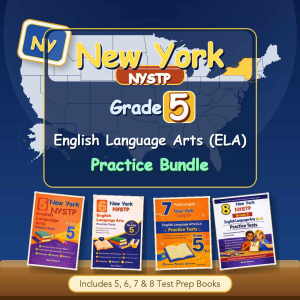 New York Grade 5 ELA Preparation Bundle
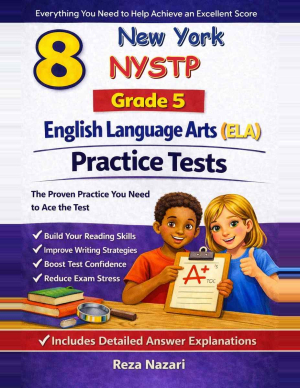 8 New York NYSTP English Language Arts (ELA) Grade 5: Full Practice Tests
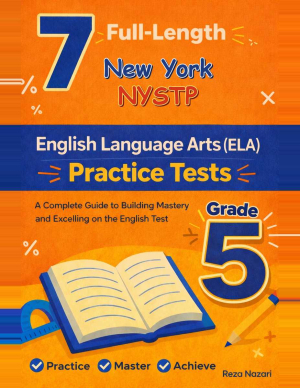 7 New York NYSTP English Language Arts (ELA) Grade 5: Full Practice Tests
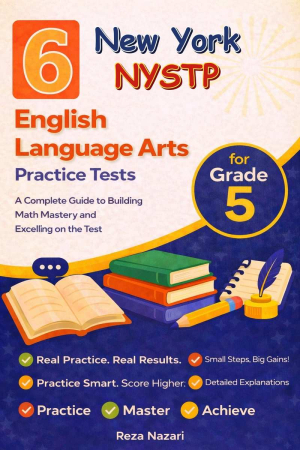 6 New York NYSTP English Language Arts (ELA) Grade 5: Full Practice Tests
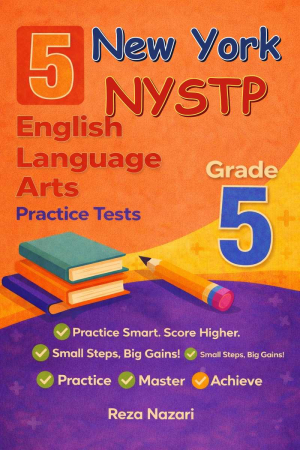 5 New York NYSTP English Language Arts (ELA) Grade 5: Full Practice Tests
More Grade 5 resources
A USEFUL NEXT STEP
New York Grade 5 English: study questions
Does first-person narration tell us what every character thinks?
No. It gives the narrator’s perspective. Use another character’s words and actions carefully, and label interpretations that go beyond them.
Where are the complete New York Grade 5 requirements?
New York’s English Language Arts page links the 2017 Next Generation ELA Learning Standards. The state’s implementation timeline places Pre-K–8 instruction under those standards from September 2022, with Grades 3–8 assessment first aligned in Spring 2023. The selected reading references below identify this activity’s focus; use the complete grade requirements and the school’s broader literacy program.
Official source ↗Resources from Effortless Math · Editorial standards