LEARN · PRACTICE · EXPLORE
Kansas Grade 5 English
Compare two original accounts of a rehearsal, trace differences in what the narrators know and emphasize, and study a selected Kansas Grade 5 literature expectation.
Focused lessons · Useful practice · Clear next steps
What do Kansas 5th graders learn in ELA?
In 5th grade, Kansas English language arts centers on comparing texts, quoting accurately, point of view, and essays supported with evidence. Students take the KAP grade 5 ELA test in the spring. This page explains each Kansas grade 5 ELA standard and pairs it with short lessons, printable worksheets and a full-length practice test.
Printable Kansas grade 5 ELA books:
- 5 Kansas KAP English Language Arts (ELA) Grade 5: Full Practice Tests
- 6 Kansas KAP English Language Arts (ELA) Grade 5: Full Practice Tests
- 7 Kansas KAP English Language Arts (ELA) Grade 5: Full Practice Tests
- 8 Kansas KAP English Language Arts (ELA) Grade 5: Full Practice Tests
- Kansas Grade 5 ELA Preparation Bundle
Standards source: Kansas English Language Arts, Kansas State Department of Education.
Explain how a narrator’s position changes the account of an event
Recognizing I or she is a useful start, but perspective involves more than pronouns. These original accounts describe one rehearsal from different positions. Compare what each narrator can report, what each emphasizes, and what remains unknown.
Curriculum reference: 2023 Kansas English Language Arts Standards, updated February 2025, from the Kansas State Department of Education standards directory.
Kansas Grade 5 references for this activity
Kansas’s current directory links the 2023 English Language Arts standards, updated February 2025. Read the Grade 5 expectations in the full state document. The selected reference supports this activity; use the school’s sequence and the remaining expectations for wider coverage.
| Grade-level expectation | Activity focus | Official requirement |
|---|---|---|
| RL.5.6 | Describe how a narrator’s or speaker’s point of view influences an account | Read the state document (PDF page 42) |
These are selected grade-level expectations from Kansas’s current English standards. Activity labels describe a teaching focus rather than reproduce complete requirements. Read the linked state document’s complete grade-level expectations, including its grade-specific details, alongside the school’s curriculum sequence.
A worked Grade 5 reading and writing activity
This original classroom example is separate from official assessment questions.
ACCOUNT A
I held the curtain rope while everyone waited. The knot looked secure, but my hands shook. When the curtain finally rose, I heard the first line and relaxed. I hoped nobody had noticed the delay.
ACCOUNT B
The students waited beside the stage. Lena checked the curtain rope and lifted the curtain after a pause. Omar began his first line. From the back row, a teacher watched the scene begin.
| Detail | Account A | Account B |
|---|---|---|
| Curtain pause | Experienced while holding the rope | Reported as an observable pause |
| Private worry | Narrator reports shaking and a hope | Not directly supplied |
| Other participants | First line is heard | Omar and a teacher are named |
Try the activity
How does the first narrator’s participation influence Account A? Compare one emphasized detail and one limit with Account B. Support the explanation with wording from both accounts rather than identify only first-person and third-person narration.
Follow the reasoning
Account A places the reader with the person holding the rope. That narrator reports shaking hands, relief, and a hope that the delay went unnoticed. The account emphasizes personal uncertainty during the pause. Account B names Lena’s visible action and places Omar and a teacher in the scene. It reports the pause without directly explaining Lena’s private worry. Both describe a curtain opening and a first line beginning, but the narration selects different details. The first account’s direct access to one participant’s feelings gives that experience prominence; the second supplies a wider set of observable actions.
Notice what needs more practice
Third-person narration does not automatically mean that a narrator knows every character’s thoughts. This short Account B does not reveal them. The first narrator’s hope that nobody noticed is not evidence that nobody did notice. Account B’s reference to a pause actually leaves room for others to have observed it. Do not call one account true and the other false merely because they differ in emphasis. A reader can describe the influence of perspective while acknowledging that neither miniature supplies a complete record of every person’s experience.
Grade 5 English worksheets
Choose printable practice that matches the skill being taught. Check the task, reading difficulty, and directions before assigning it; the collection is independently published.
Use the next session to build independence
- Identify each narrator’s position relative to the event.
- Compare details that position makes prominent.
- Support a perspective explanation and name a limit in what is known.
Rewrite Account B from Omar’s first-person position. Decide which feelings or thoughts you are inventing and keep the shared visible events consistent. Then ask a partner how that narrator’s role changes the account’s emphasis. Compare the new account with Lena’s rather than assume that both participants must feel the same thing. A later literary selection can offer richer evidence about reliability and a narrator’s choices. This short task develops the Kansas Grade 5 point-of-view expectation without claiming that identifying a pronoun alone completes it.
For more general reading and writing resources, visit the Grade 5 English Online Center.
Kansas Grade 5 English: useful planning questions
Does third-person narration always reveal every character’s thoughts?
No. Account B reports actions without revealing everyone’s thoughts. Explain what the actual narrator provides rather than assume unlimited knowledge.
Where are the complete state requirements?
Kansas’s current directory links the 2023 English Language Arts standards, updated February 2025. Read the Grade 5 expectations in the full state document. The selected reference supports this activity; use the school’s sequence and the remaining expectations for wider coverage. The school’s sequence also includes reading, writing, speaking, listening, and language work beyond this example.
Official sources checked October 6, 2026. Grade 5 is within the Kansas Assessment Program general summative English language arts testing range. This original lesson is independent practice. Read the Kansas assessment overview and use the school’s guidance for preparation. Read the 2026–27 Kansas assessment overview (PDF). Kansas’s 2026–27 assessment overview lists general summative English language arts and mathematics in Grades 3–8 and 10, and science in Grades 5, 8, and 11. The HGSS classroom-based assessment applies in Grades 4, 7, and one district-selected grade among 10, 11, and 12. The optional Grade 2 reading assessment is separate from the general summative ELA range. Eligible students use their assigned alternate-assessment pathway. Follow the school’s current assessment assignment, accommodations, and guidance; this classroom activity is independent practice and does not predict a state performance level. This site’s practice and books are independently published. Check their editions and contents against current standards and assessment guidance.
Grade 5 English in other states
When moving between school systems, compare the official curriculum and the school’s learning sequence. Use the national Online Center’s map to find another state’s resources.
Recommended Kansas Grade 5 resources
Build a Strong Kansas Grade 5 KAP English Practice Library
These independently published resources have their own coverage and editions. Check the contents alongside Kansas’s current English standards before choosing assessment preparation.
Use these Kansas Grade 5 resources for reading comprehension, language, writing, and full-length practice where available. Click any cover to open the resource page.
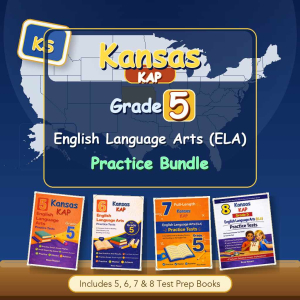 Kansas Grade 5 ELA Preparation Bundle
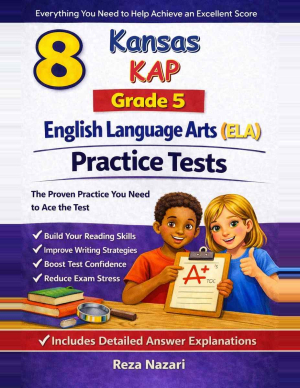 8 Kansas KAP English Language Arts (ELA) Grade 5: Full Practice Tests
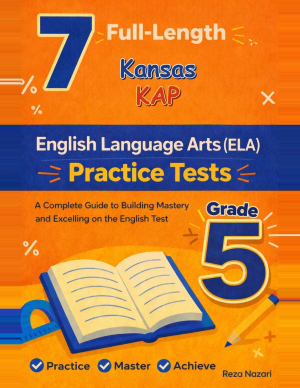 7 Kansas KAP English Language Arts (ELA) Grade 5: Full Practice Tests
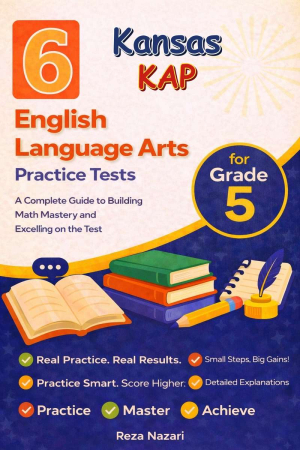 6 Kansas KAP English Language Arts (ELA) Grade 5: Full Practice Tests
 5 Kansas KAP English Language Arts (ELA) Grade 5: Full Practice Tests
More Grade 5 resources
A USEFUL NEXT STEP
Kansas Grade 5 English: study questions
Does third-person narration always reveal every character’s thoughts?
No. Account B reports actions without revealing everyone’s thoughts. Explain what the actual narrator provides rather than assume unlimited knowledge.
Where are the complete Kansas Grade 5 requirements?
Kansas’s current directory links the 2023 English Language Arts standards, updated February 2025. Read the Grade 5 expectations in the full state document. The selected reference supports this activity; use the school’s sequence and the remaining expectations for wider coverage.
Official source ↗Resources from Effortless Math · Editorial standards