LEARN · PRACTICE · EXPLORE
Michigan Grade 5 English
Trace two points in an original school-library proposal, connect each with supporting evidence, and find Michigan Grade 5 English learning resources.
Focused lessons · Useful practice · Clear next steps
What do Michigan 5th graders learn in ELA?
In 5th grade, Michigan English language arts centers on comparing texts, quoting accurately, point of view, and essays supported with evidence. Students take the M-STEP grade 5 ELA test in the spring. This page explains each Michigan grade 5 ELA standard and pairs it with short lessons, printable worksheets and a full-length practice test.
Printable Michigan grade 5 ELA books:
- 5 Michigan M-STEP English Language Arts (ELA) Grade 5: Full Practice Tests
- 6 Michigan M-STEP English Language Arts (ELA) Grade 5: Full Practice Tests
- 7 Michigan M-STEP English Language Arts (ELA) Grade 5: Full Practice Tests
- 8 Michigan M-STEP English Language Arts (ELA) Grade 5: Full Practice Tests
- Michigan Grade 5 ELA Preparation Bundle
Standards source: Michigan English Language Arts, Michigan Department of Education.
Connect each reason and piece of evidence with its point
A passage can support more than one point. Match each reason or example with the particular idea it helps explain.
Curriculum reference: Michigan K–12 English Language Arts Standards, from the Michigan Department of Education academic standards directory.
Michigan Grade 5 references for this activity
The state’s academic standards directory links the Michigan K–12 English Language Arts Standards, adopted by the State Board of Education in 2010. Read the individual Grade 5 requirements and the school’s sequence. These selected references support this activity; they do not cover the whole English curriculum.
| Grade-level expectation | Activity focus | Official requirement |
|---|---|---|
| RI.5.8 | Identify which reasons and evidence support particular points | Read the state framework (PDF page 14) |
| RI.5.1 | Accurate quotation supporting explanations | Read the state framework (PDF page 14) |
These are selected grade-level expectations from the currently linked Michigan English standards adopted in 2010. Activity labels describe a teaching focus rather than reproduce complete requirements. Read the linked state document’s complete grade-level expectations, including its grade-specific details, alongside the school’s curriculum sequence.
A worked Grade 5 reading and writing activity
This original classroom example is separate from official assessment questions.
The school library should label its return bins more clearly and place them nearer the entrance. Clear labels would help students choose the correct bin: in our invented one-week record, 14 of 40 returned books were placed in the wrong category. A closer location would also shorten the route for students returning a book before class. The present bins require a walk around two long tables, while the proposed spot is beside the doorway. The proposal does not claim that moving bins alone will teach everyone the categories.
Try the activity
Identify the two changes the author proposes. Match the evidence about misplaced books and the description of the walking route with the point each supports. Quote a short phrase accurately and explain the connection rather than simply copy the passage.
Follow the reasoning
The author proposes clearer labels and a location nearer the entrance. The 14 incorrectly categorized returns support the point that students need help choosing the correct bin; clearer labels are offered as a possible aid. The route around two tables supports the separate point that the current location makes returning a book less direct. A doorway location addresses that route. The closing sentence limits the proposal: moving the bins is not presented as a complete solution to category knowledge. A useful answer distinguishes these relationships, even though both points belong to one library proposal.
Notice what needs more practice
The figure 14 of 40 is about placement categories, not how long a walk takes. Using it as direct proof that the doorway route is shorter confuses the points. Likewise, a description of a shorter route does not show that every student will read a label correctly. The record is invented for the activity and does not establish conditions at a real Michigan school. Students should explain the author’s use of evidence while recognizing the proposal’s limited claims. Accurate quotations need surrounding explanation to support the analysis.
Grade 5 English worksheets
Choose printable practice that matches the skill being taught. Check the task, reading difficulty, and directions before assigning it; the collection is independently published.
Use the next session to build independence
- State each proposed change in your own words.
- Match a reason or record with its particular point.
- Quote briefly and explain how the evidence is used.
Suggest information that could help assess each proposal separately: a comparable record of category errors after clearer labels, and a measure of the two routes. Explain why those observations would address different questions. Do not invent successful results. Then read a teacher-selected informational text with several points and draw connections from each point to its reasons or evidence. A paragraph may support more than one idea, so check its actual wording before assigning it to a category. Keep this exercise alongside sustained reading and writing in the school’s Grade 5 sequence.
For more general reading and writing resources, visit the Grade 5 English Online Center.
Michigan Grade 5 English: useful planning questions
Does any number in a passage support every point the author makes?
No. Identify what the number measures and explain its connection with the particular point. Category errors do not directly measure walking distance.
Where are the complete state requirements?
The state’s academic standards directory links the Michigan K–12 English Language Arts Standards, adopted by the State Board of Education in 2010. Read the individual Grade 5 requirements and the school’s sequence. These selected references support this activity; they do not cover the whole English curriculum. The school’s sequence also includes reading, writing, speaking, listening, and language work beyond this example.
Sources checked October 6, 2026. The currently linked 2025–26 state guide identifies M-STEP English language arts and mathematics in Grades 3–7, including Grade 5. Follow the school’s current assigned assessment pathway and directions. Read the state assessment guide, PDF page 24, and MDE assessment updates for later guidance. Independently published practice may use its own timer, question count, and scoring; those features are not official administration specifications or a prediction of a state performance level. Use the complete standards and the school’s learning sequence to choose further reading, writing, speaking, listening, and language work. This original classroom activity is not an official assessment item.
Grade 5 English in other states
When moving between school systems, compare the official curriculum and the school’s learning sequence. Use the national Online Center’s map to find another state’s resources.
Recommended Michigan Grade 5 resources
Build a Strong Michigan Grade 5 M-STEP English Practice Library
These independently published resources have their own coverage and editions. Check the contents alongside Michigan’s current English standards before choosing assessment preparation.
Use these Michigan Grade 5 resources for reading comprehension, language, writing, and full-length practice where available. Click any cover to open the resource page.
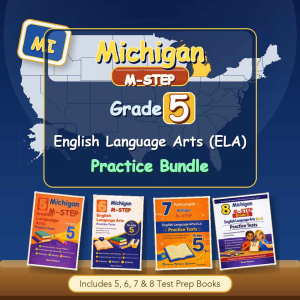 Michigan Grade 5 ELA Preparation Bundle
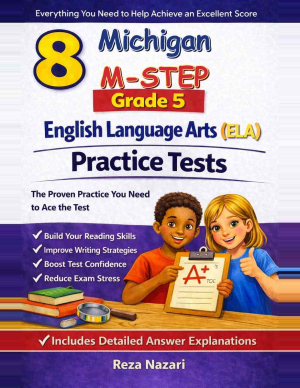 8 Michigan M-STEP English Language Arts (ELA) Grade 5: Full Practice Tests
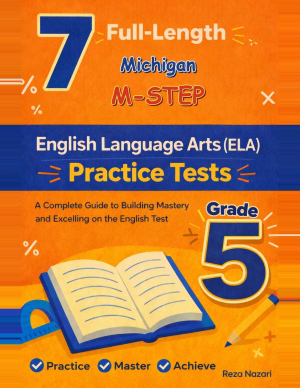 7 Michigan M-STEP English Language Arts (ELA) Grade 5: Full Practice Tests
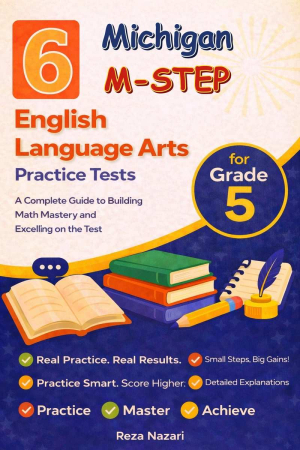 6 Michigan M-STEP English Language Arts (ELA) Grade 5: Full Practice Tests
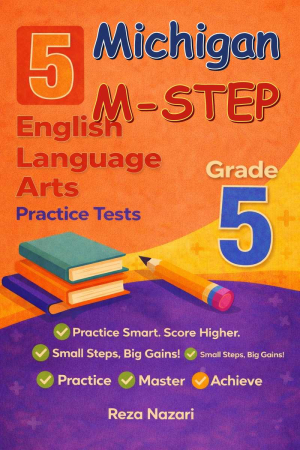 5 Michigan M-STEP English Language Arts (ELA) Grade 5: Full Practice Tests
More Grade 5 resources
A USEFUL NEXT STEP
Michigan Grade 5 English: study questions
Does any number in a passage support every point the author makes?
No. Identify what the number measures and explain its connection with the particular point. Category errors do not directly measure walking distance.
Where are the complete Michigan Grade 5 requirements?
The state’s academic standards directory links the Michigan K–12 English Language Arts Standards, adopted by the State Board of Education in 2010. Read the individual Grade 5 requirements and the school’s sequence. These selected references support this activity; they do not cover the whole English curriculum.
Official source ↗Resources from Effortless Math · Editorial standards