LEARN · PRACTICE · EXPLORE
Minnesota Grade 5 English
Read an original three-scene play, explain each scene’s contribution, and explore Minnesota Grade 5 English benchmarks and learning resources.
Focused lessons · Useful practice · Clear next steps
What do Minnesota 5th graders learn in ELA?
In 5th grade, Minnesota English language arts centers on comparing texts, quoting accurately, point of view, and essays supported with evidence. Students take the Minnesota MCA grade 5 ELA test in the spring. This page explains each Minnesota grade 5 ELA standard and pairs it with short lessons, printable worksheets and a full-length practice test.
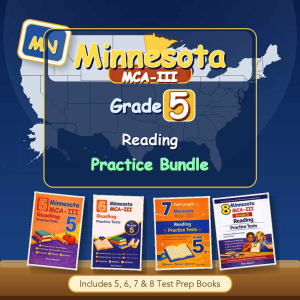
Printable Minnesota grade 5 ELA books:
Standards source: Minnesota English Language Arts, Minnesota Department of Education.
Explain how three scenes build one story
A scene does more than mark a change of place. Read this original miniature play and explain how each part helps the story develop.
Curriculum reference: 2020 Minnesota K–12 English Language Arts Standards, February 2024 corrected edition, from the Minnesota Department of Education academic standards directory.
Minnesota Grade 5 references for this activity
Use Minnesota’s 2020 English Language Arts standards, February 2024 corrected edition. The state implementation page identifies full implementation in 2025–26. These selected benchmarks support one activity; use the complete framework and the school’s sequence for curriculum planning.
| Grade-level expectation | Activity focus | Official requirement |
|---|---|---|
| 5.1.5.1 | Scenes and overall structure | Read the state framework (PDF page 51) |
These selected benchmark labels describe an activity focus. Read the complete state requirements and the school’s sequence, including the framework’s reading, writing, discussion, media-literacy, and Dakota and Anishinaabe perspectives requirements. This original example does not represent those communities or fulfill the entire curriculum.
A worked Grade 5 reading and writing activity
This original classroom example is separate from official assessment questions.
The Garden Concert
Scene 1 — A classroom, Friday afternoon
Mara: Our concert is tomorrow in the garden. I have the music sheets.
Eli: I will bring the chairs. Everyone knows the plan.
Scene 2 — The same classroom, Saturday morning
[Rain beats against the window.]
Eli: The garden chairs are soaked. We cannot use that space.
Mara: We still have the music. Let us ask whether the hall is available.
Scene 3 — The school hall, Saturday afternoon
[An adult opens the hall. The children arrange dry chairs.]
Eli: The place changed, but the concert can begin.
Mara: And now everyone can hear us without getting wet.
Try the activity
Explain what each scene contributes to the whole play. What would become unclear if Scene 2 were removed? Use the dialogue and stage directions as evidence.
Follow the reasoning
Scene 1 establishes the planned event and divides preparations between Mara and Eli. Scene 2 introduces the weather problem and the idea of seeking another space. The stage direction supplies the rain, while Eli explains its effect on the original plan. Mara’s suggestion creates a bridge to Scene 3. The final scene shows the requested hall becoming available and the chairs being arranged, so the concert can begin. Removing Scene 2 would leave a jump from a garden plan to a hall without the problem or proposed solution that connects them. Each scene therefore has a structural role: preparation, disruption and response, then resolution. The final line also shows that the event’s purpose survives the change in location.
Notice what needs more practice
A summary saying first they talk, then they talk again, then they perform misses the scenes’ functions. Ask what changes because of each part. The play does not show the entire concert, so say it can begin rather than claim an audience applauded. Mara suggests asking about the hall; the adult opening it later supplies the resolution. Students should not infer that a child may use a school space without permission. The passage is an original classroom play, not a historical account or an official assessment item.
Grade 5 English worksheets
Choose printable practice that matches the skill being taught. Check the task, reading difficulty, and directions before assigning it; the collection is independently published.
Use the next session to build independence
- Summarize each scene in one sentence.
- Name the new information or change that the scene contributes.
- Explain a connection between two scenes using textual details.
Write a clearly labeled fourth scene showing one event during the concert. Explain how it would extend the supplied ending, and distinguish your addition from the original text. Next, compare the roles of scenes in a teacher-selected play with those of chapters in a story. Some chapters introduce a new viewpoint rather than a new obstacle; determine their contribution from the actual work. Use longer texts over the school’s sequence to develop structural analysis beyond this small example.
For more general reading and writing resources, visit the Grade 5 English Online Center.
Minnesota Grade 5 English: useful planning questions
Is retelling each scene the same as explaining structure?
Retelling says what happens. Explaining structure also shows how each scene contributes to the development of the whole work and connects with other parts.
Where are the complete state requirements?
Use Minnesota’s 2020 English Language Arts standards, February 2024 corrected edition. The state implementation page identifies full implementation in 2025–26. These selected benchmarks support one activity; use the complete framework and the school’s sequence for curriculum planning. The school’s sequence also includes reading, writing, speaking, listening, and language work beyond this example.
Sources checked October 6, 2026. The state assessment-design page identifies Reading MCA-IV beginning in spring 2026 for Grades 3–8 and 10, including Grade 5. Follow the school’s assigned assessment pathway and current directions. Read the Minnesota assessment-design page, and MDE English implementation guidance for later guidance. Independently published practice may use its own timer, question count, and scoring; those features are not official administration specifications or a prediction of a state performance level. Use the complete standards and the school’s learning sequence to choose further reading, writing, speaking, listening, and language work. This original classroom activity is not an official assessment item.
Grade 5 English in other states
When moving between school systems, compare the official curriculum and the school’s learning sequence. Use the national Online Center’s map to find another state’s resources.
Recommended Minnesota Grade 5 resources
Build a Strong Minnesota Grade 5 MCA English Practice Library
These independently published resources have their own coverage and editions. Check the contents alongside Minnesota’s current English standards before choosing assessment preparation.
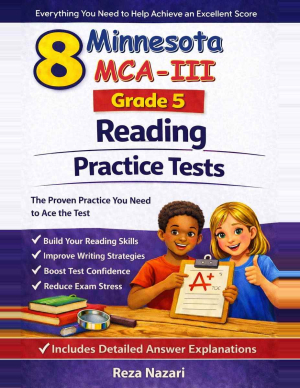
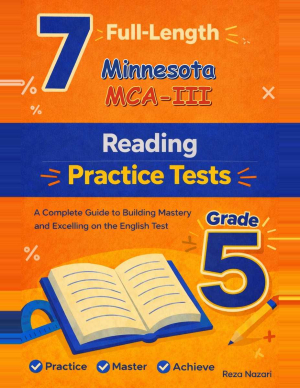
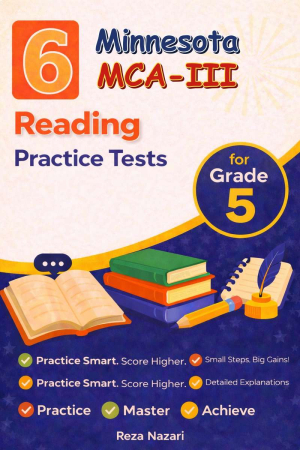
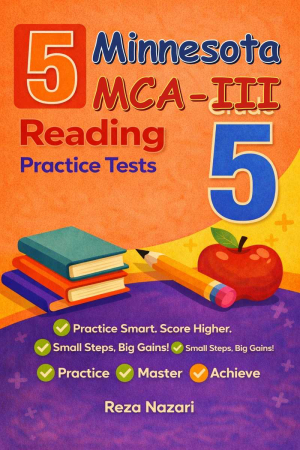
Use these Minnesota Grade 5 resources for reading comprehension, language, writing, and full-length practice where available. Click any cover to open the resource page.
More Grade 5 resources
A USEFUL NEXT STEP
Minnesota Grade 5 English: study questions
Is retelling each scene the same as explaining structure?
Retelling says what happens. Explaining structure also shows how each scene contributes to the development of the whole work and connects with other parts.
Where are the complete Minnesota Grade 5 requirements?
Use Minnesota’s 2020 English Language Arts standards, February 2024 corrected edition. The state implementation page identifies full implementation in 2025–26. These selected benchmarks support one activity; use the complete framework and the school’s sequence for curriculum planning.
Official source ↗Resources from Effortless Math · Editorial standards