LEARN · PRACTICE · EXPLORE
Massachusetts Grade 5 English
Compare two characters using accurate text evidence, distinguish shared aims from different methods, and read Massachusetts Grade 5 English references.
Focused lessons · Useful practice · Clear next steps
What do Massachusetts 5th graders learn in ELA?
In 5th grade, Massachusetts English language arts centers on comparing texts, quoting accurately, point of view, and essays supported with evidence. Students take the MCAS grade 5 ELA test in the spring. This page explains each Massachusetts grade 5 ELA standard and pairs it with short lessons, printable worksheets and a full-length practice test.
Printable Massachusetts grade 5 ELA books:
- 5 Massachusetts MCAS English Language Arts (ELA) Grade 5: Full Practice Tests
- 6 Massachusetts MCAS English Language Arts (ELA) Grade 5: Full Practice Tests
- 7 Massachusetts MCAS English Language Arts (ELA) Grade 5: Full Practice Tests
- 8 Massachusetts MCAS English Language Arts (ELA) Grade 5: Full Practice Tests
- Massachusetts Grade 5 ELA Preparation Bundle
Standards source: Massachusetts English Language Arts, Massachusetts Department of Elementary and Secondary Education.
Compare characters through their responses to one task
Two characters can want the same result and still approach a problem differently. Build the comparison around details rather than a list of unsupported traits.
Curriculum reference: 2017 Massachusetts English Language Arts and Literacy Framework, from the Massachusetts Department of Elementary and Secondary Education current frameworks directory.
Massachusetts Grade 5 references for this activity
The state’s current frameworks directory links the 2017 Massachusetts English Language Arts and Literacy Framework, adopted in March 2017. Read the individual Grade 5 requirements and the school’s sequence. These selected references support this activity; they do not cover the whole English curriculum.
| Grade-level expectation | Activity focus | Official requirement |
|---|---|---|
| RL.5.3 | Compare characters using specific details and interactions | Read the state framework (PDF page 69) |
| RL.5.1 | Accurate quotation or paraphrase supporting explanation | Read the state framework (PDF page 69) |
These are selected grade-level expectations from the current 2017 Massachusetts English framework. Activity labels describe a teaching focus rather than reproduce complete requirements. Read the linked state document’s complete grade-level expectations, including its grade-specific details, alongside the school’s curriculum sequence.
A worked Grade 5 reading and writing activity
This original classroom example is separate from official assessment questions.
The school exhibit opened in an hour, and the model lighthouse still leaned to one side. Eva placed a new block under its base. “Let’s test it now,” she said. Tomas drew the base on scrap paper and measured the gap. “If this support is too high, it will lean the other way.” Eva stepped back while he marked a smaller support. Then they fitted it together. “You found the gap,” she told him. “And you found out where it needed help,” he replied.
Try the activity
Compare Eva and Tomas, explaining one similarity and one difference in their approaches. Use at least one specific detail about each character and explain how their interaction contributes to the solution. Quote briefly or paraphrase accurately.
Follow the reasoning
Both characters want the lighthouse to stand upright before the exhibit. Eva begins by trying a physical support and proposing a test. Tomas begins with a drawing and measurement to predict whether the support will fit. These details support a difference in method, not a conclusion that one cares and the other does not. Eva steps back for Tomas’s measurement, and they fit the revised support together. Their final exchange acknowledges both contributions. A useful comparison connects their shared goal, different actions, and cooperation. It should not reduce them to a careless person and a perfect person when the passage supports neither judgment.
Notice what needs more practice
If the response says only that Eva is a girl and Tomas is a boy, it misses the relevant actions. If it invents a successful exhibition or a prize, return to the limited outcome: they fit a support together. The passage does not explicitly report the final lighthouse angle. Accurate paraphrase preserves what happened without adding a result. Two quotations are not a complete comparison unless the writer explains the relationship between them. This short example is an entry point; a longer story can show characters changing methods over time.
Grade 5 English worksheets
Choose printable practice that matches the skill being taught. Check the task, reading difficulty, and directions before assigning it; the collection is independently published.
Use the next session to build independence
- List one action and one spoken line for each character.
- Identify a supported similarity and difference.
- Explain how their interaction changes the attempt to solve the task.
Add a teacher-selected scene in which the same characters face another challenge, then test whether the initial descriptions still fit. Alternatively, ask students to draft a new ending and label it as their own addition. Revise a comparison paragraph so each interpretation is tied to an accurate detail. Choose quotation or paraphrase according to the point being made, and check that quoted words remain exact. Follow the school’s wider Grade 5 sequence for sustained reading, writing, speaking, listening, and language work beyond this focused activity.
For more general reading and writing resources, visit the Grade 5 English Online Center.
Massachusetts Grade 5 English: useful planning questions
Do different approaches prove that one character is better than the other?
No. Compare what each actually does, their shared aim, and the interaction shown. Judgments about ability or later outcomes require additional evidence.
Where are the complete state requirements?
The state’s current frameworks directory links the 2017 Massachusetts English Language Arts and Literacy Framework, adopted in March 2017. Read the individual Grade 5 requirements and the school’s sequence. These selected references support this activity; they do not cover the whole English curriculum. The school’s sequence also includes reading, writing, speaking, listening, and language work beyond this example.
Sources checked October 6, 2026. Grade 5 is within the MCAS English language arts testing range. The state overview identifies English language arts and mathematics testing in Grades 3–8 and 10. Follow the school’s assigned pathway and current administration directions. The official MCAS overview states that MCAS is untimed within a regular school day. Independently published practice may use its own timer, question count, and scoring; those features are not official MCAS specifications or a prediction of a state performance level. Use the complete framework and the school’s learning sequence to choose further reading, writing, speaking, listening, and language work. This original classroom activity is not an official assessment item.
Grade 5 English in other states
When moving between school systems, compare the official curriculum and the school’s learning sequence. Use the national Online Center’s map to find another state’s resources.
Recommended Massachusetts Grade 5 resources
Build a Strong Massachusetts Grade 5 MCAS English Practice Library
These independently published resources have their own coverage and editions. Check the contents alongside Massachusetts’s current English standards before choosing assessment preparation.
Use these Massachusetts Grade 5 resources for reading comprehension, language, writing, and full-length practice where available. Click any cover to open the resource page.
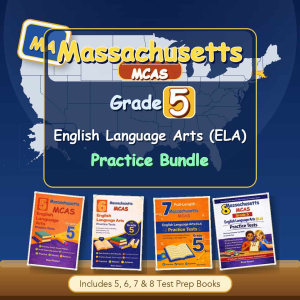 Massachusetts Grade 5 ELA Preparation Bundle
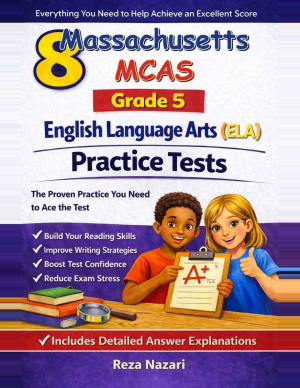 8 Massachusetts MCAS English Language Arts (ELA) Grade 5: Full Practice Tests
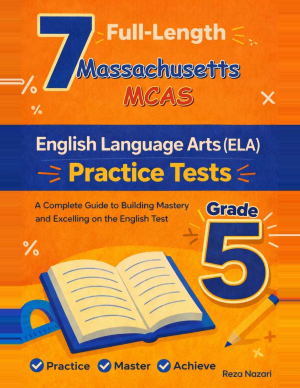 7 Massachusetts MCAS English Language Arts (ELA) Grade 5: Full Practice Tests
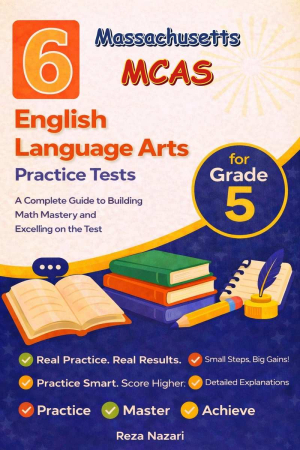 6 Massachusetts MCAS English Language Arts (ELA) Grade 5: Full Practice Tests
 5 Massachusetts MCAS English Language Arts (ELA) Grade 5: Full Practice Tests
More Grade 5 resources
A USEFUL NEXT STEP
Massachusetts Grade 5 English: study questions
Do different approaches prove that one character is better than the other?
No. Compare what each actually does, their shared aim, and the interaction shown. Judgments about ability or later outcomes require additional evidence.
Where are the complete Massachusetts Grade 5 requirements?
The state’s current frameworks directory links the 2017 Massachusetts English Language Arts and Literacy Framework, adopted in March 2017. Read the individual Grade 5 requirements and the school’s sequence. These selected references support this activity; they do not cover the whole English curriculum.
Official source ↗Resources from Effortless Math · Editorial standards