LEARN · PRACTICE · EXPLORE
North Dakota Grade 5 English
Explain how an original Grade 5 poem uses exaggeration for meaning, with North Dakota English references, a worked response, and printable practice.
Focused lessons · Useful practice · Clear next steps
What do North Dakota 5th graders learn in ELA?
In 5th grade, North Dakota English language arts centers on comparing texts, quoting accurately, point of view, and essays supported with evidence. Students take the NDSA grade 5 ELA test in the spring. This page explains each North Dakota grade 5 ELA standard and pairs it with short lessons, printable worksheets and a full-length practice test.
Printable North Dakota grade 5 ELA books:
- 5 North Dakota NDSA English Language Arts (ELA) Grade 5: Full Practice Tests
- 6 North Dakota NDSA English Language Arts (ELA) Grade 5: Full Practice Tests
- 7 North Dakota NDSA English Language Arts (ELA) Grade 5: Full Practice Tests
- 8 North Dakota NDSA English Language Arts (ELA) Grade 5: Full Practice Tests
- North Dakota Grade 5 ELA Preparation Bundle
Standards source: North Dakota adopted content standards.
Explain an Exaggeration
Explain how an original Grade 5 poem uses exaggeration for meaning, with North Dakota English references, a worked response, and printable practice. Connect this activity with the school’s wider literacy sequence.
Curriculum reference: North Dakota English Language Arts Content Standards, June 2023, from the NDDPI English Language Arts standards page.
North Dakota Grade 5 references for this activity
NDDPI’s current English Language Arts page links the June 2023 K–12 standards. The document organizes literacy through foundations, communication, reading, writing, and inquiry/research; foundations apply through Grade 6, while later grades extend reading, writing, communication, and inquiry. Selected references here use the state document’s own grade and strand codes. Read the school’s complete course sequence alongside the full standards rather than treat one activity as an entire literacy program.
| Selected North Dakota reading reference | Activity focus | State-linked standards document |
|---|---|---|
| 5.R.7 | Explain how literary devices contribute to meaning | Read the state-linked document (PDF page 27) |
These selected reference labels identify an activity focus, with the correct grade and PDF page linked separately. Read the complete standards selected by the school and its learning sequence, including reading, writing, language, speaking, and listening. This short original example does not fulfill the entire curriculum or establish a student’s grade-level proficiency.
The minute before the curtain
This original classroom example is separate from official assessment questions.
The curtain stayed closed. I checked the clock.
One minute felt like a mountain to climb.
Then someone called, “Ready!” beyond the cloth.
My shoes found the stage at the very same time.
Try the activity
Explain what the comparison in the second line adds to the poem. Does it report an actual mountain or a measurable change in time? Use the beginning and ending to explain the speaker’s experience.
Follow the reasoning
The second line makes a short wait feel large and difficult by comparing the minute with climbing a mountain. The word “felt” presents the speaker’s experience rather than a literal measurement. The closed curtain and clock-checking establish waiting; the call and movement onto the stage change it into action. The comparison therefore contributes a sense of anticipation and effort before the performance. It combines a simile with exaggerated scale: an ordinary minute becomes a much larger task in the speaker’s imagination. Calling it a literary device is only a starting point; explain how its words develop the experience in this poem.
Notice what needs more practice
The poem does not tell whether the speaker is afraid, excited, or experiencing both. “Anticipation” is supported more directly than a specific diagnosis or permanent trait. A minute has not physically become a mountain, and the poem does not provide a timing experiment. It is an original invented poem, not a historical account.
Grade 5 English worksheets
Choose printable practice that matches the skill being taught. Check the task, reading difficulty, and directions before assigning it; the collection is independently published.
Use the next session to build independence
- Find the comparison and distinguish literal from felt experience.
- Connect its meaning with the surrounding lines.
- Explain what it adds before labeling the device.
Read a teacher-selected poem with imagery, a simile, or hyperbole. Explain the effect of the particular words, then compare a plain literal version. Discuss what meaning or feeling the literal version loses.
For more general reading and writing resources, visit the Grade 5 English Online Center.
North Dakota Grade 5 English: useful planning questions
Is naming “simile” a complete answer?
No. Explain the comparison’s meaning and how it contributes to the text. Use the surrounding words as evidence.
Which standards does the school use?
NDDPI’s current English Language Arts page links the June 2023 K–12 standards. The document organizes literacy through foundations, communication, reading, writing, and inquiry/research; foundations apply through Grade 6, while later grades extend reading, writing, communication, and inquiry. Selected references here use the state document’s own grade and strand codes. Read the school’s complete course sequence alongside the full standards rather than treat one activity as an entire literacy program. The school’s sequence also includes reading, writing, speaking, listening, and language work beyond this example.
Sources checked October 6, 2026. The official 2026–2027 assessment-window page lists general ND A+ summative English language arts in Grades 3–8 and 10, including Grade 5, within March 15–May 7, 2027. Confirm the school’s actual day, the learner’s assigned assessment pathway, and accommodations. Read the NDDPI 2026–2027 assessment windows and current ELA standards resources. Independently published practice has its own directions and scoring. Its result does not predict a state performance level, and this original activity is not an official assessment item.
Grade 5 English in other states
When moving between school systems, compare the official curriculum and the school’s learning sequence. Use the national Online Center’s map to find another state’s resources.
Recommended North Dakota Grade 5 resources
Build a Strong North Dakota Grade 5 NDSA English Practice Library
These independently published resources have their own coverage and editions. Check the contents alongside North Dakota’s current English standards before choosing assessment preparation.
Use these North Dakota Grade 5 resources for reading comprehension, language, writing, and full-length practice where available. Click any cover to open the resource page.
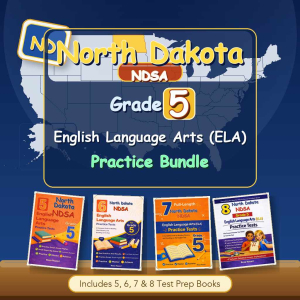 North Dakota Grade 5 ELA Preparation Bundle
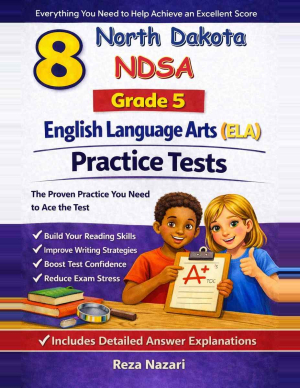 8 North Dakota NDSA English Language Arts (ELA) Grade 5: Full Practice Tests
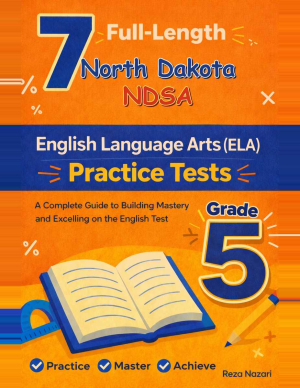 7 North Dakota NDSA English Language Arts (ELA) Grade 5: Full Practice Tests
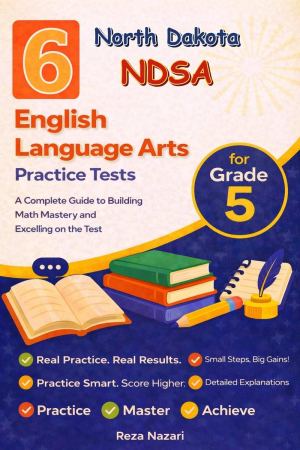 6 North Dakota NDSA English Language Arts (ELA) Grade 5: Full Practice Tests
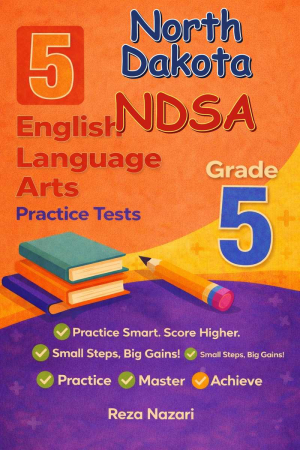 5 North Dakota NDSA English Language Arts (ELA) Grade 5: Full Practice Tests
More Grade 5 resources
A USEFUL NEXT STEP
North Dakota Grade 5 English: study questions
Is naming “simile” a complete answer?
No. Explain the comparison’s meaning and how it contributes to the text. Use the surrounding words as evidence.
Where are the complete North Dakota Grade 5 requirements?
NDDPI’s current English Language Arts page links the June 2023 K–12 standards. The document organizes literacy through foundations, communication, reading, writing, and inquiry/research; foundations apply through Grade 6, while later grades extend reading, writing, communication, and inquiry. Selected references here use the state document’s own grade and strand codes. Read the school’s complete course sequence alongside the full standards rather than treat one activity as an entire literacy program.
Official source ↗Resources from Effortless Math · Editorial standards