LEARN · PRACTICE · EXPLORE
West Virginia Grade 5 English
Explain which reasons and evidence support particular points. Read an original Grade 5 example, follow its explanation, and connect the next practice step with a selected West Virginia English standard.
Focused lessons · Useful practice · Clear next steps
What do West Virginia 5th graders learn in ELA?
In 5th grade, West Virginia English language arts centers on comparing texts, quoting accurately, point of view, and essays supported with evidence. Students take the WVGSA grade 5 ELA test in the spring. This page explains each West Virginia grade 5 ELA standard and pairs it with short lessons, printable worksheets and a full-length practice test.
Printable West Virginia grade 5 ELA books:
- 5 West Virginia WVGSA English Language Arts (ELA) Grade 5: Full Practice Tests
- 6 West Virginia WVGSA English Language Arts (ELA) Grade 5: Full Practice Tests
- 7 West Virginia WVGSA English Language Arts (ELA) Grade 5: Full Practice Tests
- 8 West Virginia WVGSA English Language Arts (ELA) Grade 5: Full Practice Tests
- West Virginia Grade 5 ELA Preparation Bundle
Standards source: West Virginia English policy and resources.
Match Evidence to the Point It Supports
Explain which reasons and evidence support particular points. Read the original example, explain what its words support, and use the next step to transfer the skill to a fuller classroom text. A selected grade-specific reference from West Virginia’s English policy identifies the focus.
Curriculum reference: West Virginia College- and Career-Readiness Standards for English Language Arts, Policy 2520.1A, from the West Virginia English language arts standards page.
West Virginia Grade 5 references for this activity
West Virginia’s English resources page links Policy 2520.1A. The policy records an effective date of August 10, 2020 and includes grade-specific English standards and literacy foundations. The selected Grade 5 reference on this page identifies the focus of an original activity. Read the complete policy and ask the teacher how the school sequences reading, writing, speaking, listening, language, and foundational skills. A short worked example is not a complete curriculum or certification of every independent resource.
| Selected West Virginia reading reference | Activity focus | State-linked standards document |
|---|---|---|
| ELA.5.16 | Explain which reasons and evidence support particular points | Read the state-linked document (PDF page 39) |
These selected reference labels identify an activity focus, with the correct grade and PDF page linked separately. Read the complete standards selected by the school and its learning sequence, including reading, writing, language, speaking, and listening. This short original example does not fulfill the entire curriculum or establish a student’s grade-level proficiency.
Two reasons for keeping a class calendar
This original classroom example is separate from official assessment questions.
The class should keep one shared calendar. It can help readers find dates: during a teacher check, nine of ten students located the visit date on it. It can also help a helper notice scheduling conflicts: the calendar showed that two proposed activities were both listed for Tuesday afternoon. These observations support different uses of the calendar. They do not show that a calendar prevents every missed date or resolves every conflict.
Try the activity
Identify the two points and match an observation with each. Explain why finding a date does not demonstrate that a conflict was resolved.
Follow the reasoning
The first point concerns locating dates, supported by nine of ten students finding the visit date during the check. The second concerns noticing conflicts, supported by two proposed activities being listed for the same afternoon. The calendar reveals a possible scheduling problem; no decision about changing those activities is reported. The first observation provides evidence about finding one date under the stated conditions, not about resolving a conflict. Matching each observation with its point makes the argument clearer than treating all details as interchangeable support for a broad claim that a calendar solves everything.
Notice what needs more practice
The paragraph and its observations are invented. The small classroom check is not a study of all students or calendars. Distinguish noticing a problem from solving it and a reported result from a universal claim.
Grade 5 English worksheets
Choose printable practice that matches the skill being taught. Check the task, reading difficulty, and directions before assigning it; the collection is independently published.
Use the next session to build independence
- Separate the two points being made.
- Match each observation with its point.
- Explain one conclusion the evidence does not establish.
Choose a fuller informational argument. Label each point and trace the evidence the author offers for it. Ask whether a detail supports that specific point or a different one.
For more general reading and writing resources, visit the Grade 5 English Online Center.
West Virginia Grade 5 English: useful planning questions
Can one useful observation support every claim in a paragraph?
No. Explain how the observation relates to the particular claim, and identify conclusions that would need different evidence.
Which standards does the school use?
West Virginia’s English resources page links Policy 2520.1A. The policy records an effective date of August 10, 2020 and includes grade-specific English standards and literacy foundations. The selected Grade 5 reference on this page identifies the focus of an original activity. Read the complete policy and ask the teacher how the school sequences reading, writing, speaking, listening, language, and foundational skills. A short worked example is not a complete curriculum or certification of every independent resource. The school’s sequence also includes reading, writing, speaking, listening, and language work beyond this example.
Sources checked October 6, 2026. WVDE’s General Summative Assessment overview lists English language arts and mathematics in Grades 3–8, with science in Grades 5 and 8. Grade 5 is included in that listed English range; follow current school directions and accommodations. This establishes the listed grade coverage, not a test duration, item count, or guaranteed result. Read the West Virginia English assessment overview, English standards guidance, and content standards and policies. Independently published practice has its own directions and scoring. Its result does not predict a state performance level, and this original activity is not an official assessment item.
Grade 5 English in other states
When moving between school systems, compare the official curriculum and the school’s learning sequence. Use the national Online Center’s map to find another state’s resources.
Recommended West Virginia Grade 5 resources
Choose West Virginia Grade 5 English practice resources
These independently published resources have their own coverage and editions. Check the contents alongside West Virginia’s current English standards before choosing assessment preparation.
Use these West Virginia Grade 5 resources for reading comprehension, language, writing, and full-length practice where available. Click any cover to open the resource page.
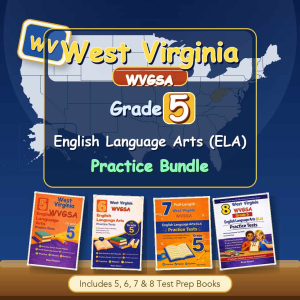 West Virginia Grade 5 ELA Preparation Bundle
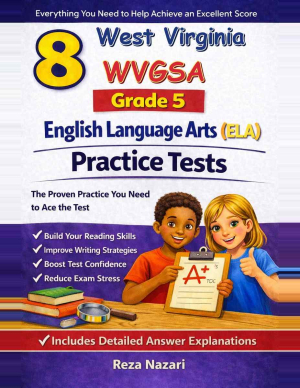 8 West Virginia WVGSA English Language Arts (ELA) Grade 5: Full Practice Tests
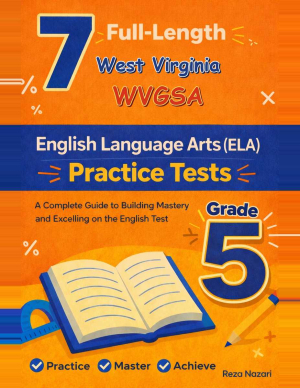 7 West Virginia WVGSA English Language Arts (ELA) Grade 5: Full Practice Tests
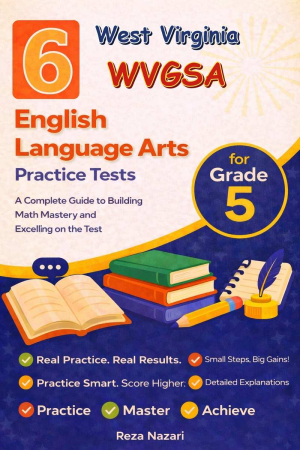 6 West Virginia WVGSA English Language Arts (ELA) Grade 5: Full Practice Tests
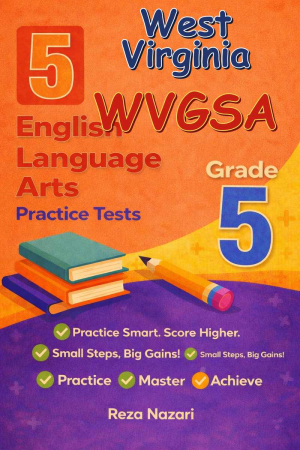 5 West Virginia WVGSA English Language Arts (ELA) Grade 5: Full Practice Tests
More Grade 5 resources
A USEFUL NEXT STEP
West Virginia Grade 5 English: study questions
Can one useful observation support every claim in a paragraph?
No. Explain how the observation relates to the particular claim, and identify conclusions that would need different evidence.
Where are the complete West Virginia Grade 5 requirements?
West Virginia’s English resources page links Policy 2520.1A. The policy records an effective date of August 10, 2020 and includes grade-specific English standards and literacy foundations. The selected Grade 5 reference on this page identifies the focus of an original activity. Read the complete policy and ask the teacher how the school sequences reading, writing, speaking, listening, language, and foundational skills. A short worked example is not a complete curriculum or certification of every independent resource.
Official source ↗Resources from Effortless Math · Editorial standards