LEARN · PRACTICE · EXPLORE
Kentucky Grade 5 English
Evaluate two claims in an original library proposal, connect reasons and evidence precisely, and practice with current Kentucky Grade 5 reading references.
Focused lessons · Useful practice · Clear next steps
What do Kentucky 5th graders learn in ELA?
In 5th grade, Kentucky English language arts centers on comparing texts, quoting accurately, point of view, and essays supported with evidence. Students take the KSA grade 5 ELA test in the spring. This page explains each Kentucky grade 5 ELA standard and pairs it with short lessons, printable worksheets and a full-length practice test.
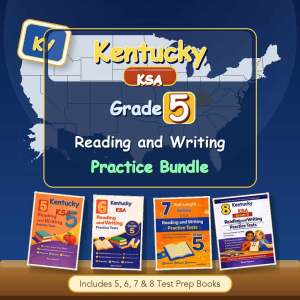
Printable Kentucky grade 5 ELA books:
Standards source: Kentucky English Language Arts, Kentucky Department of Education.
Match a writer’s evidence to the claim it actually supports
This original school-library proposal makes two claims. Test each against its own evidence, including the limits of a short observation. The proposal is an invented teaching text, not a report about an actual Kentucky school.
Curriculum reference: Kentucky Academic Standards for Reading and Writing, October 2025, from the Kentucky Department of Education standards directory.
Kentucky Grade 5 references for this activity
Kentucky’s current directory links the October 2025 Reading and Writing standards, adopted into law in May 2026. Read the Grade 5 expectations in the full state document. The selected reference supports this activity; use the school’s sequence and the remaining expectations for wider coverage.
| Grade-level expectation | Activity focus | Official requirement |
|---|---|---|
| RI.5.8 | Explain which reasons and evidence support a particular claim | Read the state document (PDF page 177) |
These are selected grade-level expectations from Kentucky’s current English standards. Activity labels describe a teaching focus rather than reproduce complete requirements. Read the linked state document’s complete grade-level expectations, including its grade-specific details, alongside the school’s curriculum sequence.
A worked Grade 5 reading and writing activity
This original classroom example is separate from official assessment questions.
Proposal: Keep the library open during Tuesday lunch. On two Tuesdays, a librarian recorded twelve requests from students to borrow a book while the library was closed. Opening at lunch would give students with that schedule another borrowing opportunity. It would also make every student read more books. The school should try the opening for a month and record how the time is used.
Try the activity
Separate the claim about borrowing opportunities from the claim about every student’s reading. Explain what the observation supports and what additional evidence the wider claim would need.
Follow the reasoning
The recorded requests concern students seeking a borrowing opportunity at a particular time. They provide a reason to investigate an opening that serves that schedule. They do not show that every student will read more books. Borrowing and reading are also different actions, so a borrowing record alone cannot establish a change in reading. A careful response connects the limited observation to the limited claim and explains the gap in the larger claim. For example, “The requests show demand during two closed lunch periods, but they do not tell how all students’ reading would change.” The suggested trial could collect useful additional information if its records match the question being asked.
Notice what needs more practice
Check exactly what the number twelve describes. The passage does not establish whether the requests came from twelve different students, whether the same students appeared twice, or how many students attend the school. Do not convert it into a percentage. A plausible proposal can contain both relevant evidence and an unsupported promise. Calling the whole text true or false loses that distinction. The author’s recommendation is to try a change; its success is not yet an observed result. Students should quote or paraphrase the relevant sentence accurately, then explain how it supports a specific claim rather than assuming any number strengthens every statement.
Grade 5 English worksheets
Choose printable practice that matches the skill being taught. Check the task, reading difficulty, and directions before assigning it; the collection is independently published.
Use the next session to build independence
- Underline the separate claims and name their scope.
- Connect each piece of evidence to the claim it can address.
- Explain what the evidence establishes and what remains untested.
Revise the claim about every student to a narrower, testable statement about access during Tuesday lunch. Then propose separate records for borrowing opportunities and for reading completed, respecting the difference between them. In discussion, compare two revisions and decide which most accurately reflects the evidence already available. This activity does not require collecting students’ personal reading information; it uses an invented proposal for reasoning practice. Kentucky’s Grade 5 reference concerns how reasons and evidence support claims. Continue with real, teacher-selected informational texts and their actual sources, using the complete state requirements and the school’s sequence to plan wider coverage.
For more general reading and writing resources, visit the Grade 5 English Online Center.
Kentucky Grade 5 English: useful planning questions
Does a borrowing request prove that a student will read more books?
No. It can support a claim about demand for borrowing access. A claim about reading completed needs evidence that addresses reading, as well as a clear definition of the group and time period.
Where are the complete state requirements?
Kentucky’s current directory links the October 2025 Reading and Writing standards, adopted into law in May 2026. Read the Grade 5 expectations in the full state document. The selected reference supports this activity; use the school’s sequence and the remaining expectations for wider coverage. The school’s sequence also includes reading, writing, speaking, listening, and language work beyond this example.
Official sources checked October 6, 2026. Grade 5 is within the Kentucky Summative Assessment reading testing range. This original lesson is independent practice. Read Kentucky’s current assessment guidance and use the school’s guidance for preparation. Kentucky’s current guidance lists KSA reading and mathematics in Grades 3–8 and 10. Beginning in 2026–27, KSA no longer tests writing or editing and mechanics. Writing and language remain part of classroom instruction. The other KSA content-area tests remain; follow the school’s current assignment and directions, including any assigned alternate-assessment pathway. This original classroom activity is independently published practice, not an official KSA item or a prediction of a state performance level. The May 2026 adoption notice explains the revised reading and writing standards. Check independently published books and practice against current standards and assessment guidance.
Grade 5 English in other states
When moving between school systems, compare the official curriculum and the school’s learning sequence. Use the national Online Center’s map to find another state’s resources.
Recommended Kentucky Grade 5 resources
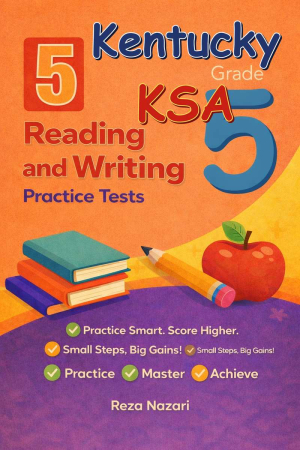
Build a Strong Kentucky Grade 5 KSA English Practice Library
These independently published resources have their own coverage and editions. Check the contents alongside Kentucky’s current English standards before choosing assessment preparation.
Use these Kentucky Grade 5 resources for reading comprehension, language, writing, and full-length practice where available. Click any cover to open the resource page.
More Grade 5 resources
A USEFUL NEXT STEP
Kentucky Grade 5 English: study questions
Does a borrowing request prove that a student will read more books?
No. It can support a claim about demand for borrowing access. A claim about reading completed needs evidence that addresses reading, as well as a clear definition of the group and time period.
Where are the complete Kentucky Grade 5 requirements?
Kentucky’s current directory links the October 2025 Reading and Writing standards, adopted into law in May 2026. Read the Grade 5 expectations in the full state document. The selected reference supports this activity; use the school’s sequence and the remaining expectations for wider coverage.
Official source ↗Resources from Effortless Math · Editorial standards