LEARN · PRACTICE · EXPLORE
Maine Grade 5 English
Compare two book-exchange accounts, explain different perspectives using exact details, and find Maine Grade 5 English references, lessons, and worksheets.
Focused lessons · Useful practice · Clear next steps
What do Maine 5th graders learn in ELA?
In 5th grade, Maine English language arts centers on comparing texts, quoting accurately, point of view, and essays supported with evidence. Students take the Maine Through Year grade 5 ELA test in the spring. This page explains each Maine grade 5 ELA standard and pairs it with short lessons, printable worksheets and a full-length practice test.
Printable Maine grade 5 ELA books:
- 5 Maine MTYA English Language Arts (ELA) Grade 5: Full Practice Tests
- 6 Maine MTYA English Language Arts (ELA) Grade 5: Full Practice Tests
- 7 Maine MTYA English Language Arts (ELA) Grade 5: Full Practice Tests
- 8 Maine MTYA English Language Arts (ELA) Grade 5: Full Practice Tests
- Maine Grade 5 ELA Preparation Bundle
Standards source: Maine English Language Arts, Maine Department of Education.
Compare how two participants describe the same event
Read two fictional accounts of one classroom book exchange. Compare their perspectives while keeping shared facts and exact textual evidence clear.
Curriculum reference: 2020 Maine English Language Arts/Literacy Standards (Word document), from the Maine Department of Education standards directory.
Maine Grade 5 references for this activity
Use the 2020 Maine English Language Arts/Literacy Standards linked from the state review directory. Reading expectations are organized by individual grades through Grade 5 and by a shared Grades 6–8 band. These selections describe the activity’s teaching focus. Read the complete relevant grade or band and the school’s instructional sequence.
| State reference | Activity focus | Official requirement |
|---|---|---|
| Reading Standard 9 · Grade 5 | Compare perspectives in accounts | Read the complete state Word document |
| Reading Standard 4 · Grade 5 | Quote accurately to support explanations | Read the complete state Word document |
These selected references identify an independently paraphrased teaching focus. For Grades 6–8, the requirements belong to a shared band rather than a separately prescribed year. Read the complete state document alongside the school’s sequence.
A worked Grade 5 reading and writing activity
This original classroom example is separate from official assessment questions.
Account A — student helper: “I spent the first part of the exchange explaining the signs. Some visitors had never brought a book before, so I showed them where to leave it and where to choose another. By the end, several visitors were explaining the signs to each other. My favorite moment was when I no longer needed to point out every shelf.”
Account B — teacher: “At the beginning, the student helpers answered many questions about the exchange. Later, visitors began helping one another find the shelves. I noted that our signs still needed larger lettering. The event gave us information for improving the next exchange, even though the helpers handled questions well.”
Try the activity
What change do both accounts describe? How does each writer’s role influence what receives attention? Quote one short detail from each account to support the comparison, and identify a conclusion neither account establishes.
Follow the reasoning
Both accounts describe a change from helpers answering questions to visitors helping one another. The student helper emphasizes becoming less necessary during the event and calls that a favorite moment. The teacher treats the same event as information for improving the next exchange and notes a remaining problem with lettering. The short phrases “My favorite moment” and “needed larger lettering” support that contrast in attention. The accounts are compatible: visitors can become more independent while the signs still need improvement. Neither account reports a count of books exchanged or establishes that every visitor found the signs easy to read.
Notice what needs more practice
Do not turn different priorities into a disagreement over whether the event happened. Both writers report visitors helping each other later. The teacher’s criticism concerns lettering, not an accusation that the student helpers did a poor job. A quotation needs to match the actual wording and connect to the explanation; copying a long section without explaining its relevance does not strengthen the comparison. These accounts are original fictional practice, not interviews conducted with a real class. Their roles help explain perspective, but students should not assume that every student or teacher would write in the same way.
Grade 5 English worksheets
Choose printable practice that matches the skill being taught. Check the task, reading difficulty, and directions before assigning it; the collection is independently published.
Use the next session to build independence
- Identify the event and the shared reported change.
- Select a short accurate quotation from each account.
- Explain the difference in emphasis without inventing a conflict.
Ask students to write one sentence that presents the shared information and a second that contrasts the emphasis. Then have a partner check the quotations against the text and explain which claim each supports. For transfer, compare two longer accounts of a common event selected by the teacher. Record each source’s author, role, purpose, and available details before forming a conclusion. New accounts may contradict one another, so use the actual evidence rather than assuming all perspectives agree. Read the complete Grade 5 performance expectations alongside the school’s course and connect this activity with wider reading and writing.
For more general reading and writing resources, visit the Grade 5 English Online Center.
Maine Grade 5 English: useful planning questions
Do the two book-exchange accounts contradict one another?
No. Both describe visitors helping one another later. The student emphasizes a satisfying moment, while the teacher also identifies a possible improvement in the signs.
Where are the complete state requirements?
Use the 2020 Maine English Language Arts/Literacy Standards linked from the state review directory. Reading expectations are organized by individual grades through Grade 5 and by a shared Grades 6–8 band. These selections describe the activity’s teaching focus. Read the complete relevant grade or band and the school’s instructional sequence. The school’s sequence also includes reading, writing, speaking, listening, and language work beyond this example.
Official sources checked October 6, 2026. Grade 5 is within the Maine Through Year Assessment Grades 3–8 reading range. The official overview identifies Common Core as its accountability standards and states that testing is untimed. Follow the school’s assigned pathway and current directions. Read the Maine Through Year Assessment overview. This original activity supports classroom reading and writing within the Maine Learning Results; it is independently published, not an official state question, a replica of assessment timing or scoring, or a complete curriculum-alignment certification. Check supplemental books and practice against the school’s current requirements.
Grade 5 English in other states
When moving between school systems, compare the official curriculum and the school’s learning sequence. Use the national Online Center’s map to find another state’s resources.
Recommended Maine Grade 5 resources
Build a Strong Maine Grade 5 Through Year Assessment English Practice Library
These independently published resources have their own coverage and editions. Check the contents alongside Maine’s current English standards before choosing assessment preparation.
Use these Maine Grade 5 resources for reading comprehension, language, writing, and full-length practice where available. Click any cover to open the resource page.
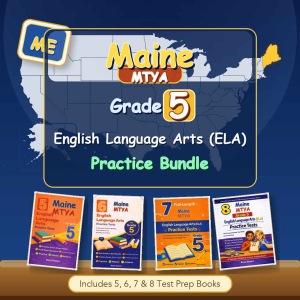 Maine Grade 5 ELA Preparation Bundle
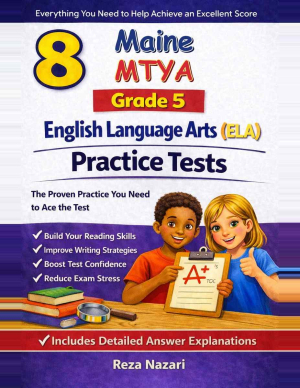 8 Maine MTYA English Language Arts (ELA) Grade 5: Full Practice Tests
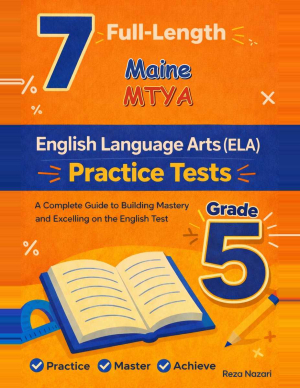 7 Maine MTYA English Language Arts (ELA) Grade 5: Full Practice Tests
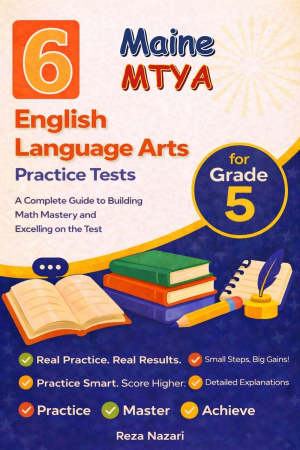 6 Maine MTYA English Language Arts (ELA) Grade 5: Full Practice Tests
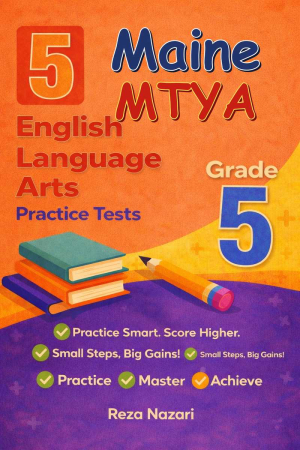 5 Maine MTYA English Language Arts (ELA) Grade 5: Full Practice Tests
More Grade 5 resources
A USEFUL NEXT STEP
Maine Grade 5 English: study questions
Do the two book-exchange accounts contradict one another?
No. Both describe visitors helping one another later. The student emphasizes a satisfying moment, while the teacher also identifies a possible improvement in the signs.
Where are the complete Maine Grade 5 requirements?
Use the 2020 Maine English Language Arts/Literacy Standards linked from the state review directory. Reading expectations are organized by individual grades through Grade 5 and by a shared Grades 6–8 band. These selections describe the activity’s teaching focus. Read the complete relevant grade or band and the school’s instructional sequence.
Official source ↗Resources from Effortless Math · Editorial standards