LEARN · PRACTICE · EXPLORE
Maryland Grade 5 English
Explore a narrator’s perspective in Grade 5 with an original story, worked response, learning resources, and selected Maryland 2025 English standards references.
Focused lessons · Useful practice · Clear next steps
What do Maryland 5th graders learn in ELA?
In 5th grade, Maryland English language arts centers on comparing texts, quoting accurately, point of view, and essays supported with evidence. Students take the MCAP grade 5 ELA test in the spring. This page explains each Maryland grade 5 ELA standard and pairs it with short lessons, printable worksheets and a full-length practice test.
Printable Maryland grade 5 ELA books:
- 5 Maryland MCAP English Language Arts (ELA) Grade 5: Full Practice Tests
- 6 Maryland MCAP English Language Arts (ELA) Grade 5: Full Practice Tests
- 7 Maryland MCAP English Language Arts (ELA) Grade 5: Full Practice Tests
- 8 Maryland MCAP English Language Arts (ELA) Grade 5: Full Practice Tests
- Maryland Grade 5 ELA Preparation Bundle
Standards source: Maryland English Language Arts, Maryland State Department of Education (archived backup).
Explain how a narrator shapes an event
A narrator gives readers a particular view of an event. This original Grade 5 scene asks students to connect that view with the details and descriptions the narrator chooses.
Curriculum reference: 2025 Maryland English standards: selected grade-level strand (archived PDF), from the Maryland State Department of Education standards directory (archived backup).
Maryland Grade 5 references for this activity
The state’s standards directory identifies revised 2025 Maryland College and Career Ready Standards for English Language Arts. Use the Grade 5 column of the selected strand document; neighboring columns show prerequisite and later expectations. These selected references support the activity and do not cover the whole English curriculum.
| Grade-level expectation | Activity focus | Official requirement |
|---|---|---|
| RL.5.6 | Narrator’s perspective and the description of events | Read the archived state document (PDF page 17) |
| RL.5.1 | Multiple accurate details supporting an explanation | Read the archived state document (PDF page 2) |
These are selected grade-level expectations from the revised 2025 Maryland English standards. Activity labels describe a teaching focus rather than reproduce complete requirements. Read the linked state document’s complete grade-level expectations, including its grade-specific details, alongside the school’s curriculum sequence.
A worked Grade 5 reading and writing activity
This original classroom example is separate from official assessment questions.
I was sure our class photograph would be a disaster. The wind folded the backdrop in half, and my carefully pinned badge twisted sideways. Mr. Bell said we could take the picture indoors. What a defeat! I had spent yesterday choosing the garden spot. Everyone carried a chair inside while I rescued the backdrop. When the photographer showed us the picture, my badge was crooked, but I was laughing beside my friends. Perhaps the garden was not the most important part after all.
Try the activity
Who tells the story, and how does that narrator describe moving the photograph indoors? Explain how the point of view shapes the account. Support the explanation with more than one accurate piece of evidence. Then explain whether the narrator’s view stays the same by the end.
Follow the reasoning
The speaker is a student participating in the photograph. At first, the narrator describes the indoor move as a defeat because choosing the garden spot mattered to them. Disaster, carefully pinned, and spent yesterday all help readers understand the narrator’s investment and disappointment. The same move could be described by another participant as a useful solution, but this narrator initially emphasizes a lost plan. By the end, laughing with friends and questioning whether the garden was most important show a changed view. A response should connect the evidence with how events are presented, rather than merely identify first-person pronouns. The crooked badge remains in the final picture; the narrator’s evaluation of the situation changes even though that detail does not.
Notice what needs more practice
A first-person narrator is not automatically unreliable, and noticing a perspective is not proof of dishonesty. The story gives access to this student’s thinking, not everyone else’s thoughts. It does not say that all classmates were disappointed or that Mr. Bell disliked the garden. Those claims go beyond the evidence. An accurate response can use quotation or a faithful paraphrase, but should choose multiple details that actually support its explanation. Quoting I without explaining the narrator’s role would identify a pronoun, not the influence of a point of view.
Grade 5 English worksheets
Choose printable practice that matches the skill being taught. Check the task, reading difficulty, and directions before assigning it; the collection is independently published.
Use the next session to build independence
- Identify the narrator’s position within the event.
- Select multiple details showing how the event is described.
- Explain a change or consistency in the narrator’s view.
Use a classroom story with a clear narrator. Ask what the narrator notices, how those details are evaluated, and whose thoughts remain unavailable. Invite students to rewrite a small event from another participant’s view, identifying which changes are imagined rather than supplied by the original. Continue the school’s work with the complete reading and writing curriculum.
For more general reading and writing resources, visit the Grade 5 English Online Center.
Maryland Grade 5 English: useful planning questions
Is identifying first-person narration enough?
No. Explain how the narrator’s position and perspective influence the description of events, using multiple accurate details rather than only pointing out a pronoun.
Where are the complete state requirements?
The state’s standards directory identifies revised 2025 Maryland College and Career Ready Standards for English Language Arts. Use the Grade 5 column of the selected strand document; neighboring columns show prerequisite and later expectations. These selected references support the activity and do not cover the whole English curriculum. The school’s sequence also includes reading, writing, speaking, listening, and language work beyond this example.
Sources checked October 6, 2026. Grade 5 is in the statewide English assessment grade range. Maryland announced a transition from MCAP to MSTAR beginning in 2026–27. Follow the school’s current assignment and administration directions, including an alternate pathway if assigned. The May 2026 state board report (PDF page 12, archived copy) describes the MSTAR transition. Older MCAP-named books and practice linked here retain their published names and should be checked against current school guidance; they are independent supplements. Their question counts, timers, and scoring are not official MSTAR specifications or predictions of a state performance level. The MSDE website displayed a maintenance notice during review and linked an archived backup. The standards links here use working archived copies of the state’s revised documents, not a claim that the live site was available. Check the MSDE website and school guidance for later updates. This original classroom activity is not an official assessment item.
Grade 5 English in other states
When moving between school systems, compare the official curriculum and the school’s learning sequence. Use the national Online Center’s map to find another state’s resources.
Recommended Maryland Grade 5 resources
Build a Strong Maryland Grade 5 MCAP English Practice Library
These independently published resources have their own coverage and editions. Check the contents alongside Maryland’s current English standards before choosing assessment preparation.
Use these Maryland Grade 5 resources for reading comprehension, language, writing, and full-length practice where available. Click any cover to open the resource page.
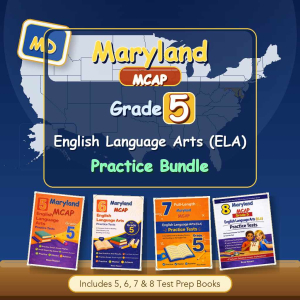 Maryland Grade 5 ELA Preparation Bundle
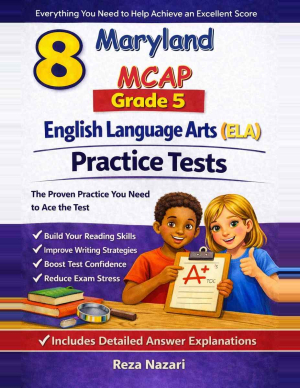 8 Maryland MCAP English Language Arts (ELA) Grade 5: Full Practice Tests
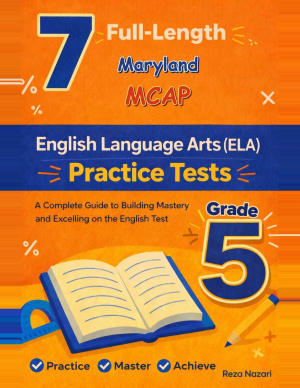 7 Maryland MCAP English Language Arts (ELA) Grade 5: Full Practice Tests
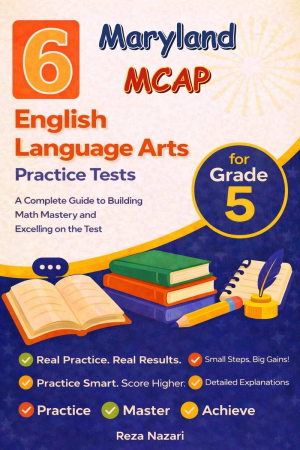 6 Maryland MCAP English Language Arts (ELA) Grade 5: Full Practice Tests
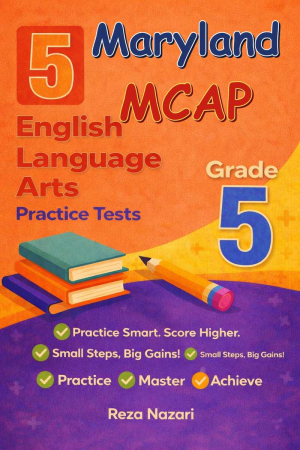 5 Maryland MCAP English Language Arts (ELA) Grade 5: Full Practice Tests
More Grade 5 resources
A USEFUL NEXT STEP
Maryland Grade 5 English: study questions
Is identifying first-person narration enough?
No. Explain how the narrator’s position and perspective influence the description of events, using multiple accurate details rather than only pointing out a pronoun.
Where are the complete Maryland Grade 5 requirements?
The state’s standards directory identifies revised 2025 Maryland College and Career Ready Standards for English Language Arts. Use the Grade 5 column of the selected strand document; neighboring columns show prerequisite and later expectations. These selected references support the activity and do not cover the whole English curriculum.
Official source ↗Resources from Effortless Math · Editorial standards