LEARN · PRACTICE · EXPLORE
District of Columbia Grade 5 English
Read an original classroom checkout process, explain relationships among its steps, and improve linking language using selected DC Grade 5 English references.
Focused lessons · Useful practice · Clear next steps
Standards source: District of Columbia Standards of Learning, DC Office of the State Superintendent of Education.
Explain why a process uses a particular order
A list of actions can hide the relationships that make a process work. Students can first trace what the people do, then explain which information one step supplies for another. This fictional checkout system provides a short text for that close reading.
Curriculum source: Common Core State Standards for English Language Arts & Literacy, adopted in DC in July 2010, from the OSSE standards directory.
District of Columbia Grade 5 references for this activity
District of Columbia’s ELA/literacy standards use the Common Core State Standards. The full ELA document contains the Grade 5 expectations across its subject strands. These are selected references for the activity on this page; use the full document for curriculum planning.
| Core Standards reference | Activity focus | Official requirement |
|---|---|---|
| RI.5.3 | Relationships among people, events, or ideas in a text | Read the primary standards document, page 14 |
| W.5.2c | Linking ideas in explanatory writing | Read the primary standards document, page 20 |
These are selected CCSS references used in District of Columbia’s ELA/literacy standards. Activity labels describe a teaching focus rather than reproduce the full requirements. Districts develop their own curriculum sequence; use the complete document and the school’s plan for wider coverage.
A worked Grade 5 reading and writing activity
This original classroom example is separate from official assessment questions.
The classroom lends drawing tools from a shared cabinet. A borrower first chooses a tool and writes its name on a checkout card. Next, the borrower adds their own name so the class can identify who has the tool. When the tool is returned, the borrower marks the card as returned. As a result, the next reader can distinguish a tool still being used from one already back in the cabinet.
Try the activity
Explain how the tool name, borrower name, and return mark serve different jobs. Then rewrite the process in a short paragraph using linking language that shows both sequence and result.
Follow the reasoning
The tool name identifies the object, while the borrower name identifies the person responsible for returning it. The return mark changes the information on the card from an active borrowing record to a completed one. “First” and “next” indicate order; “so” explains the purpose of recording a name; “as a result” connects the return mark with the reader’s interpretation. Replacing all of them with “then” would keep an order but weaken the explanation of why the steps matter.
Notice what needs more practice
The text describes the proposed system’s logic, not proof that no tool can ever be lost. If a student claims the card physically returns the tool, distinguish the recorded information from the borrower’s action. An explanation should also avoid merging the two names: writing only a person’s name leaves the reader unsure which tool was borrowed.
Grade 5 English worksheets
Choose printable practice that matches the skill being taught. Check the task, reading difficulty, and directions before assigning it; the collection is independently published.
Use the next session to build independence
- Label each step’s action and the information it records.
- Explain one purpose or result using the text rather than listing all the steps again.
- Write a new short process paragraph and have a partner identify a sequence link and a purpose or result link.
Use a teacher-selected explanation of another familiar process. Compare the way linking language connects people, actions, and results. Choose precise links based on the relationship instead of inserting a transition at random.
For more general reading and writing resources, visit the Grade 5 English Online Center.
District of Columbia Grade 5 English: useful planning questions
Does every linking word show the same relationship?
No. First and next signal sequence, while so and as a result can explain purpose or consequence. Choose the link that fits the relationship the paragraph needs to explain.
Where are the complete state requirements?
District of Columbia’s ELA/literacy standards use the Common Core State Standards. The full ELA document contains the Grade 5 expectations across its subject strands. These are selected references for the activity on this page; use the full document for curriculum planning. The school’s sequence also includes reading, writing, speaking, listening, and language work beyond this example.
Official sources checked October 5, 2026. Grade 5 is within the DC CAPE Next English language arts testing range. This original lesson is independent practice. Read the official assessment overview and use the school’s guidance for preparation. DC CAPE Next begins with the spring 2027 administration; OSSE says the educational standards have not changed. This site’s practice and books are independently published resources, not official items or a certified match to the new test design.
Grade 5 English in other states
When moving between school systems, compare the official curriculum and the school’s learning sequence. Use the national Online Center’s map to find another state’s resources.
Recommended District of Columbia Grade 5 resources
Build a Strong District of Columbia Grade 5 DC CAPE English Practice Library
These independently published resources may reflect earlier DC CAPE editions. Check the edition and contents alongside OSSE’s DC CAPE Next guidance before choosing assessment preparation.
Use these District of Columbia Grade 5 resources for reading comprehension, language, writing, and full-length practice where available. Click any cover to open the resource page.
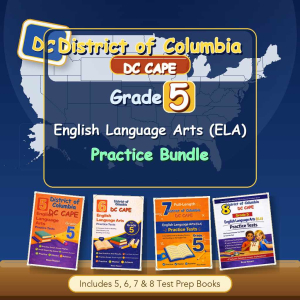 District of Columbia Grade 5 ELA Preparation Bundle
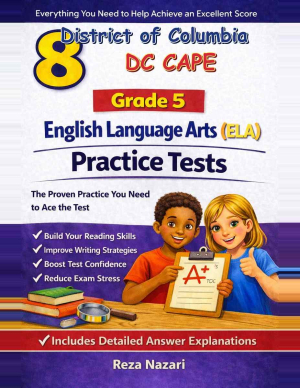 8 District of Columbia DC CAPE English Language Arts (ELA) Grade 5: Full Practice Tests
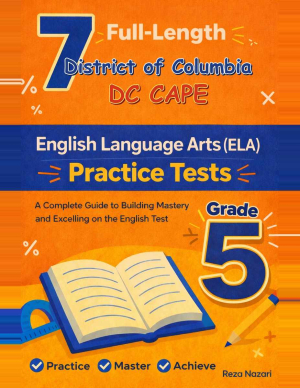 7 District of Columbia DC CAPE English Language Arts (ELA) Grade 5: Full Practice Tests
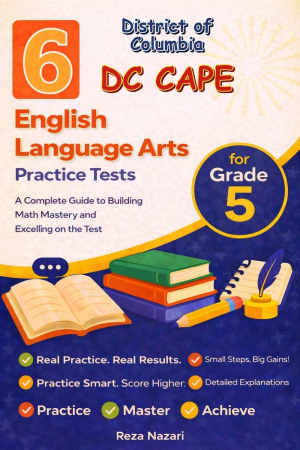 6 District of Columbia DC CAPE English Language Arts (ELA) Grade 5: Full Practice Tests
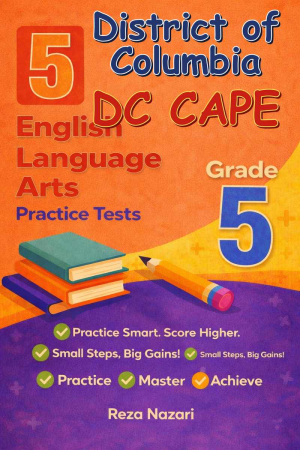 5 District of Columbia DC CAPE English Language Arts (ELA) Grade 5: Full Practice Tests
More Grade 5 resources
A USEFUL NEXT STEP
District of Columbia Grade 5 English: study questions
Does every linking word show the same relationship?
No. First and next signal sequence, while so and as a result can explain purpose or consequence. Choose the link that fits the relationship the paragraph needs to explain.
Where are the complete District of Columbia Grade 5 requirements?
District of Columbia’s ELA/literacy standards use the Common Core State Standards. The full ELA document contains the Grade 5 expectations across its subject strands. These are selected references for the activity on this page; use the full document for curriculum planning.
Official source ↗Resources from Effortless Math · Editorial standards