LEARN · PRACTICE · EXPLORE
New Jersey Grade 5 English
Practice New Jersey Grade 5 English by comparing two original text structures, quoting supporting details, and using worked reading guidance and printable resources.
Focused lessons · Useful practice · Clear next steps
What do New Jersey 5th graders learn in ELA?
In 5th grade, New Jersey English language arts centers on comparing texts, quoting accurately, point of view, and essays supported with evidence. Students take the NJSLA grade 5 ELA test in the spring. This page explains each New Jersey grade 5 ELA standard and pairs it with short lessons, printable worksheets and a full-length practice test.
Printable New Jersey grade 5 ELA books:
- 5 New Jersey NJSLA English Language Arts (ELA) Grade 5: Full Practice Tests
- 6 New Jersey NJSLA English Language Arts (ELA) Grade 5: Full Practice Tests
- 7 New Jersey NJSLA English Language Arts (ELA) Grade 5: Full Practice Tests
- 8 New Jersey NJSLA English Language Arts (ELA) Grade 5: Full Practice Tests
- New Jersey Grade 5 ELA Preparation Bundle
Standards source: 2023 New Jersey ELA standards.
Compare how two texts organize information about the same project
Practice New Jersey Grade 5 English by comparing two original text structures, quoting supporting details, and using worked reading guidance and printable resources. The selected 2023 New Jersey standards identify this activity’s focus; use the complete grade expectations and the school’s teaching sequence for broader planning.
Curriculum reference: 2023 New Jersey Student Learning Standards for English Language Arts, official grade page, from the official New Jersey ELA standards directory.
New Jersey Grade 5 references for this activity
The 2023 New Jersey Student Learning Standards for English Language Arts define grade-specific end-of-year expectations. These selected references point to the activity’s reading focus; the complete grade page also includes language, writing, speaking, and listening. Use the full expectations and the school’s teaching sequence when planning instruction.
| Selected state reference | Activity focus | Official grade page |
|---|---|---|
| RI.CR.5.1 | Quote accurately to explain details and inferences | Read the complete grade expectations |
| RI.TS.5.4 | Compare organizational structures across informational texts | Read the complete grade expectations |
These selected reference labels identify an activity focus, with links to the official grade page. Read the complete New Jersey standards and the school’s learning sequence, including reading, writing, language, speaking, and listening. This short original example does not fulfill the entire curriculum or establish a student’s grade-level proficiency.
Two ways to explain the class display
This original classroom example is separate from official assessment questions.
Text A — Project record
On Monday, the class sorted its local-history photographs by date. On Tuesday, students wrote captions using the dates supplied with each photograph. By Wednesday, they had arranged the photographs on a long wall strip. They placed the oldest picture at the left and the newest at the right. On Thursday, another class read the display and asked questions. The organizers added two clearer captions before the Friday opening.
Text B — A choice for the display
A wall strip can show how a place changes over time, but it needs a long, open surface. A folder display uses less wall space and lets a reader turn one page at a time. It can, however, make it harder to see several dates together. The class chose a wall strip because comparing older and newer photographs was its main aim. The choice worked for that aim because the classroom had an available wall.
Try the activity
Compare the main structures of Text A and Text B. Quote a short phrase from each to support your answer. Explain what each structure helps a reader understand and what would be lost if you described both merely as “about photographs.”
Follow the reasoning
Text A mainly uses chronology: it follows the work from Monday through the Friday opening. A phrase such as “On Tuesday” signals that the next step follows the previous day. This structure helps readers understand the order of preparation and how the organizers revised the captions before opening. Text B mainly compares two display formats, a wall strip and a folder, and explains a choice based on their advantages and limitations. The phrase “uses less wall space” introduces a way the folder differs from the strip; the text also compares how easily readers can see several dates. Calling both texts “about photographs” identifies a shared topic but leaves out how their information is arranged. The chronology explains a sequence of work, while the comparison clarifies why one format suited this project. Neither account establishes that wall strips are best for every classroom.
Notice what needs more practice
A text can include more than one relationship. Text A ends with a revision responding to questions, but the dated sequence still provides its main organization. Text B mentions a decision, yet it does not give a day-by-day record of the project. Look at the relationship among the paragraphs and ideas rather than assigning a structure from one signal word. Quote exactly from the supplied writing and explain the phrase’s role; a quotation by itself is not an analysis.
Grade 5 English worksheets
Choose printable practice that matches the skill being taught. Check the task, reading difficulty, and directions before assigning it; the collection is independently published.
Use the next session to build independence
- Mark the sequence in Text A and the comparison criteria in Text B.
- Choose a brief quotation that reveals each structure.
- Explain how each organization contributes to the reader’s understanding.
Write two short accounts of a classroom project: one showing the order of work and one comparing two possible approaches. Ask a reader to identify each organization and explain its value. If the structures seem the same, revise the relationships among ideas rather than adding more signal words alone.
For more general reading and writing resources, visit the Grade 5 English Online Center.
New Jersey Grade 5 English: useful planning questions
Can two texts share a topic but have different structures?
Yes. One text can organize a project chronologically while another compares possible approaches. Explain the relationships among ideas, not only the shared subject.
Which standards does the school use?
The 2023 New Jersey Student Learning Standards for English Language Arts define grade-specific end-of-year expectations. These selected references point to the activity’s reading focus; the complete grade page also includes language, writing, speaking, and listening. Use the full expectations and the school’s teaching sequence when planning instruction. The school’s sequence also includes reading, writing, speaking, listening, and language work beyond this example.
Sources checked October 6, 2026. The official 2026–2027 schedule lists NJSLA-A ELA for Grades 3–9, including Grade 5. NJDOE describes ELA and mathematics as adaptive assessments. Confirm the learner’s assigned pathway and school directions. Read the official adaptive assessment overview, 2026–2027 statewide schedule, and 2023 ELA standards directory. Independently published practice has its own timing and scoring and does not predict a state performance level. Use the teacher’s sequence for further reading, writing, speaking, listening, and language work. This original activity is not an official assessment item.
Grade 5 English in other states
When moving between school systems, compare the official curriculum and the school’s learning sequence. Use the national Online Center’s map to find another state’s resources.
Recommended New Jersey Grade 5 resources
Build a Strong New Jersey Grade 5 NJSLA English Practice Library
These independently published resources have their own coverage and editions. Check the contents alongside New Jersey’s current English standards before choosing assessment preparation.
Use these New Jersey Grade 5 resources for reading comprehension, language, writing, and full-length practice where available. Click any cover to open the resource page.
 New Jersey Grade 5 ELA Preparation Bundle
 8 New Jersey NJSLA English Language Arts (ELA) Grade 5: Full Practice Tests
 7 New Jersey NJSLA English Language Arts (ELA) Grade 5: Full Practice Tests
 6 New Jersey NJSLA English Language Arts (ELA) Grade 5: Full Practice Tests
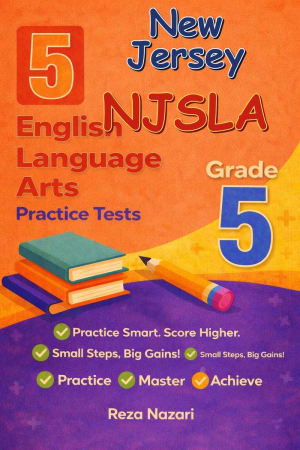 5 New Jersey NJSLA English Language Arts (ELA) Grade 5: Full Practice Tests
More Grade 5 resources
A USEFUL NEXT STEP
New Jersey Grade 5 English: study questions
Can two texts share a topic but have different structures?
Yes. One text can organize a project chronologically while another compares possible approaches. Explain the relationships among ideas, not only the shared subject.
Where are the complete New Jersey Grade 5 requirements?
The 2023 New Jersey Student Learning Standards for English Language Arts define grade-specific end-of-year expectations. These selected references point to the activity’s reading focus; the complete grade page also includes language, writing, speaking, and listening. Use the full expectations and the school’s teaching sequence when planning instruction.
Official source ↗Resources from Effortless Math · Editorial standards