Postwar Growth, Organized Labor, Automation, and the Service Economy
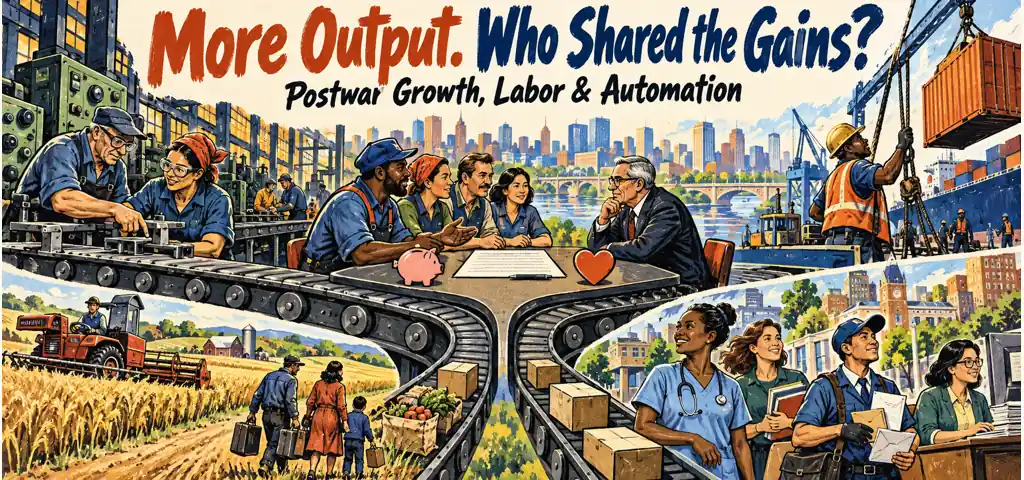
Chapter 12 of the CLEP History of the United States II study guide on Effortless Math covers Postwar Growth, Organized Labor, Automation, and the Service Economy: the key terms, the core ideas, and worked examples showing how this topic is tested on the exam.
CLEP History of the United States II, Chapter 12
The long postwar boom combined growth with relative stability
From 1945 to about 1970, productivity, real family income, homeownership, consumption, and manufacturing employment rose strongly. Consumer prices increased slowly through most of the 1950s and early 1960s. The double-digit rates associated with the 1970s came later. Pent-up household demand, wartime savings, residential construction, exports, public spending, and a growing labor force all contributed. "Affluent" describes the aggregate expansion. Poverty, racial exclusion, regional inequality, and insecure work remained.
Automatic stabilizers made downturns less destructive
Federal deposit insurance reduced the danger that bank runs would destroy savings and contract credit as they had during the Great Depression. Unemployment insurance and other benefit programs paid more when jobs fell, supporting household purchasing power without a new law for each recession. Progressive taxation also reduced collections as income declined. Recessions continued. These automatic stabilizers interrupted feedback loops in which lost jobs, failed banks, and collapsing consumption had once deepened one another.
Pattern bargaining spread the gains of mass production
Large auto, steel, rubber, and electrical unions negotiated contracts that other firms often copied. Postwar agreements increasingly included health insurance, pensions, paid leave, and wage increases tied to productivity or the cost of living. Employer-provided benefits also reflected wartime wage controls that had encouraged compensation outside the paycheck. The arrangement linked mass production to mass consumption: workers who shared in productivity gains could buy the goods factories produced. Coverage, however, depended heavily on occupation, employer, and union strength.
Union density peaked as the job structure began to shift
Roughly one worker in three belonged to a union at the mid-1950s peak, and the AFL and CIO merged in 1955. Yet white-collar employees were coming to outnumber blue-collar workers. Unions had built their strongest institutions in factories, mines, transport, and construction, not in offices, retail, or many private services. Employment growth therefore moved toward sectors with lower organization rates. Taft-Hartley restrictions, employer resistance, regional movement, and later plant closure compounded the structural problem.
Automation raised output while redistributing risk
Automation uses machines and control systems to perform tasks once done by labor. Work remained, but the task mix and number of workers changed. In 1960 the International Longshore and Warehouse Union accepted mechanized cargo handling on West Coast docks in exchange for guaranteed pay, early retirement, and protections for displaced members. The bargain shows technology passing through a labor contract. Seniority, retraining, and alternative jobs then determined who carried the cost.
Agriculture demonstrated the scale of productivity change
Postwar farms combined tractors and mechanical harvesters with hybrid seed, inexpensive nitrogen fertilizer, irrigation, pesticides, and scientific management. Output rose while farm employment and population fell. Farming remained economically central, with each worker and acre supporting greater production. Consolidation and rural out-migration accelerated. Productivity measures output per unit of input. The statistic leaves the cost to displaced households for separate evidence to establish.
The occupational structure moved from farms to goods to services
Farm work collapsed as a share of employment first. Goods-producing employment, including manufacturing and construction, held a large share through midcentury and then declined relatively while services expanded. Clerical work, retail, health care, education, finance, government, and professional occupations absorbed millions. A service economy still depends on physical goods, energy, transport, and food. The label tracks where people work and value is recorded. Material production continued throughout the shift.
Government employees built a new union stronghold
Executive orders and state laws expanded bargaining rights for many public employees during the 1960s, and teachers, sanitation workers, transit workers, and other municipal employees organized rapidly. Public-sector bargaining differed from private industry because elected governments set budgets and provided essential services. Union decline was therefore uneven: private-sector membership fell while public-sector membership grew. Aggregate union density can conceal opposing trends in different labor markets.
The 1970 postal strike converted disruption into bargaining rights
More than two hundred thousand postal workers joined a wildcat strike that began with New York letter carriers despite the federal ban on strikes. President Nixon sent troops to sort mail, but their limited effectiveness strengthened the workers' position. The settlement brought raises, and the Postal Reorganization Act created the United States Postal Service and recognized collective bargaining over wages while retaining the strike ban. Unlike the PATCO confrontation eleven years later, the strikers were not permanently dismissed.
PATCO marked a harder turn against strikes
In 1981 air traffic controllers represented by PATCO struck in violation of federal law. President Reagan ordered them back and dismissed those who refused. The defeat lowered the political and reputational cost of permanently replacing strikers, and private employers adopted more aggressive antiunion strategies. PATCO became a visible turning point inside a decline already driven by sectoral change, employer policy, globalization, law, and regional relocation.
Mine safety organizing joined disaster to chronic disease
After the 1968 Farmington mine disaster, West Virginia miners organized around black lung as well as explosions. Pneumoconiosis developed through repeated coal-dust exposure and disabled far more workers than a single visible accident. Strikes and the Black Lung Association pressed for compensation and enforceable dust limits. The 1969 federal coal-mine law strengthened inspections, safety standards, and disability benefits. The campaign translated occupational evidence into regulation by connecting individual illness to workplace conditions.
Defense contracting created concentrated market dependence
Postwar aerospace firms often depended on one dominant buyer: the federal government. A household-goods company responds to millions of customers, but a defense contractor's employment and investment can turn on congressional appropriations, procurement choices, and the cancellation of one weapons or space program. Federal contracts helped build Sunbelt metropolitan economies while also exposing them to political budget decisions. Private corporate ownership therefore coexisted with a market structured by public purchasing.
Trade moved from surplus toward persistent deficit
The United States emerged from the Second World War with enormous industrial capacity and recurrent merchandise trade surpluses. After 1970 imports grew faster than exports, and goods trade moved into substantial deficit. Exchange rates, foreign recovery, energy imports, multinational production, consumer demand, and industrial competition all mattered. A country can export heavily and still run a deficit. The measure records that imports exceed exports in value during the period under study.
The productivity slowdown changed the path of living standards
Output per hour grew rapidly through the quarter century after 1948, then rose at roughly half that pace from the early 1970s into the mid-1990s. Slower productivity growth constrained the sustainable rise of real wages and family living standards. The timing puzzled economists because firms were buying computers before the payoff became obvious in national statistics. Output per hour still rose. Each year's gain simply compounded from a smaller increase.
Employment can rise while unemployment also rises
Between two dates, the number of jobs can increase by millions while the unemployment rate rises if the labor force grows faster still. Baby boomers reaching working age, immigration, and women's increased paid employment enlarged the labor force. The unemployment rate uses people working or actively seeking work as its denominator. Children, retirees, and adults outside the job search remain in the total population but outside that calculation. Read the job count and the rate together.
separate productivity from employment
A table shows farm output rising while farm jobs fall.
Postwar prosperity rested on institutions with uneven reach
Collective bargaining, automatic stabilizers, federal contracts, education, and mass production spread income and reduced some risks. Sectoral movement, racial and gender exclusion, automation, and regional relocation distributed gains unevenly. By the 1970s slower productivity, trade pressure, inflation, and industrial restructuring weakened the older bargain. Follow the institutions that converted growth into wages, benefits, security, and mobility, then identify the workers they left outside.
Watch the history in motion
This short lesson adds voices, images, and chronology to the ideas you just studied.
Video: Postwar ECONOMIC Prosperity, Causes & Effects [APUSH Review], Heimler's History.
Try four CLEP-style questions
- Which evidence would best show that a service economy had not stopped producing or moving physical goods?
- A declining private-sector union rate alongside public-sector organizing
- Falling farm employment alongside higher output per agricultural worker
- Rising freight, energy use, and goods output alongside a larger service-sector workforce
- A larger share of consumer spending going to medical care and financial services
- Slower growth in output per hour after the early 1970s
- Mine owners call black-lung complaints anecdotal because accident reports count chiefly explosions and collapses. Which evidence would best test the miners' broader claim?
- Payroll records comparing hourly wages among underground job classifications
- Medical histories linking years of dust exposure to pneumoconiosis and disability
- Annual totals for deaths caused by explosions and roof falls alone
- Production reports measuring tons of coal mined per worker
- Inspection counts listing equipment violations without workers' health outcomes
- Farm output per worker rises sharply. Which additional evidence is most necessary to assess the human cost of that productivity gain?
- The value of merchandise exports compared with imports
- The share of research spending financed by the federal government
- The number of service jobs created in finance and health care
- The bargaining provisions in longshore and automobile contracts
- Migration, farm consolidation, wages, and employment losses in affected counties
- Which example is an automatic stabilizer rather than a new discretionary response to a recession?
- Congress authorizes a one-time public-works appropriation after unemployment rises.
- The Federal Reserve announces a new emergency lending facility.
- A city negotiates a temporary wage freeze with its employees.
- Unemployment-insurance payments rise as eligible workers lose jobs.
- A defense agency accelerates purchases under a newly enacted supplemental bill.
Check your answers and reasoning
Independent preparation. CLEP is a registered trademark of the College Board, which does not endorse this lesson.

Related to This Article
More math articles
- Interpreting Cell-Cycle Experiments: Data and Worked Examples
- Primary elections
- Integrals Made Easier Using Tables: A Complete Explanation And Examples
- 49 Free Hawaii SBAC Grade 5 Math Worksheets — Print, Practice, and Check the Answer Key
- Washington Smarter Balanced Grade 7 Math Worksheets: 95 Free Printable Skill PDFs
- Civil rights enforcement
- Multi-Line Slots: When 25 Paylines Cost More Than They Pay
- Free Grade 8 English Worksheets for Maryland Students
- Multiplying Binomials Practice — FOIL (Free)
- Free Grade 4 English Worksheets for North Carolina Students




















What people say about "Postwar Growth, Labor and the Service Economy"?
No one replied yet.