Television, Advertising, Consumerism, and Mass Culture
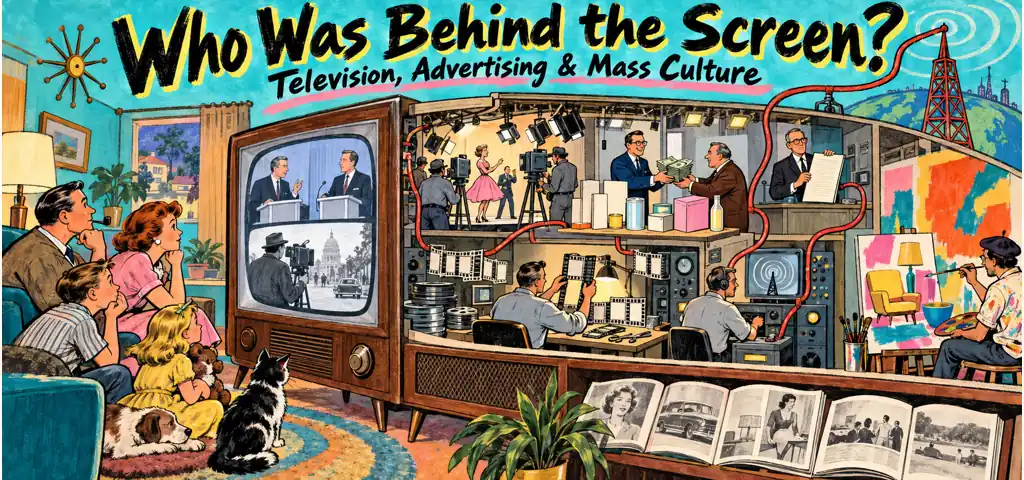
Chapter 12 of the CLEP History of the United States II study guide on Effortless Math covers Television, Advertising, Consumerism, and Mass Culture: the key terms, the core ideas, and worked examples showing how this topic is tested on the exam.
CLEP History of the United States II, Chapter 12
National advertising sold identities as well as products
By the 1920s agencies increasingly joined goods to status, romance, cleanliness, popularity, and modernity. Research, slogans, illustrations, and repeated national placement turned a purchase into an answer to social anxiety. Radio intensified the model because sponsors paid for programs that gathered a predictable audience. Daytime serials became "soap operas" because soap and household-goods companies financed dramas aimed at homemakers. Advertising did not invent consumer desire, but it organized desire into a national commercial language.
Broadcasting used private stations under public licenses
The Communications Act of 1934 created the Federal Communications Commission and required licensees to serve the public interest, convenience, and necessity. Stations remained largely commercial and privately operated, but access to scarce frequencies carried a public obligation. This mixed arrangement later supported Newton Minow's 1961 criticism of television's "vast wasteland": broadcasters could not answer that ratings alone settled their duty because their licenses came from the public.
Picture magazines made photography the narrative
Henry Luce launched Life in 1936 on the premise that photographs could carry a story while text became captions and brief explanation. Margaret Bourke-White's Fort Peck Dam image appeared on the first cover. Norman Rockwell's 323 Saturday Evening Post covers, painted from posed photographs between 1916 and 1963, built small narratives around closely observed everyday life. Both forms made national experience visible through edited, commercially distributed images.
Television reorganized household leisure and advertising
Television ownership spread from a small minority of households in 1950 to a large majority by decade's end. The living-room set gathered family leisure, delivered national brands, and gave a few networks extraordinary power over what audiences saw. Sponsored programs and commercial breaks financed entertainment, news, sports, and children's shows. Disney even used network television to finance and promote Disneyland. A new medium succeeded because programming, advertising, affiliates, and household schedules formed a system.
Television changed political presentation
The 1960 Kennedy-Nixon debates showed that candidates now reached a national electorate through visual performance as well as words. Camera framing, appearance, pace, and control of the setting became part of political communication. Television did not make policy knowledge irrelevant, and radio listeners could judge the same exchange differently. The episode demonstrates that a medium changes the evidence citizens receive and the skills campaigns reward.
News images shortened the distance to public events
Film of police dogs and fire hoses in Birmingham and combat footage from Vietnam entered homes through network news. Images could give distant events immediacy and speed national reaction beyond what a description alone achieved. Opinion did not move mechanically in one direction, and editors selected what reached the screen. Television's importance lies in a changed relationship among event, camera, national audience, and political response.
Scandals exposed the manufacture behind apparent spontaneity
Congressional hearings in 1959 revealed that television quiz-show producers had supplied contestants with answers and instructed them when to lose. A different self-regulatory system followed the 1954 attack on crime and horror comics: publishers created the Comics Code Authority, and wholesalers favored books carrying its seal. Both cases show private media industries responding to public pressure without direct federal production of content.
Mass communication compressed the Atlantic
Lindbergh flew from New York to Paris in 1927; the recorded eyewitness account of the Hindenburg disaster circulated in 1937; Edward R. Murrow reported live from bombed London in 1940; and Telstar relayed transatlantic television in 1962. The sequence moves from physical travel to recorded radio, live radio, and live pictures. Chronology reveals how rapidly distance ceased to delay a shared media event.
Postwar art made New York an international center
Abstract expressionists such as Jackson Pollock, Mark Rothko, and Willem de Kooning used gesture, scale, and fields of color rather than familiar narrative subjects. By the early 1950s New York had displaced Paris as the most watched center of the international avant-garde. Pop artists then turned commercial imagery, packaging, celebrities, and comics into art. Both movements belonged to a postwar argument about American power and mass culture.
Critics attacked manipulation rather than abundance itself
Vance Packard examined motivational research, status consumption, and planned obsolescence in books published from 1957 to 1960. Postwar consumer critics generally accepted that mass production had raised material living standards. They questioned debt, conformity, waste, manufactured desire, and the use of psychological research to bypass reflective choice. Denying abundance would contradict the condition that made their criticism urgent.
Later media challenged the single mass audience
Cable channels, videocassette recording, remote controls, home video, and eventually digital media fragmented the audience after 1980. The industry's conversion to color during the 1960s did not cause that later breakup; color operated within the three-network system. Fragmentation increased choice and niche programming while weakening the shared schedule that had let one broadcast reach much of the country at once.
Popular formats could register social change
Ms. magazine, launched by feminists, centered work, law, politics, and inequality rather than treating fashion and housekeeping as women's complete field. The Mary Tyler Moore Show built a comedy around an unmarried woman supporting herself in a professional job, contrasting with the family-centered comedies of the 1950s. Mass media can reinforce norms, revise them, or hold competing versions at the same time.
separate the medium from its message
A prompt claims television caused support for civil rights because it showed Birmingham violence.
Mass culture is produced through institutions
Artists, advertisers, sponsors, networks, regulators, publishers, retailers, and audiences all shaped the national culture. A program's popularity cannot alone explain who financed it, which license rules applied, or why a scandal changed standards. Ask who paid, who selected, what technology distributed the work, which audience was imagined, and how people used or resisted the result.
Watch the history in motion
This short lesson adds voices, images, and chronology to the ideas you just studied.
Video: Mass Consumer Culture The Golden Age of the Middle Class 1950s, American History II Online.
Try four CLEP-style questions
- Which comparison best distinguishes a Life photo essay from a Norman Rockwell magazine cover?
- The photo essay edited documentary images into reportage, while Rockwell constructed a painted scene from posed studies.
- The photo essay treated photographs as minor decoration, while Rockwell assembled documentary news sequences.
- The photo essay relied on one imagined scene, while Rockwell paired candid photographs with reporting captions.
- The photo essay was painted after interviews, while Rockwell printed posed photographs without alteration.
- Both claimed that cameras recorded scenes without staging, captions, or editorial selection.
- What did the quiz-show hearings and the Comics Code controversy have most clearly in common?
- Both transferred the production of popular entertainment to the FCC.
- Public exposure pushed private media industries to adopt or defend new controls.
- Both ended commercial sponsorship of nationally distributed entertainment.
- Congress wrote the scripts and editorial rules that producers then followed.
- Both controversies arose because audiences had fragmented among cable channels.
- Civil-rights footage reaches a national television audience, but viewers respond differently. Which conclusion best fits the evidence?
- Camera coverage made local organization unnecessary once violence appeared on screen.
- Network distribution ensured that viewers reached the same political judgment.
- Television created the official violence that cameras recorded in the streets.
- The medium widened and accelerated exposure without determining a uniform response.
- Broadcast licensing required stations to endorse the demonstrators' demands.
- Which contrast most accurately separates abstract expressionism from pop art?
- Abstract expressionism borrowed product packaging, while pop art avoided commercial imagery through nonobjective color fields.
- Abstract expressionism emphasized gesture or fields of color, while pop art reused mass-market imagery.
- Abstract expressionism revived regional landscapes, while pop art returned to documentary social realism.
- Abstract expressionism retained narrative figures, while pop art abandoned recognizable objects.
- Abstract expressionism revived federal mural painting, while pop art depended on WPA arts patronage.
Check your answers and reasoning
Independent preparation. CLEP is a registered trademark of the College Board, which does not endorse this lesson.

Related to This Article
More math articles
- Ratio, Proportion and Percentages Puzzle – Challenge 25
- Free Grade 5 English Worksheets for Nevada Students
- How to Support Grade 5 Reading at Home: 12 Smart Strategies That Build Independence
- Amicus curiae briefs
- 3rd Grade IAR Math FREE Sample Practice Questions
- Is ALEKS just for Mathematics?
- New York Grade 2 Math Worksheets — Free Printable PDFs
- SAT Math-Test Day Tips
- Top Tablets for Online Math Teaching
- Division of Labor, Alienation, Labor Markets, and Professions


















What people say about "Television, Advertising, and Mass Culture"?
No one replied yet.