Religious Revival, Rock and Roll, the Beats, and Cultural Dissent
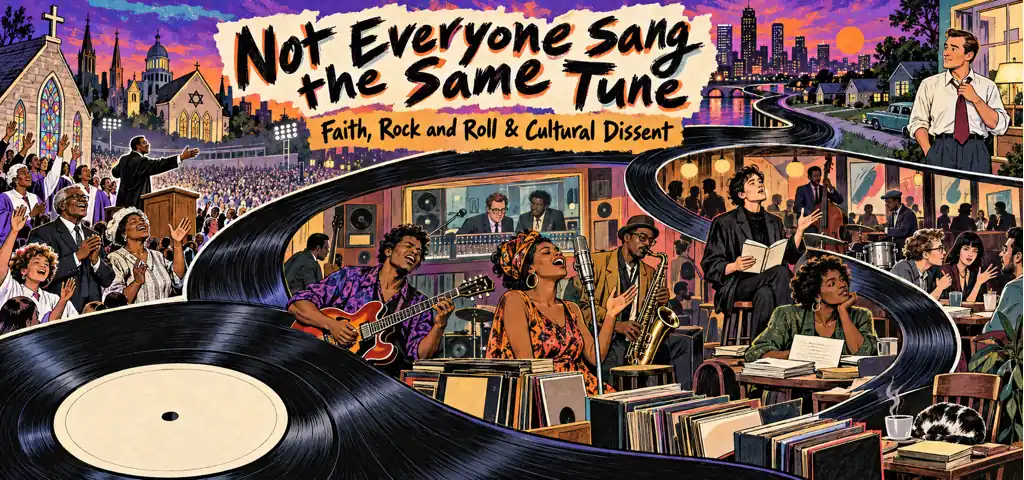
Chapter 12 of the CLEP History of the United States II study guide on Effortless Math covers Religious Revival, Rock and Roll, the Beats, and Cultural Dissent: the key terms, the core ideas, and worked examples showing how this topic is tested on the exam.
CLEP History of the United States II, Chapter 12
Postwar revival joined private faith to public identity
Church and synagogue membership rose after 1945, Billy Graham drew large stadium audiences, and religious language became more visible in civic ritual. Congress added "under God" to the Pledge of Allegiance in 1954 and adopted "In God We Trust" as the national motto in 1956. These acts joined a genuine religious revival to Cold War contrast with officially atheistic communism. Public piety was neither one denomination nor proof of uniform belief.
Neo-evangelicals chose engagement over separation
After 1942, conservative Protestants associated with the National Association of Evangelicals distinguished themselves from separatist fundamentalism. They defended biblical authority while building schools, publications, missions, and cooperative institutions able to engage the wider culture. Graham became their best-known public figure. The difference was strategic as well as theological: withdrawal protected purity, whereas neo-evangelical organization sought national influence.
Religion could preserve identity after other ethnic customs faded
Will Herberg argued in Protestant-Catholic-Jew that immigrants' grandchildren often lost ancestral languages and many old-country customs while retaining a religious affiliation. Participation could signal both American belonging and a continuing group identity. Norman Vincent Peale's The Power of Positive Thinking mixed devotional language, repeated affirmation, and popular psychology, promising peace of mind and worldly effectiveness. Critics found the optimism thin, but its popularity matched the era's confidence.
Niebuhr rejected easy Social Gospel optimism
Reinhold Niebuhr broke with the belief that moral education and goodwill would steadily harmonize society. Individuals may act generously, he argued, but classes and nations defend interests through organized power. Justice therefore requires countervailing power, political responsibility, and awareness of unintended consequences. His Christian realism did not celebrate selfishness. It warned reformers that appeals to conscience alone cannot settle conflicts structured by unequal power.
Catholic public life moved from suspicion to reform and dissent
Anti-Catholic claims that a president would answer to Rome badly damaged Al Smith in 1928 but did not prevent John Kennedy's election in 1960. The Second Vatican Council encouraged vernacular worship and greater congregational participation. In 1968 Humanae Vitae restated the ban on artificial contraception and prompted open dissent among American clergy and laypeople. In 1986 the bishops' Economic Justice for All judged economic arrangements by human dignity, workers, and their effect on poor people.
The Beats made movement and improvisation a rebuke to conformity
Allen Ginsberg's Howl and Jack Kerouac's On the Road rejected the settled office, mortgage, and managed respectability of the 1950s middle class. The Beats sought spontaneity in travel, jazz, sexuality, spiritual experiment, and marginal lives. Their revolt was cultural rather than a legislative program. That made them visible evidence of dissent inside affluence without making them representative of every young American.
Postwar literature challenged success and social visibility
Arthur Miller's Death of a Salesman questioned the promise that likability and effort guarantee business success. Ralph Ellison's invisible narrator is unseen because others refuse to recognize him as an individual. Lorraine Hansberry's A Raisin in the Sun, the first Broadway play written by a Black woman, centered a working-class Black family. James Baldwin argued in The Fire Next Time that white Americans must confront what racial domination had done to their own moral lives.
War writing shifted from mobilization to absurdity and memory
John Hersey's account Hiroshima filled a 1946 issue of The New Yorker with survivors' experiences. Joseph Heller's 1961 novel Catch-22 portrayed war as an absurd system whose bureaucratic rules trapped the individual soldier. Kurt Vonnegut's 1969 Slaughterhouse-Five returned to the firebombing of Dresden through fragmented chronology, fatalism, and a narrator skeptical that mass death could be made orderly or heroic. Both later novels differed from much fiction produced during wartime mobilization by distrusting institutional purpose and conventional battle narrative. Commemoration also changed: the Unknown Soldier was interred in 1921, Rockwell's Four Freedoms ran in 1943, Hersey followed in 1946, and the Marine Corps War Memorial was dedicated in 1954.
Bebop transformed jazz from dance music into demanding listening
Charlie Parker, Dizzy Gillespie, and other bebop musicians worked in smaller groups, used rapid tempos and complex harmonies, and addressed attentive listeners more than ballroom dancers. Bebop grew from Black musical innovation and reshaped modern jazz. It did not simply displace swing everywhere. Dance bands, popular vocals, rhythm and blues, gospel, country, and jazz continued to coexist and exchange musicians and audiences.
Rock and roll crossed markets built under segregation
Mid-1950s rock and roll drew heavily from rhythm and blues recorded by Black performers for Black audiences, while also taking from country and gospel. White cover versions often reached larger radio audiences and outsold the originals because distribution and programming were unequal. The crossover widened exposure while raising questions about credit and compensation. Musical mixture and unequal markets can occur at the same time.
Motown made crossover a Black-owned business strategy
Berry Gordy founded Motown in Detroit and built a Black-owned label whose tightly produced singles sold strongly to white as well as Black listeners. Songwriters, studio musicians, choreography, artist development, and quality control created a recognizable sound. Integration also transformed baseball. After Jackie Robinson entered the major leagues in 1947, Negro-league clubs lost leading players and paying audiences. The Negro National League folded after 1948, while other clubs and the Negro American League survived into the 1950s. Access to the larger institution weakened autonomous Black enterprises through a rapid but uneven decline.
Social criticism moved from conformity toward institutional attack
David Riesman's The Lonely Crowd (1950) described the other-directed person guided by peers, colleagues, and mass media. William Whyte's The Organization Man (1956) examined corporate conformity. Michael Harrington's The Other America (1962) exposed poverty hidden by affluence, and Ralph Nader's Unsafe at Any Speed (1965) attacked institutional failure in automobile design. The chronology traces a change in target as well as publication date.
A longer literary chronology places the Beats within earlier revolts
Sinclair Lewis published Main Street in 1920, Alain Locke's The New Negro appeared in 1925, John Steinbeck's The Grapes of Wrath followed in 1939, and Kerouac's On the Road arrived in 1957. Women's literary milestones crossed periods as well. Edith Wharton received the Pulitzer Prize for The Age of Innocence in 1921, Zora Neale Hurston published Their Eyes Were Watching God in 1937, Betty Friedan published The Feminine Mystique in 1963, and Toni Morrison received the Nobel Prize in Literature in 1993. These dates place postwar dissent within a longer history of women reshaping literary authority.
distinguish integration from equal reward
A white cover of a Black rhythm-and-blues song sells more copies than the original.
test a claim of 1950s consensus
Membership statistics show religious growth, while Beat writing and social criticism attack conformity.
Culture should be read through form, institution, audience, and power
A sermon, novel, record, ballpark, magazine, and memorial make different claims and reach audiences through different institutions. Chronology prevents anachronism; ownership and distribution reveal who benefited; close reading identifies the argument. Postwar abundance generated celebration, assimilation, innovation, and dissent at once. The historian's job is to explain the relationship rather than force every cultural work into one national mood.
Watch the history in motion
This short lesson adds voices, images, and chronology to the ideas you just studied.
Video: PBS Documentary – The 1950s – Segment 1 of 3, tularem.
Try four CLEP-style questions
- Which contrast best distinguishes Niebuhr's Christian realism from Peale's positive-thinking message?
- Niebuhr placed reform in private confidence, while Peale stressed institutional balances among organized groups.
- Niebuhr treated denominational identity as the main source of power, while Peale analyzed conflict among nations and classes.
- Niebuhr stressed collective power and unintended consequences, while Peale emphasized personal confidence and effectiveness.
- Niebuhr urged separatist withdrawal from public life, while Peale built a political theory of countervailing organizations.
- Niebuhr measured justice by rising consumption, while Peale judged institutions by their effects on workers and poverty.
- What did Motown change about crossover compared with the mid-1950s practice of white pop covers?
- A Black-owned label coordinated songs, performers, production, and promotion to reach audiences across the racial market.
- A white-owned distributor purchased finished recordings and selected which Black performers could reach pop stations.
- The label licensed its songs chiefly for white cover versions instead of developing its own performers.
- Independent producers worked without a central studio system, artist development, or quality control.
- The company relied on independent regional studios and promoted each release without a shared house sound.
- Church membership rises while Beat writing attacks settled respectability. Which conclusion best fits both kinds of evidence?
- The literary dissent proves that postwar religious participation was statistically insignificant.
- The sources establish that religious revival caused the Beat revolt against middle-class life.
- Widely shared institutions and a visible culture of dissent could exist at the same time.
- The membership figures show that critics of conformity had no audience outside New York.
- The disagreement can be resolved only by treating either the books or the statistics as unreliable.
- Which development best shows that reduced anti-Catholic electoral suspicion did not end debate within American Catholic life?
- Al Smith lost in 1928, while Congress added religious language to the Pledge in 1954.
- Vatican II encouraged vernacular worship, while Billy Graham expanded stadium evangelism.
- Herberg described retained religious identity, while Peale connected devotion to personal success.
- Kennedy won the presidency in 1960, while many clergy and laypeople later disputed Humanae Vitae.
- The bishops criticized poverty in 1986, while neo-evangelicals had organized nationally in 1942.
Check your answers and reasoning
Independent preparation. CLEP is a registered trademark of the College Board, which does not endorse this lesson.

Related to This Article
More math articles
- FREE 6th Grade MEAP Math Practice Test
- Calorimetry and Heat: Choosing the System and the Sign
- Deskilling, Taylorism, Child Labor, and Women’s Wage Work
- Ease Your Integration: The Partial Fractions Technique
- FREE ALEKS Math Practice Test
- MTTC Mathematics (Elementary) (089) Worksheets: FREE & Printable
- FREE 3rd Grade MEAP Math Practice Test
- Rhode Island RICAS Grade 6 Math Free Worksheets: Printable Grade 6 Math Practice, Fully Worked Keys
- Ultimate Guide to Proving Angles Congruent: Techniques and Tips
- The Best SAT Math Book for Students Starting From the Basics



















What people say about "Religious Revival, Rock and Roll and the Beats"?
No one replied yet.