Public Health, Medical Ethics, and Postwar Science
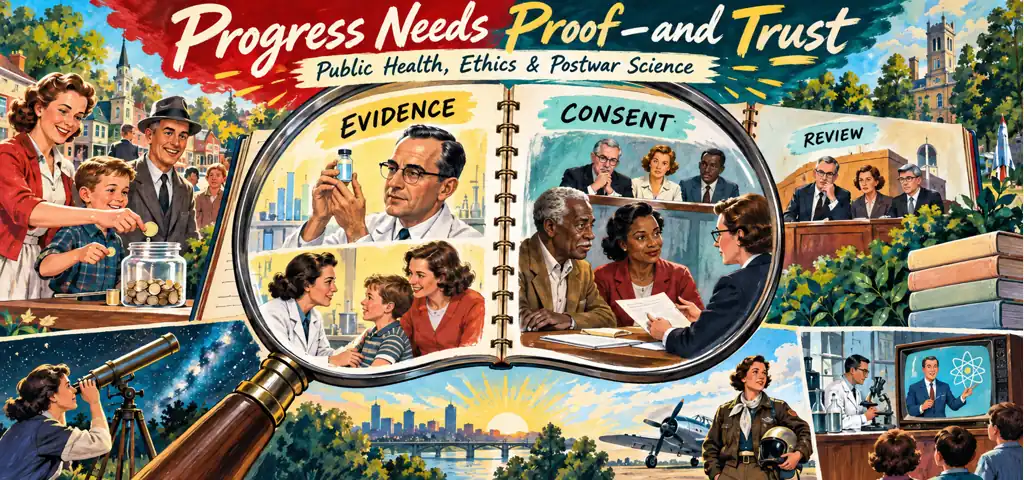
Chapter 12 of the CLEP History of the United States II study guide on Effortless Math covers Public Health, Medical Ethics, and Postwar Science: the key terms, the core ideas, and worked examples showing how this topic is tested on the exam.
CLEP History of the United States II, Chapter 12
Postwar public health joined fear, fundraising, and research
Polio epidemics returned in summer, and the United States recorded nearly 58,000 cases in 1952. Families kept children from pools, theaters, and crowds because transmission was poorly understood and no medicine cured the virus. The National Foundation for Infantile Paralysis, known through the March of Dimes, used small donations to support patients, rehabilitation, laboratories, and vaccine research. Public participation therefore financed both care and scientific investigation.
The Salk trial was a mass civic experiment
Jonas Salk developed an inactivated-virus vaccine. In 1954 roughly 1.8 million children participated as vaccine recipients, placebo recipients, or observed controls in a field trial financed principally by the National Foundation rather than a pharmaceutical cabinet department. The announcement of success in April 1955 brought enormous relief. Salk's vaccine sharply reduced disease, but distribution, manufacturing safety, later oral vaccine use, and continued surveillance were also necessary to turn a discovery into population protection.
Antibiotic success did not apply to every disease
Penicillin transformed treatment of many bacterial infections after wartime production expanded, but it could not cure viral polio. Distinguishing pathogen type prevents a common error in narratives of medical progress. A powerful treatment can change mortality for susceptible diseases while leaving other illnesses untouched. Public health combines therapy with vaccination, sanitation, surveillance, behavior, and communication because no single instrument addresses every mechanism of disease.
Tuskegee violated consent and denied effective treatment
Beginning in 1932 the Public Health Service observed Black men in Alabama with syphilis without telling them the true diagnosis or obtaining meaningful informed consent. Researchers continued the study after penicillin became the accepted effective therapy in the 1940s and worked to prevent participants from receiving it. The stakes had changed. The abuse included deception from the start and the later withholding of available treatment.
Exposure of abuse changed research governance
Public disclosure ended the Tuskegee study in 1972. The National Research Act of 1974 and later rules strengthened institutional review, informed consent, and principles governing research with human subjects. Rules cannot erase the harm or guarantee ethical behavior. They create independent review and documented obligations so that scientific value does not automatically override autonomy, risk, fair selection, and the right to refuse.
Belmont separated respect, beneficence, and justice
The Belmont Report organized research ethics around three related duties. Respect for persons supports voluntary, informed participation and added protection when autonomy is limited. Beneficence requires investigators to reduce harm and justify risk in relation to likely benefit and knowledge. Justice concerns fair subject selection and the distribution of burdens and benefits: researchers should not recruit a convenient or vulnerable population for risky work while a different, advantaged population receives most of the resulting benefit. One study can violate more than one principle, so identify the specific defect described.
The National Science Foundation supported civilian knowledge
Created in 1950, the National Science Foundation funded basic research and science education outside the narrower missions of weapons and medicine agencies. Federal support usually moved through competitive grants, contracts, fellowships, and institutionally operated laboratories. Washington did not create a cabinet department that owned and directed the laboratories of private corporations. The distinction between financing and performing research is central to postwar science policy.
Cold War and space spending changed the research system
Defense, atomic-energy, and space programs pushed the federal share of national research spending to a high point in the mid-1960s. Universities and firms performed much of the work under federal grants and contracts, while government laboratories and contractor-operated facilities filled other roles. Later business-financed research grew faster and the federal share declined. A falling share can coexist with rising federal dollars if total research spending grows more rapidly.
Astronaut selection exposed institutional barriers to women
In the early 1960s a privately organized group of women pilots completed medical testing comparable to that given male astronaut candidates. The tests did not produce NASA flight assignments: the agency required backgrounds such as military jet-test piloting that women had been barred from obtaining and did not recognize the private program as an astronaut selection. The episode shows how a formally stated credential can preserve earlier exclusion embedded in access to the qualifying career.
The smoking report translated epidemiology into warning
The 1964 Surgeon General's report concluded that cigarette smoking causes lung cancer and is a serious health hazard. Congress required warning labels in 1965, and later rules restricted broadcast advertising. The conclusion rested on converging population, clinical, laboratory, and exposure evidence rather than one dramatic experiment. Public-health causation often emerges from patterns that become convincing before every biological step is fully described.
Science popularization addressed democratic accountability
Carl Sagan, a Cornell astronomer, presented the 1980 public-television series Cosmos, created with Ann Druyan and Steven Soter. It explained astronomy, the history of science, and how evidence builds knowledge for a general audience. Popularization is not identical to original research, but it matters in a society that publicly finances complex work. Citizens need intelligible accounts of what institutions study, how claims are tested, and why uncertainty remains.
diagnose the ethical failure precisely
A prompt says Tuskegee was unethical because there was no cure in 1932.
Scientific achievement and ethical authority are separate questions
A vaccine may work biologically while a trial still requires voluntary participation and fair risk. Federal financing may expand knowledge while creating dependence on mission priorities. Popular television may explain research without replacing peer review. Evaluate postwar science along at least three axes: whether a claim is supported, whether people were treated ethically, and which institutions controlled money, access, and communication.
Watch the history in motion
This short lesson adds voices, images, and chronology to the ideas you just studied.
Video: NLM’s Collection on the US Public Health Service Syphilis Study at Tuskegee, National Library of Medicine.
Try four CLEP-style questions
- Which post-1974 safeguard most directly reduced investigators' power to decide for themselves whether a human-subject study was acceptable?
- A funding agency's decision that the research question deserved support
- Publication of the results after participants had completed the study
- Independent institutional review together with documented informed consent
- A participant's receipt of medical examinations during data collection
- A researcher's promise that the expected scientific value exceeded the cost
- A research team fully discloses a study's risks and obtains voluntary consent, yet exposes participants to a serious avoidable danger for little scientific value. Which ethical judgment is strongest?
- Consent satisfies all three Belmont principles because participants knowingly accepted the disclosed danger and its possible consequences.
- Payment proportionate to the danger converts an avoidable risk into fair subject selection and ethically permissible research.
- Justice is the only remaining concern because beneficence applies to clinical treatment rather than voluntary research protocols.
- Independent review adds no protection once a consent form explains every foreseeable injury and estimates its likelihood.
- Respect for persons may be satisfied, but beneficence still requires minimized risk and a defensible balance of harm and value.
- Which comparison most accurately distinguishes the Salk vaccine trial from the evidence behind the 1964 smoking report?
- The vaccine trial assigned comparison groups, while the smoking conclusion drew on converging population, clinical, and laboratory evidence.
- The vaccine trial observed an untreated infection, while the smoking report withheld an accepted therapy from participants.
- The vaccine trial tested a bacterial drug, while the smoking report measured the spread of a contagious virus.
- The vaccine trial used only laboratory animals, while the smoking report depended on one controlled human experiment.
- The vaccine trial relied on national mortality trends, while the smoking report randomly assigned participants to smoke or abstain.
- Why can a program such as Cosmos matter in a publicly financed research system without replacing peer review?
- Audience ratings settle technical disputes that research institutions cannot resolve.
- Viewers authorize grants directly after judging televised demonstrations.
- Public television converts science communication into original laboratory research.
- A scripted program verifies claims through presentation rather than replication.
- Public explanation helps citizens assess evidence, institutions, and uncertainty.
Check your answers and reasoning
Independent preparation. CLEP is a registered trademark of the College Board, which does not endorse this lesson.

Related to This Article
More math articles
- How to Use Area Models to Subtract Fractions with Like Denominators
- Environmental Corrective Actions and Area Cleaning
- 10 Most Common 8th Grade MCAS Math Questions
- How to Discovering Patterns: Using Graphs to Find Rules
- Studying Inequality Responsibly
- Free Nebraska Grade 2 English Worksheets
- Free Grade 5 Math Worksheet Library for Virginia (SOL): 49 Printable Skill Pages
- Three-Fifths Compromise
- Roles and Powers of the President
- The Best Grade 7 ELA Practice Tests for Mississippi Students








What people say about "Public Health, Medical Ethics, and Science"?
No one replied yet.