Short-run choice follows the monopoly rule
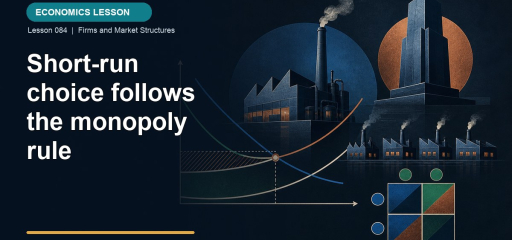
Short-run choice follows the monopoly rule: this Effortless Math guide explains the topic in plain language, shows how it works through solved examples, and gives you free practice to try immediately, so the idea sticks instead of staying abstract.
Differentiation gives each firm a downward-sloping demand curve.
A monopolistically competitive firm’s markup exists because
- downward-sloping demand permits price above marginal cost
- entry barriers protect permanent economic profit
- the firm faces perfectly elastic demand
- a regulator sets price above marginal cost
- average total cost is constant at every output
downward-sloping demand permits price above marginal cost Product differentiation creates downward-sloping demand, so the firm chooses an output where price exceeds marginal cost.
Advertising by a monopolistically competitive firm can be socially useful when it
- guarantees higher economic profit forever
- eliminates product differentiation
- reduces consumer information
- forces every rival to exit
- provides information that helps buyers compare products
provides information that helps buyers compare products Informative advertising can lower search costs and help consumers match products to preferences, although persuasive advertising may also create costs.
A differentiated seller faces downward-sloping demand. Its marginal revenue equals marginal cost at 80 units, and demand shows a price of $14 at that quantity. What is the short-run choice?
- Produce 80 units and charge $14
- Produce where price equals marginal cost
- Charge the marginal-revenue value
- Produce at minimum average total cost
- Exit regardless of average cost
Produce 80 units and charge $14 The firm uses marginal revenue and marginal cost to choose 80 units, then uses demand to find the price buyers will pay. Average total cost is still needed to measure profit, but it does not replace the output rule.
Watch the idea in action
A focused video lesson from Khan Academy.
The firm chooses quantity where MR equals MC and charges the price on demand. It can earn profit, break even, or incur loss. Advertising can shift demand right, make it less elastic by building loyalty, or simply raise cost. Its profitability depends on added revenue versus added cost.
In the short run, the graph is the same decision architecture as monopoly because the differentiated firm faces downward-sloping demand. MR lies below demand. Locate q at MR=MC, move up to firm demand for price, and compare price with ATC. The label “many firms” does not make the individual seller a price taker.
The firm may earn profit if price exceeds ATC, incur loss if price is below ATC but covers AVC, or shut down if price is below AVC. Entry has not yet had time to change the number of close substitutes. Short-run profit status is therefore not fixed by the market-structure label.
Product differentiation can be physical or perceived. Location and service are real differences even when the basic product is similar. Because close substitutes exist, demand is usually more elastic than monopoly demand but not perfectly elastic like a competitive firm’s.
Differentiation can involve features, quality, convenience, atmosphere, brand, or information. It gives the seller a limited customer base but also creates cross-price response with rivals. If one restaurant raises price, some customers remain due to location or preference while others switch.
Short-run differentiated-firm choice
A salon’s MR meets MC at 80 appointments. Its demand curve gives a price of $45, and ATC is $38. The salon earns (45-38)80=$560. It does not charge the MR value and it does not expect the profit to persist if comparable salons can enter.
Advertising should be treated as an investment. If an extra $1,000 campaign shifts demand enough to add more than $1,000 to profit, it is worthwhile. A sales increase alone does not prove success because the campaign and added service have costs. Informative advertising can increase elasticity by helping comparison, while loyalty advertising can reduce it. Use the stated mechanism.
Markup does not guarantee profit. A firm can have P>MC but P<ATC because fixed cost or weak demand produces a loss. Allocative markup and accounting of total cost are separate.
The short run assumes the number of firms fixed. If the question asks what occurs after profit attracts entry, shift to the long-run tangency analysis rather than leaving the initial demand curve unchanged.
The firm’s demand can shift without the market having a single homogeneous supply-and-demand graph. A successful advertisement, a new feature, or a rival’s exit can raise the firm’s demand and MR. An input-price change shifts MC. Recompute the intersection rather than applying a competitive price-taking response.
If advertising raises revenue by less than its cost, the campaign lowers profit even when sales rise. Strong answers compare incremental profit, not market share or total revenue alone. The same marginal logic governs the advertising decision.
Because firm demand slopes downward, P>MC can hold whether the firm earns profit or loss. Markup reflects differentiation. Profit also requires price to cover ATC. The two conclusions must be checked separately.

Reza is an experienced Math instructor and a test-prep expert who has been tutoring students since 2008. He has helped many students raise their standardized test scores--and attend the colleges of their dreams. He works with students individually and in group settings, he tutors both live and online Math courses and the Math portion of standardized tests. He provides an individualized custom learning plan and the personalized attention that makes a difference in how students view math.
Related to This Article
More math articles
- Values, Beliefs, Norms, and Sanctions
- How to Use Number Lines for Multiplication by a Negative Integer?
- Question Types on the ACT Math Test
- Full-Length SSAT Upper Level Practice Test-Answers and Explanations
- Michigan M-STEP Grade 4 Math Free Worksheets: Free Standards-Aligned Worksheets, Answers Included
- ATI TEAS Math Study Plan: A 30-Day Roadmap to a Top Score
- How to Write the Equation of a Sine Graph
- The Ultimate TABE Math Formula Cheat Sheet
- Rule of Four
- How Viruses Replicate: Life Cycles and Practice Questions




















What people say about "Short-Run Choice Follows the Monopoly Rule"?
No one replied yet.