Additive and multiplicative relationships

Quick answer: In an additive relationship, you add the same number to x to get y, so y = x + b. In a table, y − x is the same in every row. Example: x = 1, 2, 3 and y = 5, 6, 7 gives y − x = 4 each time, so y = x + 4. In a multiplicative one, y ÷ x stays the same (y = kx).
An additive relationship has a constant difference between the paired values, so y = x + b; a multiplicative one has a constant ratio, so y = kx. Below: how to tell which a table shows, what each looks like on a graph, and worked examples.
A step-by-step guide to identifying Additive and multiplicative relationships
An additive relationship has a constant difference between corresponding values. For pairs ( (x,y) ), this means (y-x=b) for the same constant (b), or equivalently (y=x+b).
A multiplicative relationship has a constant ratio between corresponding values: when (xne0), (y/x=k) for the same constant (k), or equivalently (y=kx).
Related Grade 6 Math Topics
The Absolute Best Book to Ace Grade 6 Math

Both Additive and Multiplicative relationships are fundamental to understanding and solving many mathematical problems, and have numerous practical applications in real-life scenarios.
Here is a step-by-step guide for identifying Additive and Multiplicative relationships:
- Identify the paired values: Treat each observation as a corresponding ( (x,y) ) pair; do not classify a relationship just because two numbers can be added or multiplied.
- Check for a constant difference: Compute (y-x) for several pairs. If it is the same value (b) each time, the pairs follow the additive rule (y=x+b).
- Check for a constant ratio: When the compared (x)-values are nonzero, compute (y/x) for several pairs. If it is the same value (k), the pairs follow the multiplicative rule (y=kx).
- Verify the rule on additional pairs: Apply the same difference or ratio test to more corresponding values. A single pair cannot establish that the relationship is constant.
- Use the confirmed rule to find a missing paired value: substitute the known value into (y=x+b) or (y=kx), then check the result against the relationship.
Remember that identifying Additive and Multiplicative relationships requires careful observation, analysis, and verification. By following these steps, you should be able to effectively identify and understand these relationships.
Additive and multiplicative relationships, Example 1
What relationship does (m=2+h) show? For (h=0,1,2), the corresponding (m)-values are (2,3,4).
Solution:
The differences (m-h) are (2,2,2), so the difference is constant. This is an additive relationship: (m=h+2).
Additive and multiplicative relationships, Example 2
What relationship (additive/ multiplicative) does the following table show?

Solution:
Compare each corresponding table pair ((x,y)). For (x=1,2,3,4), the ratios (y/x) are all (7). The ratio is constant, so the relationship is multiplicative: (y=7x).
Mastering Grade 6 Math
Mastering Grade 6 Math Word Problems

How to Tell Which Table Shows an Additive Relationship
Test questions often show two or three tables and ask which one is additive. Use this quick check on each table.
- For every row, subtract: y − x.
- If the answer is the same in every row, the table is additive. Write the rule as y = x + (that number).
- If the differences change, divide instead: y ÷ x. If that answer is the same in every row, the table is multiplicative, y = kx.
| x | Table A: y | y − x | Table B: y | y ÷ x |
|---|---|---|---|---|
| 1 | 6 | 5 | 3 | 3 |
| 2 | 7 | 5 | 6 | 3 |
| 3 | 8 | 5 | 9 | 3 |
| 4 | 9 | 5 | 12 | 3 |
Table A is additive because y − x is always 5, so y = x + 5. Table B is multiplicative because y ÷ x is always 3, so y = 3x. Notice that in Table B the differences are 2, 4, 6 and 8, so the subtraction test fails.
Additive vs. Multiplicative Relationships on a Graph
Both kinds of relationships graph as straight lines, but the lines behave differently.
- Additive (y = x + b): the line always goes up 1 for every 1 step to the right, so its slope is 1. It crosses the y-axis at b, not at the origin (unless b = 0).
- Multiplicative (y = kx): the line always passes through the origin (0, 0). Its steepness depends on k. For y = 3x, it goes up 3 for every 1 step right.
A real-life additive example: Sam is always 3 years older than his sister. When she is 5, he is 8. When she is 10, he is 13. The gap never changes, so Sam’s age = sister’s age + 3. A real-life multiplicative example: each ticket costs $4, so the total cost = 4 × number of tickets.
One special case: y = x is both additive (y = x + 0) and multiplicative (y = 1 × x).
Frequently Asked Questions
What is an additive relationship?
An additive relationship is a pattern where you always add the same number to x to get y, so it can be written as y = x + b. The quickest check in a table is to compute y − x for every row. If that difference never changes, the relationship is additive, and the constant difference is the value of b in the rule.
Which table shows an additive relationship?
The table where y − x gives the same result in every row shows an additive relationship. For example, x = 2, 5, 8 with y = 8, 11, 14 gives a difference of 6 each time, so y = x + 6. A table with x = 2, 5, 8 and y = 6, 15, 24 is not additive, because the differences are 4, 10 and 16. Its ratio is always 3, so it is multiplicative.
What is a multiplicative relationship?
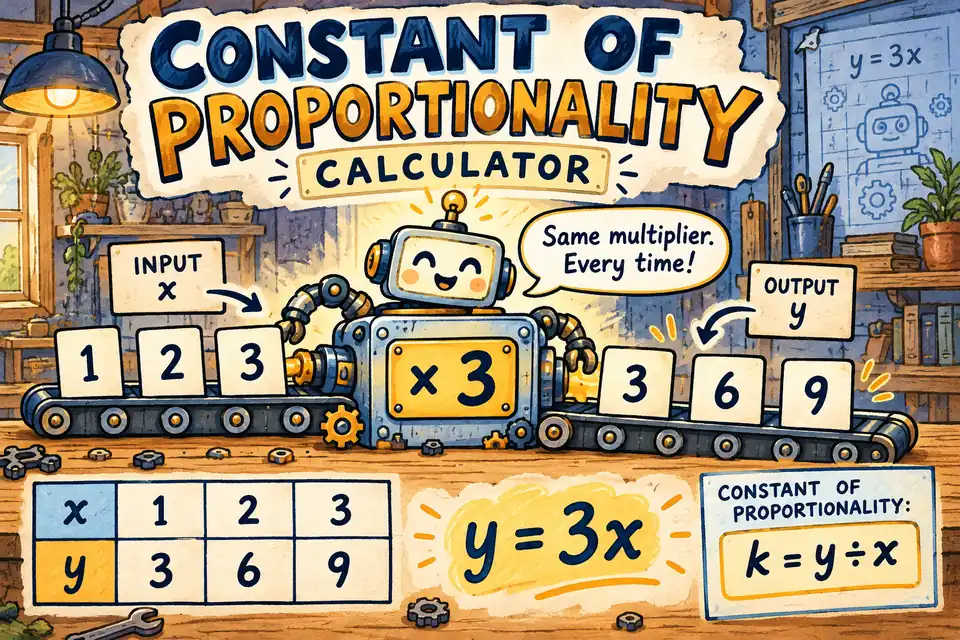
A multiplicative relationship is one where y is always the same multiple of x, written y = kx. Dividing y by x gives the same number k in every row. For example, if each movie ticket costs $4, then 1 ticket costs $4, 2 tickets cost $8 and 5 tickets cost $20. Every row has y ÷ x = 4, so the rule is y = 4x.
What is an example of an additive relationship?
Siblings’ ages are a classic example. If Sam is 3 years older than Mia, then Sam’s age is always Mia’s age + 3. When Mia is 5, Sam is 8. When Mia is 10, Sam is 13. The ages keep the same difference of 3 every year, even though the ratio between them keeps changing, which is why this is additive and not multiplicative.
What does an additive relationship look like on a graph?
An additive relationship y = x + b graphs as a straight line that rises 1 unit for every 1 unit to the right, and it crosses the y-axis at b instead of at the origin (unless b = 0). A multiplicative relationship y = kx is also a straight line, but it always passes through (0, 0) and its steepness depends on k.
What is the difference between additive and multiplicative relationships?
In an additive relationship the two values differ by a constant amount (y = x + b), while in a multiplicative relationship they share a constant ratio (y = kx). Test both. For the pairs (3, 6), (4, 8) and (7, 14), the differences are 3, 4 and 7, so it is not additive. The ratios are all 2, so it is multiplicative with y = 2x.

Related to This Article
More math articles
- How to Pass the HiSET Math Test: 2026 Strategy Guide
- How to Prepare for the Next-Generation ACCUPLACER Math Test?
- Advanced Vocabulary Words: Emit to Fanatic
- Compare the Temperatures Above and Below Zero
- How to Solve Powers of Products and Quotients? (+FREE Worksheet!)
- Excess Capacity: Zero Profit, Markup and Minimum ATC
- The Ultimate NM-MSSA Algebra 1 Course (+FREE Worksheets)
- How to Compare Two Linear Functions? (+FREE Worksheet!)
- The Best Algebra 1 Book for Indiana Students
- Types of Sequences and Series: Examples, Formulas & Practice

















What people say about "Additive Relationship: Definition, Tables and Examples"?
No one replied yet.