Square Root Simplifier (Simplest Radical Form, with Steps)
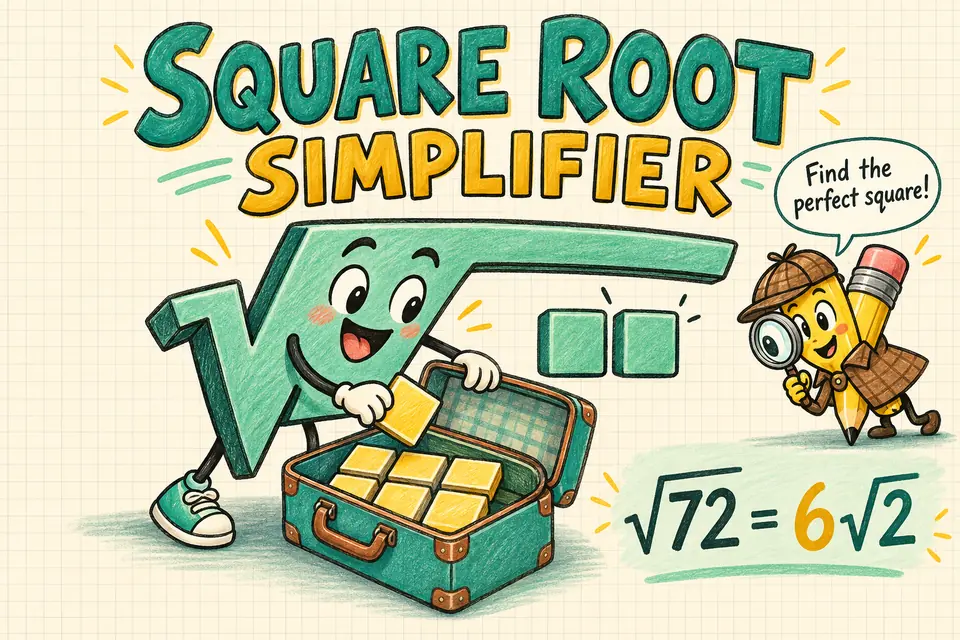
To simplify a square root, find the largest perfect square that divides the number, take its root outside, and leave the rest inside: √72 = √36 × √2 = 6√2. This square root simplifier does that for any whole number up to one trillion and shows the prime factorization and every step. Practice questions below the calculator let you check that the method has stuck.
How to use the Square Root Simplifier
- Type the number under the square root sign in the box labeled n, for example 72.
- If the radical has a number in front, such as 3√50, type that number in the “In front (a)” box. Otherwise leave it empty.
- Press Simplify (or Enter). The green box shows the simplest radical form and a decimal check.
- Read the steps: prime factorization, the pairs of equal primes, the largest perfect-square factor, and the final split of the root.
- Scroll down to the practice section and try a few questions on your own. Your score is kept as you go.
How to simplify a square root by hand
A square root is in simplest radical form when the number left under the root has no perfect-square factor other than 1. The whole method rests on one rule: the square root of a product is the product of the square roots, √(x·y) = √x · √y. If one of the factors is a perfect square, its root is a whole number and it can move outside.
There are two reliable ways to find that perfect square.
- Perfect-square method. Test the perfect squares 4, 9, 16, 25, 36, 49, 64, 81, 100, … and use the largest one that divides your number.
- Prime factorization method. Break the number into primes, circle each pair of equal primes, and bring one prime from each pair outside the root. Anything without a partner stays inside. This works even for large numbers where guessing the perfect square is hard.
Example 1: Simplify √180
Prime factorization: 180 = 2 × 2 × 3 × 3 × 5 = 2² × 3² × 5.
Pairs: (2 × 2) and (3 × 3). The 5 has no partner, so it stays inside.
Largest perfect-square factor: 2² × 3² = 4 × 9 = 36. So 180 = 36 × 5.
Split the root: √180 = √36 × √5 = 6√5.
Check: 6² × 5 = 36 × 5 = 180. As a decimal, 6√5 ≈ 13.4164, and √180 ≈ 13.4164 as well.
Example 2: Simplify 2√98
Start with the radical and deal with the 2 in front at the end.
Prime factorization: 98 = 2 × 7 × 7 = 2 × 7².
Largest perfect-square factor: 7² = 49, so 98 = 49 × 2 and √98 = √49 × √2 = 7√2.
Multiply by the number in front: 2 × 7√2 = 14√2.
Check: 14² × 2 = 196 × 2 = 392, and (2√98)² = 4 × 98 = 392. The two match, so 2√98 = 14√2 ≈ 19.799.
Quick reference: common square roots in simplest radical form
These come up again and again in algebra and geometry. Knowing a handful of them by sight saves a lot of time on tests.
| Square root | Largest perfect-square factor | Simplest radical form |
|---|---|---|
| √8 | 4 | 2√2 |
| √12 | 4 | 2√3 |
| √18 | 9 | 3√2 |
| √20 | 4 | 2√5 |
| √24 | 4 | 2√6 |
| √27 | 9 | 3√3 |
| √32 | 16 | 4√2 |
| √45 | 9 | 3√5 |
| √48 | 16 | 4√3 |
| √50 | 25 | 5√2 |
| √72 | 36 | 6√2 |
| √75 | 25 | 5√3 |
| √98 | 49 | 7√2 |
| √128 | 64 | 8√2 |
| √200 | 100 | 10√2 |
Common mistakes when simplifying radicals
- Stopping too early. Writing √72 = 2√18 is true, but 18 still contains the perfect square 9. Keep going: 2√18 = 2 × 3√2 = 6√2. Using the largest perfect-square factor from the start avoids this.
- Bringing out the wrong number. In √12 = √4 × √3, the 4 comes out as its root, 2. The answer is 2√3, not 4√3.
- Splitting a sum. The product rule does not work for addition. √(9 + 16) = √25 = 5, but √9 + √16 = 3 + 4 = 7.
- Forgetting the number in front. In 3√50, simplify √50 = 5√2 and then multiply: 3 × 5√2 = 15√2.
- Trying to simplify a prime. √13, √17 and √97 are already in simplest form. A prime has no perfect-square factor other than 1.
If prime factorization itself is the slow part, the prime factorization calculator shows the factor tree step by step.
When you need simplest radical form
Students first meet square roots of perfect squares and the idea that √2 is irrational in grade 8 (Common Core 8.EE.A.2). Simplifying radicals such as √72 is usually taught in Algebra 1, and rewriting radical expressions with the properties of exponents is part of the high school standard HSN.RN.A.2.
After that, simplified radicals show up everywhere. The Pythagorean theorem and the distance formula often give answers like √50 = 5√2. The quadratic formula produces expressions such as (4 ± √12)/2. Special right triangles are written entirely in radicals: a 45-45-90 triangle with legs of 5 has a hypotenuse of 5√2, which you can explore with the special right triangles calculator. Teachers ask for simplest radical form because it is exact, while a decimal like 7.0711 is only an approximation.
Radicals are also exponents in disguise: √x = x^(1/2). The exponent rules calculator is a good companion when you move on to rational exponents.
Check your answer
You can check any simplified radical in two quick ways. First, square the number outside and multiply by the number inside; you should get the original number back. For 6√5, that is 36 × 5 = 180. Second, look at the number left inside and make sure no perfect square (4, 9, 16, 25, …) divides it. If both checks pass, your answer is in simplest radical form.
Simplifying square roots practice quiz: 10 questions
Test yourself with 10 multiple-choice questions. Choose an answer and press Submit to see if you are right and why. Your score appears at the end.
72 = 36 × 2, and 36 is the largest perfect-square factor. √72 = √36 × √2 = 6√2. The choices 3√8 and 2√18 equal √72 too, but 8 and 18 still contain perfect-square factors, so they are not in simplest form.
The largest perfect-square factor of 180 is 36 (180 = 36 × 5). So √180 = 6√5. 3√20 is equal in value but 20 still has the factor 4.
30 = 2 × 3 × 5 has no repeated prime factor, so no perfect square divides it. 48 = 16 × 3, 75 = 25 × 3 and 98 = 49 × 2 can all be simplified.
√12 = √4 × √3 = 2√3. Then 3 × 2√3 = 6√3. Check: 6² × 3 = 108 and 3² × 12 = 108.
200 = 100 × 2, so √200 = 10√2. 2√50 has the right value but 50 still contains 25.
96 = 16 × 6, and 6 has no perfect-square factor, so 16 is the largest. 32 and 48 are factors of 96 but are not perfect squares. This gives √96 = 4√6.
108 = 36 × 3, so √108 = 6√3. Check by squaring: 6² × 3 = 108. The others give 54, 112 and 432.
Side = √128. 128 = 64 × 2, so √128 = 8√2 cm. 4√8 has the same value but is not simplified.
Quiz complete
Frequently asked questions
How do you simplify a square root?
Find the largest perfect square that divides the number under the root, write the number as that perfect square times the leftover factor, and take the root of the perfect square outside. For example, √48 = √16 × √3 = 4√3.
What is the square root of 72 in simplest radical form?
The square root of 72 in simplest radical form is 6√2. The largest perfect square that divides 72 is 36, so √72 = √36 × √2 = 6√2, which is about 8.4853.
How do I know if a square root is fully simplified?
A square root is fully simplified when the number left under the root has no perfect-square factor other than 1. Check by dividing it by 4, 9, 16, 25, 36 and so on, up to the number itself. If none of them divide evenly, you are done.
Can you simplify the square root of a prime number?
No. A prime number has no perfect-square factor except 1, so roots such as √2, √7, √23 and √97 are already in simplest radical form. You can still give a decimal approximation, for example √7 ≈ 2.6458.
How do you simplify a square root with a number in front?
Simplify the radical first, then multiply the number in front by the number that came out. For 3√50, √50 = 5√2, so 3√50 = 3 × 5√2 = 15√2.
Can you simplify the square root of a negative number?
Not with real numbers, because no real number squared gives a negative result. With imaginary numbers you write √(−n) = i√n and then simplify √n as usual, so √(−72) = 6i√2. This calculator works with real numbers, so it accepts 0 and positive whole numbers.

Related to This Article
More math articles
- How to Calculate Unit Prices and Total Price
- Presidential elections
- Roman Numerals Converter (Number ↔ Roman, Free)
- Proportions Practice — Solve for the Unknown (Free)
- Single-Skill Grade 5 Math for West Virginia (WVGSA): 49 Free Practice PDFs, No Signup
- Montana MAST Grade 4 Math Free Worksheets: Free Printable PDF Worksheets with Full Solutions
- Denotation and Connotation
- What Is the Highest Score for SHSAT Test?
- Transitive Property: Definition, Geometry Examples & Practice
- Can You Change Answers on the NREMT AEMT Exam? (2027 Prep)















What people say about "Square Root Simplifier: Simplest Radical Form with Steps"?
No one replied yet.