Pythagorean Theorem Calculator (Find the Missing Side, with Steps)
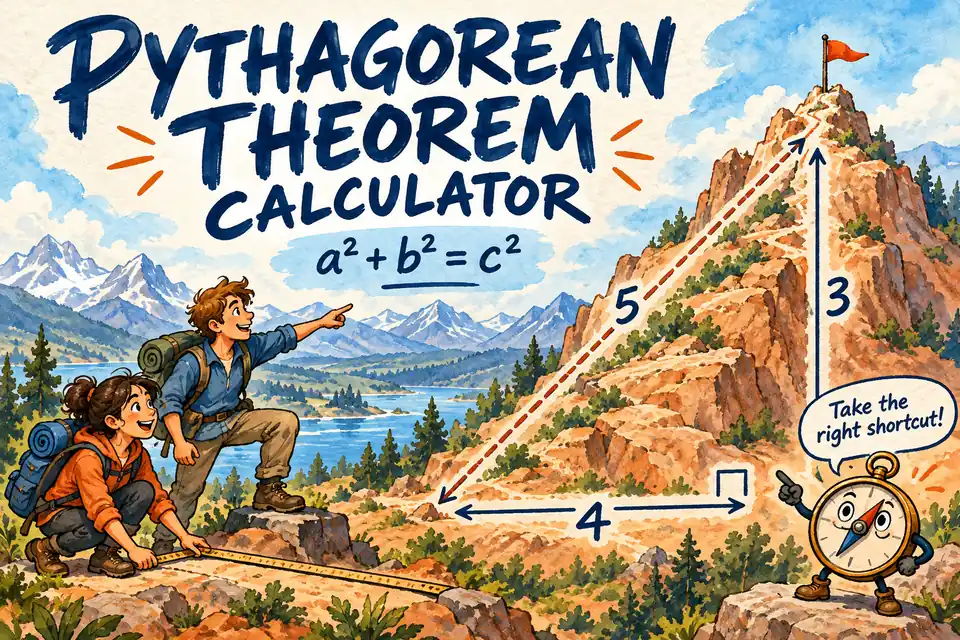
To find a missing side of a right triangle, use a² + b² = c²: add the squares of the legs and take the square root to get the hypotenuse, or subtract to get a leg. This Pythagorean theorem calculator does that for you, gives the answer in exact simplified radical form and as a decimal, draws the triangle, and spots Pythagorean triples. A second mode checks whether three side lengths make a right triangle.
How to use the Pythagorean Theorem Calculator
- Choose “Find a missing side” or “Is it a right triangle?”.
- To find a side, pick what you are solving for: c (the hypotenuse) or one of the legs, a or b. That box is grayed out.
- Enter the two sides you know. Whole numbers and decimals (up to 3 places) both work.
- Press Calculate or Enter. You get the exact answer, a decimal rounded to 4 places, a labeled diagram, and the full working.
- To test three sides, switch modes and type them in any order. The calculator finds the longest side for you.
How to find a missing side by hand
In a right triangle, the two sides that form the right angle are the legs, a and b. The side across from the right angle is the hypotenuse, c. It is always the longest side. The Pythagorean theorem says:
a² + b² = c²
That gives two versions of the same formula:
- Missing hypotenuse: c = √(a² + b²). Square the legs, add, take the square root.
- Missing leg: a = √(c² − b²). Square both sides you know, subtract the leg from the hypotenuse, take the square root.
Example 1: Find the hypotenuse when the legs are 6 and 9
Write the theorem: 6² + 9² = c².
Square and add: 36 + 81 = 117, so c² = 117.
Take the square root: c = √117.
Simplify the radical. The largest perfect square that divides 117 is 9, because 117 = 9 × 13. So √117 = √9 × √13 = 3√13.
Answer: c = 3√13 ≈ 10.82. That is longer than both legs, as a hypotenuse should be.
Example 2: Find a leg when the hypotenuse is 10 and the other leg is 4
Write the theorem with the unknown leg: a² + 4² = 10².
Subtract: a² = 100 − 16 = 84.
Take the square root: a = √84.
Simplify: 84 = 4 × 21, and 21 has no perfect-square factor, so √84 = √4 × √21 = 2√21.
Answer: a = 2√21 ≈ 9.17. Check: 84 + 16 = 100 = 10². ✓
Pythagorean triples to know
A Pythagorean triple is a set of three whole numbers that fit a² + b² = c². When a problem uses one, the answer comes out as a whole number, and recognizing it saves the arithmetic. Any whole-number multiple of a triple is also a triple.
| Triple (a, b, c) | Check a² + b² = c² | Some multiples |
|---|---|---|
| 3, 4, 5 | 9 + 16 = 25 | 6, 8, 10 and 9, 12, 15 |
| 5, 12, 13 | 25 + 144 = 169 | 10, 24, 26 |
| 8, 15, 17 | 64 + 225 = 289 | 16, 30, 34 |
| 7, 24, 25 | 49 + 576 = 625 | 14, 48, 50 |
| 20, 21, 29 | 400 + 441 = 841 | 40, 42, 58 |
| 9, 40, 41 | 81 + 1,600 = 1,681 | 18, 80, 82 |
Common mistakes
- Adding when you should subtract. If the hypotenuse is given, you are finding a leg, so subtract: a² = c² − b². Adding gives a leg longer than the hypotenuse, which is impossible.
- Stopping at c². In Example 1, c² = 117, but c is √117. Always take the square root at the end.
- Thinking √(a² + b²) = a + b. For legs 3 and 4, √(9 + 16) = √25 = 5, not 3 + 4 = 7.
- Putting the wrong side in for c. The hypotenuse is opposite the right angle and is the longest side. When checking three lengths, the largest one must play the role of c.
- Rounding too early. Keep exact values like 117 or √117 until the last step, then round once.
- Using it on any triangle. The theorem only applies to right triangles. For other triangles, use the law of cosines or a general triangle calculator.
Is it a right triangle? The converse
The converse of the Pythagorean theorem works the other way around. Square the two shorter sides and add them, then compare with the square of the longest side:
- a² + b² = c²: the triangle is a right triangle.
- a² + b² > c²: the triangle is acute (every angle is less than 90°).
- a² + b² < c²: the triangle is obtuse (one angle is more than 90°).
For sides 5, 6 and 7: 25 + 36 = 61, which is greater than 49, so the triangle is acute. Before any of that, the two shorter sides must add up to more than the longest side, or the lengths cannot form a triangle at all (1, 2 and 3 fail this test).
Where the Pythagorean theorem is used
In the Common Core standards, the theorem is a grade 8 geometry topic. Students explain a proof of the theorem and its converse (8.G.B.6), use it to find unknown side lengths in right triangles in two and three dimensions (8.G.B.7), and apply it to find the distance between two points on a coordinate grid (8.G.B.8). It stays in use through high school geometry, trigonometry and the SAT and ACT.
The distance formula is the Pythagorean theorem in coordinate form, which you can see step by step in the distance and midpoint calculator. The 45-45-90 and 30-60-90 shortcuts also come straight from it; see the special right triangles calculator. Everyday examples include the length of a ladder against a wall, the diagonal of a TV screen, and checking that a corner is square in carpentry with the 3-4-5 rule.
Check your answer
Two quick checks catch most errors. First, the hypotenuse must be the longest side: if your leg came out longer than c, you added instead of subtracting. Second, plug all three sides back into a² + b² = c². With an exact radical answer this is easy, because (3√13)² = 9 × 13 = 117.
Pythagorean theorem practice quiz: 10 questions
Test yourself with 10 multiple-choice questions. Choose an answer and press Submit to see if you are right and why. Your score appears at the end.
c² = 6² + 8² = 36 + 64 = 100, so c = √100 = 10. 14 comes from adding the legs, and 100 is c², not c.
b² = 13² − 5² = 169 − 25 = 144, so b = 12. When the hypotenuse is known, subtract the squares.
c² = 25 + 49 = 74, so c = √74 ≈ 8.60. 74 has no perfect-square factor, so √74 is already simplest form.
Check a² + b² = c² with the longest side as c: 81 + 1600 = 1681 = 41². The others fail: 36 + 49 = 85 ≠ 81, 64 + 100 = 164 ≠ 169, 25 + 121 = 146 ≠ 144.
The ladder is the hypotenuse: h² = 15² − 9² = 225 − 81 = 144, so h = 12 ft.
The diagonal splits the rectangle into two right triangles: d² = 400 + 441 = 841, so d = 29 cm.
The horizontal change is 3 and the vertical change is 4. Distance = √(3² + 4²) = √25 = 5.
Quiz complete
Frequently asked questions
How do you find the missing side of a right triangle?
Use a² + b² = c². If the hypotenuse is missing, add the squares of the two legs and take the square root. If a leg is missing, subtract the square of the known leg from the square of the hypotenuse, then take the square root.
What is the formula for the hypotenuse?
The hypotenuse is c = √(a² + b²), where a and b are the legs. For legs 5 and 12, c = √(25 + 144) = √169 = 13.
Does the Pythagorean theorem work for all triangles?
No. It only works for right triangles. For a triangle without a right angle, use the law of cosines, c² = a² + b² − 2ab·cos C, which reduces to the Pythagorean theorem when angle C is 90°.
How do you know if three sides make a right triangle?
Square the two shorter sides and add them. If the sum equals the square of the longest side, it is a right triangle. For 9, 12 and 15: 81 + 144 = 225 = 15², so it is a right triangle.
What is a Pythagorean triple?
A Pythagorean triple is a set of three whole numbers that satisfy a² + b² = c², such as 3, 4, 5 or 5, 12, 13. Multiplying a triple by any whole number gives another triple, so 6, 8, 10 is one too.
Which side is the hypotenuse?
The hypotenuse is the side opposite the right angle. It is always the longest side of a right triangle, and it is the c in a² + b² = c².

Related to This Article
More math articles
- Limits on judicial power
- Stability and change in opinion
- CBEST Math Worksheets: Free Printable PDFs
- The Slope of The Slope: Second Derivatives
- Voting Rights in the United States: Expansion and Barriers
- Intelligent Math Puzzle – Challenge 81
- How to Solve Coterminal Angles and Reference Angles? (+FREE Worksheet!)
- Free Grade 6 English Worksheets for Pennsylvania Students
- The Best Grade 8 Math Book for Texas Students
- 10 Most Common 5th Grade ACT Aspire Math Questions


















What people say about "Pythagorean Theorem Calculator: Missing Side with Steps"?
No one replied yet.