Free Grade 3 English Worksheets for Tennessee Students
There’s a small moment in every Tennessee third grader’s year when reading stops being about getting through the page and starts being about understanding it. You can almost see it happen, the kid reads a paragraph, looks up, and says something like *wait, but the author kind of hates winter, doesn’t she?* That’s the year. That’s the leap. And TCAP, when it comes around, is checking whether your kid has made it.
The worksheets on this page are built for that exact transition. They use short passages, the kind that fit on one side of a sheet, and they ask the kinds of questions Tennessee Academic Standards push for: what’s the main idea, where’s the proof, what does this word mean in this sentence, how would you rewrite this so it’s clearer. Each link is a PDF. There’s no signup, no popup, no “create an account to download.” Click, print, use.
Bring a worksheet to the kitchen table. Bring it to a long car ride. Hand it to a tutor or a babysitter. It’s yours.
What’s in here
Tennessee Academic Standards for Grade 3 ELA cover the whole reading and writing arc, literature, informational text, foundational skills, writing, speaking and listening, and language. The worksheets below cover every standard area, with one focused page per skill.
A small honest note before the list: don’t try to use all of these. Use one tonight, another later this week, maybe two next week. A worksheet that’s overdone becomes a worksheet that doesn’t teach.
Reading: Literature
- Text Evidence in Stories, [RL.3.1] find proof in the story for what you say about it
- Central Message, Lesson, or Moral, [RL.3.2] figure out the lesson a story teaches
- Describing Characters in a Story, [RL.3.3] traits, feelings, motivations
- Literal and Nonliteral Language, [RL.3.4] the difference between what words say and what they mean
- Parts of Stories, Dramas, and Poems, [RL.3.5] chapters, scenes, stanzas
- Point of View in Stories, [RL.3.6] who’s telling the story
- Illustrations in Stories, [RL.3.7] reading the pictures alongside the words
- Comparing Stories, [RL.3.9] two stories side by side
Reading: Nonfiction
- Text Evidence in Nonfiction, [RI.3.1] back up answers with the article itself
- Main Idea and Key Details, [RI.3.2] what the passage is mostly about, and the facts that support it
- Sequence, Steps, and Cause & Effect, [RI.3.3] first, next, because, so
- Vocabulary in Nonfiction, [RI.3.4] the topic-specific words in science and social-studies texts
- Text Features in Nonfiction, [RI.3.5] headings, sidebars, captions
- Author’s Point of View in Nonfiction, [RI.3.6] what the writer thinks vs. Plain facts
- Using Maps, Photos, and Diagrams, [RI.3.7] the picture is doing some of the work
- Logical Connections in Nonfiction, [RI.3.8] how paragraphs connect
- Comparing Two Texts on the Same Topic, [RI.3.9] two articles, same topic, different angles
Foundational Reading Skills
- Prefixes and Suffixes, [RF.3.3a] word parts that change meaning
- Words with Latin Suffixes, [RF.3.3b] -tion, -sion, -able
- Decoding Multisyllable Words, [RF.3.3c] break the long ones into pieces
- Irregularly Spelled Words (Sight Words), [RF.3.3d] the tricky words that just have to be memorized
- Reading Fluency: Rate and Expression, [RF.3.4b] read aloud so it sounds like talking
- Self-Correcting While You Read, [RF.3.4c] fix it when the sentence stops making sense
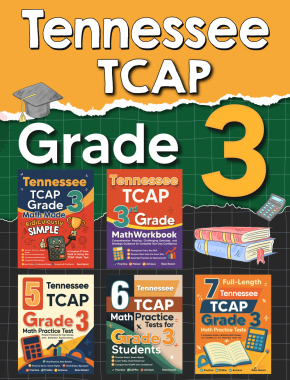
Working on Math Too? Try the Tennessee TCAP Grade 3 Math Bundle
Many third graders are getting ready for the TCAP in both subjects. If your child also needs math practice that matches the same standards, this companion bundle is the shortest path, workbook, study guide, and full practice tests in one download.
Writing
- Opinion Writing, [W.3.1] say what you think and back it up
- Informative/Explanatory Writing, teach someone something they didn’t know
- Narrative Writing, [W.3.3] tell a story in order, with details
- Organizing Writing for Task and Purpose, [W.3.4] different writing for different jobs
- Editing and Revising, [W.3.5] make a draft better, one pass at a time
- Short Research Project, [W.3.7] ask a question, find some answers
- Gathering Information and Taking Notes, [W.3.8] write down what you find, not everything you see
Listening and Speaking
- Listening for Main Idea (Read-Aloud), what was that mostly about?
- Asking Questions of a Speaker, what to ask after a presentation
- Reporting on a Topic, telling a class about something, clearly
Grammar
- Parts of Speech, nouns, pronouns, verbs, adjectives, adverbs
- Regular and Irregular Plural Nouns, [L.3.1b] tables; geese; children
- Abstract Nouns, [L.3.1c] words for ideas and feelings
- Regular and Irregular Verbs, [L.3.1d] walked vs. Went
- Simple Verb Tenses, past, present, future
- Subject, Verb and Pronoun, Antecedent Agreement, [L.3.1f] the dog barks; the dogs bark
- Comparative and Superlative Adjectives and Adverbs, [L.3.1g] fast, faster, fastest
- Coordinating and Subordinating Conjunctions, [L.3.1h] and, but, because, when
- Simple, Compound, and Complex Sentences, [L.3.1i] all three sentence types
Capitalization, Punctuation, and Spelling
- Capitalizing Words in Titles, [L.3.2a] title-case rules
- Commas in Addresses and Dates, [L.3.2b] where the commas go
- Commas and Quotation Marks in Dialogue, [L.3.2c] punctuating what characters say
- Possessives, [L.3.2d] showing that something belongs
- Conventional Spelling, common words you’ll spell often
- Spelling Patterns and Generalizations, [L.3.2f] the rules behind the spellings
- Using Reference Materials to Check Spelling, [L.3.2g] look it up to confirm
Vocabulary and Word Study
- Word Choice for Effect, [L.3.3a] pick vivid words for a stronger sentence
- Spoken vs. Written English, [L.3.3b] casual vs. Formal
- Context Clues, [L.3.4a] use surrounding words to find meaning
- Affixes for Vocabulary, [L.3.4b] use word parts to figure out meaning
- Root Words, [L.3.4c] the base word inside a longer one
- Using Glossaries and Beginning Dictionaries, [L.3.4d] look up words to confirm meaning
- Figurative Language: Similes, Metaphors, and Idioms, [L.3.5a] read figurative phrases with confidence
- Real-Life Word Connections, [L.3.5b] connect words to real situations
- Shades of Meaning, [L.3.5c] tell apart words with similar meanings
- Academic and Domain-Specific Vocabulary, [L.3.6] Grade 3 academic words
How to actually use these
A pile of worksheets isn’t a plan. Here are the four habits that turn a single page into actual learning.
Pick by the wobble. Whatever your kid stumbled on this week, the spelling test, the social-studies paragraph, the spelling word that came up at dinner, pick the worksheet that targets that. Don’t pick by what looks easy.
Read the Quick Review aloud. That gray box at the top is the lesson in miniature. Treat it like a mini teacher. Read it together, talk through the example, then your kid takes the pencil.
Step back. Once your child is working, leave the table. Make coffee. Move laundry. Independent struggle is most of the practice. Coming back too soon shrinks the learning.
Use the answer key as a tutor. After the page is done, sit down together. Don’t grade, *discuss*. Read the explanations for the wrong answers. Have your child put the reasoning in their own words. That’s where the worksheet stops being a worksheet and starts being a lesson.
Read with your kid every day. Not as a chore. Twenty minutes of reading aloud, taking turns, sharing the work, does more for TCAP scores than any worksheet ever will.
What about TCAP?
The TCAP ELA in Grade 3 is built around short reading passages, a mix of multiple-choice and short constructed-response questions, and a writing task that asks for evidence from a text. The skills it weighs heaviest are exactly the ones your kid’s teacher is already drilling all year: main idea, evidence, vocabulary in context, and writing that is *organized*.
For one place to start: Main Idea and Key Details is the single highest-use worksheet for TCAP-style reading. Text Evidence in Nonfiction pairs well with it. Context Clues is the third one I’d add, because it solves the “I don’t know that word” problem before it becomes a “I don’t understand this paragraph” problem.
For writing, Organizing Writing for Task and Purpose and Editing and Revising are the two that quietly improve scored writing without anyone calling it test prep.
Tennessee parents often ask
Are these aligned with Tennessee Academic Standards? Yes. Each worksheet maps to a specific Grade 3 ELA standard from the Tennessee framework.
Will these work in our homeschool? Yes, and you can print as many copies as you need. Plenty of Tennessee homeschool families use these as the practice spine of their ELA day.
My kid is reading above grade level, what do I pick? Try Comparing Two Texts on the Same Topic and Figurative Language. Both push deeper without leaving third-grade vocabulary.
My kid is struggling with reading. Begin with Decoding Multisyllable Words and Prefixes and Suffixes. Word-attack skills underpin everything else.
One last thought
If you sit down tonight, print a worksheet, and your kid finishes it with two right answers out of ten, the right move is not to panic. It’s to celebrate that you have a clear next thing to work on. A worksheet that exposes a gap is a worksheet that just did its job. Come back when you need the next page.
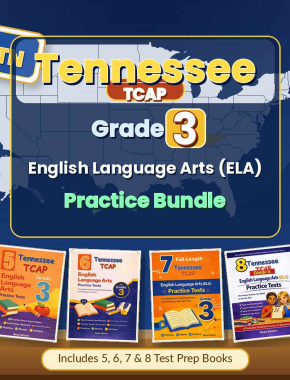
Best Bundle to Ace the Tennessee TCAP Grade 3 ELA
Looking for the best resource to help your kid ace the Tennessee TCAP? Try this bundle, four full practice-test books (5 + 6 + 7 + 8 tests) covering the same Grade 3 reading, writing, and language skills your child is already learning. Instant PDF download, answer keys included.

Related to This Article
More math articles
- How to Pass the SBAC Math Test (Smarter Balanced) in 2026
- Top 10 Tips to Overcome PERT Math Anxiety
- NCLEX-RN Study Material Audit: Keep, Patch, or Replace? (2027 Prep)
- Pie Graphs
- The Best Grade 8 Math Book for Alaska Students
- What Skills Do I Need for the CHSPE Math Test?
- DNA, RNA, and Protein Synthesis
- North Carolina EOG Grade 3 Math Worksheets: 49 PDF Links
- Full-Length 6th Grade STAAR Math Practice Test-Answers and Explanations
- 8 Useful Tips on Learning Mathematics Effectively








What people say about "Free Grade 3 English Worksheets for Tennessee"?
No one replied yet.