Mixed Number Calculator (Add, Subtract, Multiply, Divide with Steps)
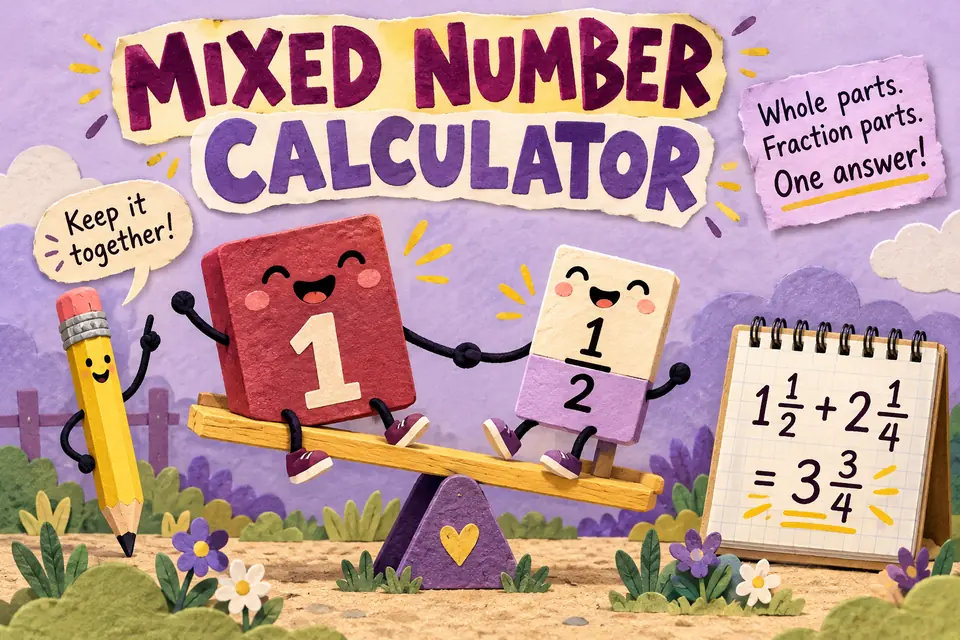
To add, subtract, multiply, or divide mixed numbers, change them to improper fractions, do the operation, simplify, and change the answer back to a mixed number. This mixed number calculator follows exactly those steps and shows each one, so you can check homework or learn the method. It also handles whole numbers, plain fractions, and negative mixed numbers.
How to use the Mixed Number Calculator
- Enter the first mixed number: the whole number in the large box, the numerator in the top small box, and the denominator in the bottom small box.
- Choose an operation: +, −, ×, or ÷.
- Enter the second mixed number the same way. Leave the fraction boxes empty for a whole number, or the large box empty for a fraction.
- For a negative number, type a minus sign in the large box.
- Press Calculate or Enter. The answer appears as a simplified fraction, a mixed number, and a decimal, followed by every step.
- Use the Practice section below the calculator to test yourself with new problems for all four operations.
How to calculate with mixed numbers by hand
A mixed number such as 3 1/4 is a whole number plus a proper fraction. It is easy to read, but awkward to compute with. Improper fractions behave the same way for every operation, so the reliable method is:
- Convert to improper fractions. Multiply the whole number by the denominator, add the numerator, and keep the denominator: 3 1/4 = (3 × 4 + 1)/4 = 13/4.
- Do the operation. For + and −, rewrite with a common denominator and combine the numerators. For ×, multiply straight across. For ÷, multiply by the reciprocal of the second fraction.
- Simplify. Divide the numerator and denominator by their greatest common factor.
- Convert back. Divide the numerator by the denominator. The quotient is the whole number, and the remainder sits over the denominator.
Worked example 1: 3 1/4 − 1 5/6
Convert. 3 1/4 = (3 × 4 + 1)/4 = 13/4 and 1 5/6 = (1 × 6 + 5)/6 = 11/6.
Common denominator. Multiples of 4: 4, 8, 12. Multiples of 6: 6, 12. The LCD is 12. Then 13/4 = 39/12 and 11/6 = 22/12.
Subtract. 39/12 − 22/12 = 17/12.
Simplify and convert back. 17 and 12 share no factor other than 1. Since 17 ÷ 12 = 1 remainder 5, the answer is 1 5/12.
Notice that working with improper fractions avoided borrowing. If you subtract the parts separately, 1/4 is smaller than 5/6, so you would have to regroup one whole first.
Worked example 2: 2 2/5 ÷ 1 1/3
Convert. 2 2/5 = (2 × 5 + 2)/5 = 12/5 and 1 1/3 = (1 × 3 + 1)/3 = 4/3.
Keep, change, flip. Keep 12/5, change ÷ to ×, and flip 4/3 to 3/4: 12/5 × 3/4.
Multiply. (12 × 3)/(5 × 4) = 36/20.
Simplify and convert back. The GCF of 36 and 20 is 4, so 36/20 = 9/5. Since 9 ÷ 5 = 1 remainder 4, the answer is 1 4/5.
For a quick multiplication example, 1 1/2 × 2 2/3 = 3/2 × 8/3 = 24/6 = 4. You can also cancel the 3s before multiplying: 3/2 × 8/3 = 8/2 = 4.
The GCF and LCM calculator helps with the simplifying and common denominators, and the simplify fractions calculator reduces any fraction step by step.
Quick reference: the four operations
| Operation | Rule after converting | Example |
|---|---|---|
| Add | Use a common denominator, add numerators | 1 1/2 + 2 1/3 = 9/6 + 14/6 = 23/6 = 3 5/6 |
| Subtract | Use a common denominator, subtract numerators | 4 1/4 − 2 1/2 = 17/4 − 10/4 = 7/4 = 1 3/4 |
| Multiply | Numerator × numerator, denominator × denominator | 1 1/3 × 2 1/4 = 4/3 × 9/4 = 36/12 = 3 |
| Divide | Multiply by the reciprocal of the second fraction | 2 1/2 ÷ 1 1/4 = 5/2 × 4/5 = 20/10 = 2 |
For addition and subtraction you may also work with the whole numbers and fractions separately. For multiplication and division you must convert first.
Common mistakes to avoid
- Multiplying the parts separately. 1 1/2 × 2 1/2 is not 2 1/4. The correct product is 3/2 × 5/2 = 15/4 = 3 3/4. Multiplying only the wholes and only the fractions leaves out the cross terms.
- Flipping the wrong fraction. In division, only the second number (the divisor) is flipped, and only after it is an improper fraction. You cannot flip 1 1/3 directly; write it as 4/3 first, then flip it to 3/4.
- Borrowing incorrectly. In 5 1/4 − 2 3/4, borrow one whole as 4/4: 4 5/4 − 2 3/4 = 2 2/4 = 2 1/2. A common error is to borrow 10 instead of one whole.
- Converting with addition and multiplication swapped. 2 3/5 is (2 × 5 + 3)/5 = 13/5, not (2 + 5 × 3)/5.
- Leaving the answer unsimplified. 36/20 equals 1 16/20, but the expected form is 1 4/5.
Where mixed numbers appear in school
In the Common Core standards, students add and subtract mixed numbers with like denominators in grade 4 (4.NF.B.3c). Grade 5 extends this to unlike denominators (5.NF.A.1) and to real-world problems that multiply fractions and mixed numbers (5.NF.B.6). Dividing a fraction by a fraction, the step behind dividing mixed numbers, is grade 6 (6.NS.A.1). Mixed numbers are common in cooking, carpentry, and sewing, where measurements such as 2 3/8 inches or 1 1/2 cups are normal.
Check your answer
Round each mixed number to the nearest whole or half and estimate. For 2 2/5 ÷ 1 1/3, think 2.4 ÷ 1.3, which is a little less than 2. The answer 1 4/5 = 1.8 fits. For 3 1/4 − 1 5/6, think 3.25 − 1.83 ≈ 1.4, and 1 5/12 ≈ 1.42. If your estimate and exact answer are far apart, recheck the conversion step first; most errors happen there.
Mixed numbers practice quiz: 10 questions
Test yourself with 10 multiple-choice questions. Choose an answer and press Submit to see if you are right and why. Your score appears at the end.
16/3 − 8/3 = 8/3 = 2 2/3. You cannot take 2/3 from 1/3 without regrouping, so 3 1/3 is wrong.
3/2 × 8/3 = 24/6 = 4. Multiplying the whole numbers and fractions separately (2 + 1/3) is a common mistake.
15/4 ÷ 5/4 = 15/4 × 4/5 = 3. 4 11/16 is what you get by multiplying instead of dividing.
Multiply the whole number by the denominator and add the numerator: 3 × 5 + 2 = 17, so 17/5.
8/3 × 3 = 24/3 = 8. Multiplying only the whole number (6 2/3) forgets the fraction part.
Quiz complete
Frequently asked questions
How do you add mixed numbers?
Change both to improper fractions, rewrite them with a common denominator, and add the numerators. Then simplify and convert back. For example, 2 1/3 + 1 3/4 = 7/3 + 7/4 = 28/12 + 21/12 = 49/12 = 4 1/12.
How do you subtract mixed numbers when the first fraction is smaller?
Either convert both to improper fractions, which avoids the problem, or borrow one whole from the first whole number. For 5 1/4 − 2 3/4, rewrite 5 1/4 as 4 5/4. Then 4 5/4 − 2 3/4 = 2 2/4 = 2 1/2.
How do you multiply mixed numbers?
Convert each mixed number to an improper fraction, multiply the numerators and the denominators, then simplify. For example, 1 1/3 × 2 1/4 = 4/3 × 9/4 = 36/12 = 3.
How do you divide mixed numbers?
Convert both to improper fractions, then multiply the first by the reciprocal of the second. For example, 2 1/2 ÷ 1 1/4 = 5/2 ÷ 5/4 = 5/2 × 4/5 = 20/10 = 2.
How do you turn a mixed number into an improper fraction?
Multiply the whole number by the denominator, add the numerator, and put the result over the same denominator. For 3 2/7, that is (3 × 7 + 2)/7 = 23/7.
What does a negative mixed number mean?
The minus sign applies to the whole number and the fraction together. So −2 1/3 means −(2 + 1/3), which is −7/3, not −2 + 1/3. In the calculator, type the minus sign in the whole-number box.

Related to This Article
More math articles
- Migration, Urbanization, Borders, and Development
- Total revenue follows elasticity
- Roosevelt’s Square Deal, Consumer Protection, and Conservation
- ISEE Middle-Level Math FREE Sample Practice Questions
- The Cold War and U.S. Foreign Policy
- Comparison and Number Ordering
- Top 10 7th Grade Common Core Math Practice Questions
- How to Evaluate Variable Expressions for Number Sequences
- Best Laptops For Online Math Teachers
- How to Get a Perfect Score of 36 on ACT Math?

















What people say about "Mixed Number Calculator: Add, Subtract, Multiply, Divide"?
No one replied yet.