ASWB Three-Option Questions: Use Evidence to Eliminate a Distractor (2027 Prep)
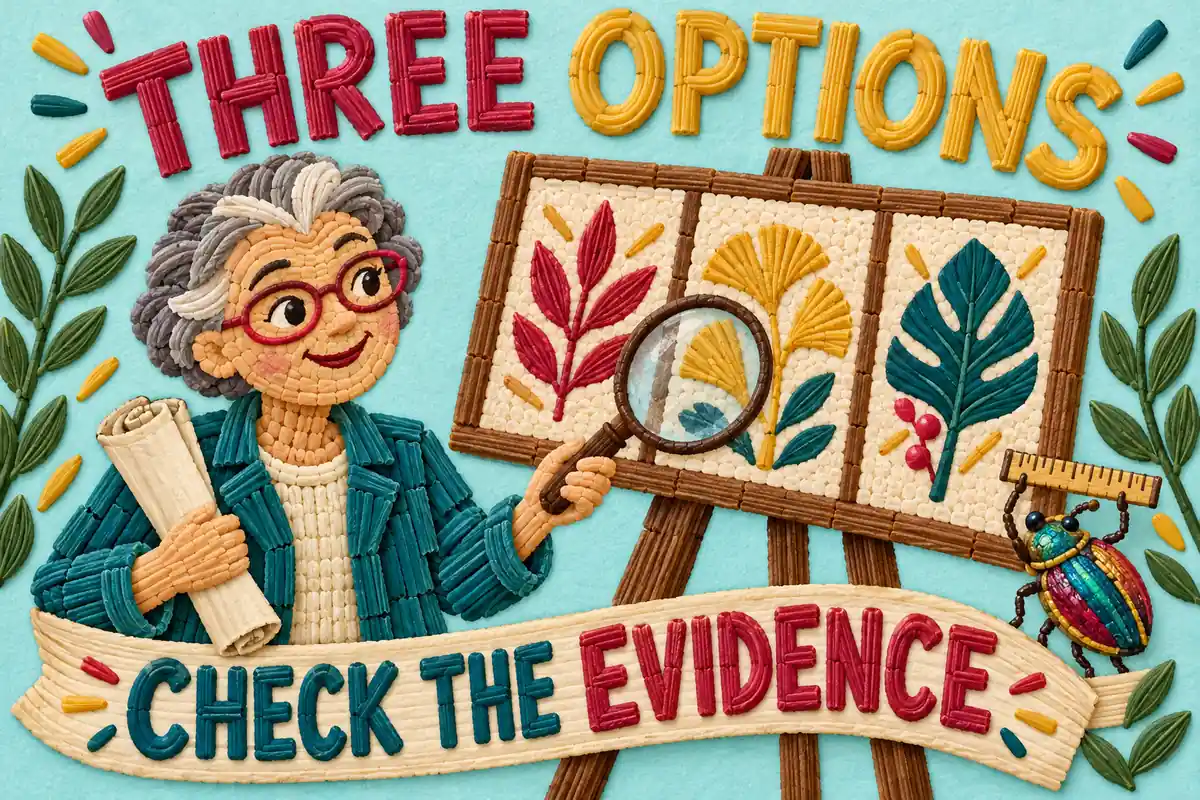
For an ASWB three-option question, eliminate a response because it conflicts with the requested task or the supplied evidence, then compare the responses that remain. Crossing out an answer because it sounds unfamiliar or less reassuring can remove the correct response, and two choices on the screen do not automatically give you a genuine 50–50 chance.
The current exam overview confirms that the exam includes a mixture of three-option and four-option questions. Expect both formats. ASWB's launch notice describes more three-option questions and a greater emphasis on applying professional knowledge through reasoning, so counting the options alone cannot establish the difficulty of a particular question.
The worked evidence map (CSV) uses three invented museum-poster proposals to demonstrate a stated contradiction and a separate unknown. The guessing assumptions (CSV) file records the assumptions behind the guessing arithmetic, while the blank evidence record (CSV) provides space for your own evidence checks and any concept that needs further study.
Keep the task visible while comparing responses
Before rejecting a response, restate the decision being requested in your own words and identify the facts that limit it. Keep this note short. A response can describe a useful action yet fail to address the requested decision, and a detail that sounds persuasive may belong to a situation that the material never described.
Read the remaining responses against that same request, including any timing or scope limit in the wording. Familiar vocabulary, a confident tone or extra detail cannot supply a missing factual link, so check whether the reason you prefer an answer actually connects it to the situation given.
If you cannot explain that connection, preserve the uncertainty in your study notes. You may need content review. Elimination helps organize a decision that still depends on relevant knowledge, and a reading technique cannot supply a professional principle that you have not learned or cannot apply.
Follow the evidence in a nonclinical design review
Our fictional museum requests a printed poster no wider than 20 centimeters, using two ink colors and containing both English and Spanish text. Those are the supplied design constraints. The narrated comparison below uses three author-created proposals and establishes no actual museum policy, design approval or printing result.
Juniper specifies a width of 24 centimeters, two inks and both languages, so it conflicts with the stated width limit. Amber specifies 18 centimeters, two inks and both languages, which fits the supplied design constraints. Cobalt specifies 18 centimeters and two inks, but its text is English only.
The evidence map rejects Juniper for its width and Cobalt for its missing Spanish text. Each rejection names a particular fact. Amber remains consistent with the stated constraints, while its approval status is unknown because the brief and proposal metadata say nothing about approval or permission to print.
| Proposal | Supplied detail | Evidence check |
|---|---|---|
| Juniper | 24 cm / 2 inks / both languages | Width conflicts |
| Amber | 18 cm / 2 inks / both languages | Fits stated brief |
| Cobalt | 18 cm / 2 inks / English only | Spanish missing |
Separate contradiction from a detail that is unstated
Juniper's width creates a direct contradiction because 24 centimeters exceeds the museum's stated maximum of 20. You can point to both values. Saying that you dislike its color palette would introduce a different reason that the supplied request does not support, even though the width already resolves the comparison.
Amber's approval status presents a different problem. It is unstated. The absence of an approval statement does not prove rejection, and matching the stated design constraints does not prove approval, so the record keeps that field unknown instead of turning a metadata comparison into permission to print.
In your own study review, distinguish an answer that contradicts a supplied fact from an answer you do not yet understand. Record the exact issue. An unfamiliar action may require subject study before you can judge it, while an attractive response may depend on an unstated assumption that you added during reading.
Understand the condition behind the 50–50 claim
If you choose uniformly at random among three responses with one correct response, the probability of selecting it is one third. Four responses give one fourth. These are mathematical models of random selection, not measurements of ASWB candidates, predictions of your performance or claims about the difficulty of a test form.
After you correctly remove a wrong response from a three-option item, two responses remain and one is correct. Uniform random selection then gives one half. The important condition is that the correct response remains available, because eliminating it leaves no chance of selecting it from the surviving pair.
Consider a separate invented model in which an elimination procedure keeps the correct response only 60 percent of the time, followed by a uniform random choice among the remaining two. The resulting probability is 0.60 times 0.50, or 0.30. That assumed retention rate is a teaching input, not an observed ASWB statistic or an estimate of your own elimination accuracy.
Compare the last two using a supported reason
The arithmetic explains why a reduction in the number of responses can be useful only under the model's stated conditions. Check the elimination itself. When reviewing study material, identify the fact or principle that supports your rejection before describing the remaining pair as equally likely, and distinguish a justified inference from a guess.
You do not need to force an elimination merely to make the screen look simpler. Keep an unresolved response visible.
If the explanation later shows that you rejected the correct answer, record the specific reading error or knowledge gap so the next review addresses that cause rather than repeating the same unsupported rule. Social-work judgments require relevant professional knowledge, with the stated situation and requested decision guiding its application. Use qualified instruction when needed. This article contains no clinical case, legal rule or treatment recommendation, and its poster comparison supplies no algorithm for resolving professional practice decisions.
Record the evidence you want to revisit
Use the blank record to capture the task in your own words, the response you considered rejecting, the supporting fact and any assumption involved. A private source reference and your own description of the reasoning issue are enough for this audit, which does not ask you to copy an exam item or its answer choices.
After checking an authorized study explanation or reviewing the relevant concept with an instructor, enter what changed in your reasoning. Leave outcomes blank until then. The record separates a contradiction, an unstated detail and a knowledge gap, with an additional field for the next study action rather than a readiness score.
For official preparation resources, start from the official guidebook landing page, which identifies the guidebook's question-structure information and category-specific outlines. Clinical candidates can also use our ASWB Clinical study hub. That destination covers Clinical, so candidates preparing for Bachelors, Masters or Advanced Generalist should continue with their own category's official preparation guidance.
2027 preparation edition. Official public informational HTML checked October 12, 2026. The current ASWB exam uses mixed three- and four-option questions. Poster proposals and random-selection models are author-created teaching material, not exam items or observed candidate data. No guidebook PDF, worksheet or linked assessment was inspected. No clinical or licensing advice, readiness finding or official elimination algorithm is supplied. The internal hub covers Clinical only. Current-source and live checks required before release.

Related to This Article
More math articles
- How to Estimate Quotients Using Compatible Numbers for One-digit Divisors
- What does PSAT Stand for?
- Why Sociology Emerged
- Virginia SOL Grade 8 Math Free Worksheets: Printable SOL-Aligned Practice, No Signup Needed
- Is Arbitrage Betting Legal in Australia?
- ACT Math Flashcards (Free Online: Formulas, Terms & Concepts)
- FREE ISEE Upper Level Math Practice Test
- Top 10 HSPT Math Practice Questions
- Revenue is not profit and transfer is not loss
- The Ultimate ATI TEAS 7 Math Formula Cheat Sheet
















What people say about "ASWB Three-Option Questions: Use Evidence to Eliminate a Distractor (2027 Prep)"?
No one replied yet.