Unit Rate Calculator (Unit Price and Better Buy, with Steps)
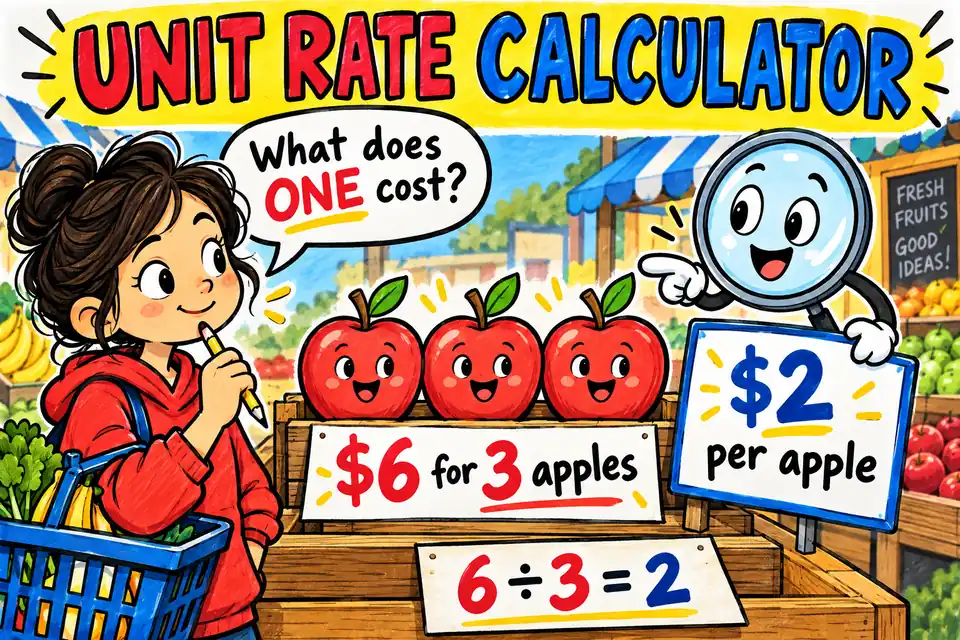
To find a unit rate, divide the first quantity by the second so the second quantity becomes 1: 150 miles in 3 hours is 150 ÷ 3 = 50 miles per hour. This unit rate calculator does that division exactly, shows the answer both ways as a fraction and a decimal, and explains every step. It also works as a unit price calculator that compares two deals and tells you which is the better buy.
How to use the Unit Rate Calculator
- Choose Find a unit rate or Compare two deals.
- Enter the first amount and its unit (for example, 4.80 dollars), then the second amount and its unit (12 ounces). Whole numbers, decimals, fractions like 3/4 and mixed numbers like 1 1/2 all work.
- Press Calculate or the Enter key.
- Read the unit rate in both directions, the exact fraction, the decimal, and the numbered steps. The last step checks the answer by multiplying back.
- Scroll down to the practice questions and try a few word problems on your own.
How to find a unit rate by hand
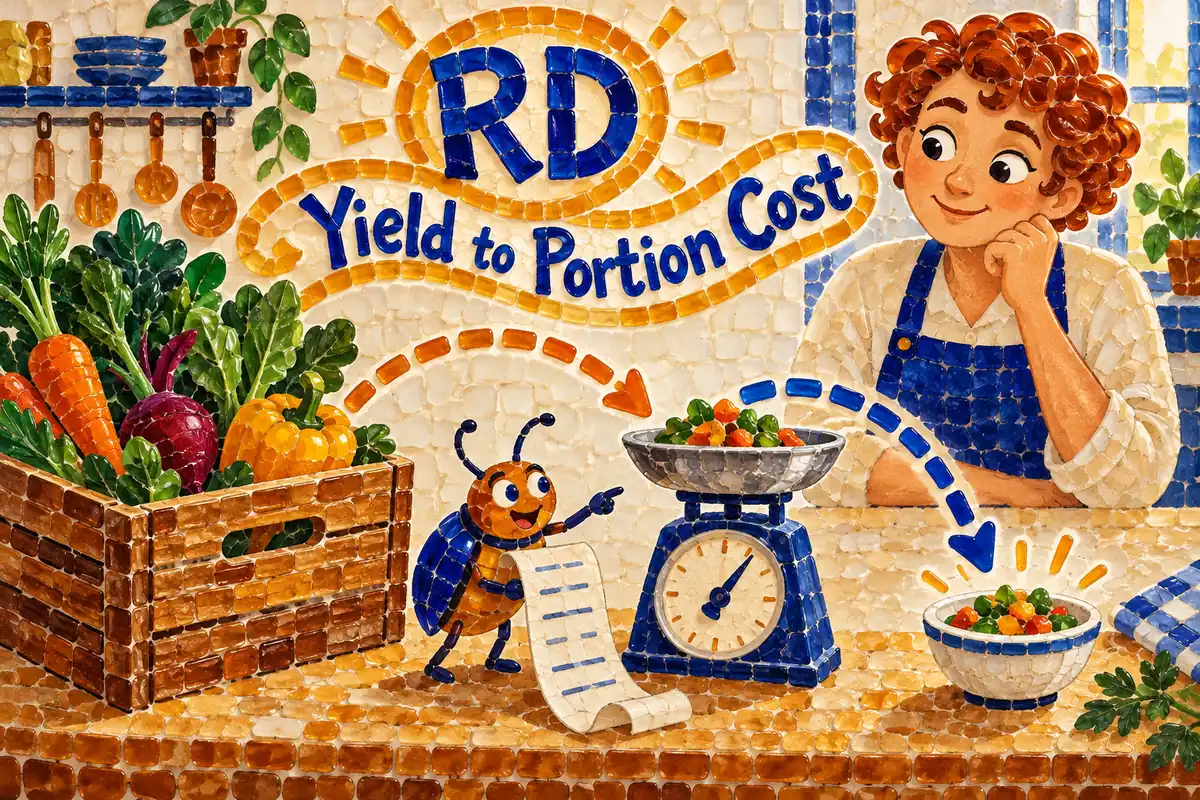
A rate compares two quantities measured in different units, such as miles and hours or dollars and ounces. A unit rate is the same rate written so the second quantity is exactly 1. Because a rate is a fraction, you find the unit rate by dividing the top number by the bottom number.
Worked example 1: speed. A cyclist rides 45 miles in 2.5 hours. What is her speed in miles per hour?
- Write the rate as a fraction with hours on the bottom: 45 miles / 2.5 hours.
- Clear the decimal by multiplying the top and the bottom by 10: 450 / 25. Multiplying both parts by the same number does not change the rate.
- Divide: 450 ÷ 25 = 18.
- Answer: 18 miles per hour. Check: 18 × 2.5 = 45 miles.
- The other unit rate flips the fraction: 2.5 ÷ 45 = 1/18 hour per mile, which is about 0.0556 hour, or 3 1/3 minutes per mile.
Worked example 2: unit price and the better buy. An 18-ounce box of cereal costs $4.32 and a 24-ounce box costs $5.52. Which is the better buy?
- Find each unit price by dividing price by ounces. Small box: $4.32 ÷ 18 = $0.24 per ounce.
- Large box: $5.52 ÷ 24 = $0.23 per ounce.
- Compare: $0.23 is less than $0.24, so the 24-ounce box is the better buy. It costs $0.01 less per ounce.
- Check: 0.24 × 18 = 4.32 and 0.23 × 24 = 5.52, so both unit prices are right.
With fractions. Lena mows 1/2 acre in 3/4 hour. Divide: 1/2 ÷ 3/4 = 1/2 × 4/3 = 4/6 = 2/3. She mows 2/3 acre per hour. Dividing by a fraction is the same as multiplying by its reciprocal, which is the step the calculator shows for fraction inputs.
Unit rate quick-reference table
| Rate | Division | Unit rate |
|---|---|---|
| 150 miles in 3 hours | 150 ÷ 3 | 50 miles per hour |
| $4.80 for 12 ounces | 4.80 ÷ 12 | $0.40 per ounce |
| 84 pages in 3.5 hours | 84 ÷ 3.5 | 24 pages per hour |
| $8.75 for 5 pounds | 8.75 ÷ 5 | $1.75 per pound |
| 12 cups of flour for 8 batches | 12 ÷ 8 | 1.5 cups per batch |
| 1/2 acre in 3/4 hour | 1/2 ÷ 3/4 | 2/3 acre per hour |
The rule in every row is the same: the unit you want “per 1” of goes on the bottom, and you divide.
Common mistakes with unit rates
- Dividing in the wrong order. For price per ounce, divide dollars by ounces. Dividing ounces by dollars gives ounces per dollar, which is a real rate but answers a different question. Say the units out loud: “dollars per ounce” means dollars on top.
- Rounding too early. A 3-pound bag of apples for $2.99 costs about $0.9967 per pound, and a 4-pound bag for $3.99 costs $0.9975 per pound. Rounded to cents, both look like $1.00, yet the 3-pound bag is slightly cheaper. Keep more decimal places, or compare the exact fractions as the calculator does.
- Mixing units. Before comparing 16 ounces with 2 pounds, convert so both use the same unit (1 pound = 16 ounces).
- Assuming the bigger package is cheaper. It often is, but not always. Work out the unit price for each option before deciding.
- Dropping the units. “50” alone is not an answer. “50 miles per hour” is.
Where unit rates show up in school
Unit rates are a core part of the Common Core ratios and proportional relationships standards. In grade 6, students learn what a unit rate is (6.RP.A.2) and solve unit rate problems, including unit pricing and constant speed (6.RP.A.3b). In grade 7, they find unit rates from ratios of fractions, such as 1/2 mile in 1/4 hour (7.RP.A.1). Unit rates then lead straight into proportional relationships, where the unit rate is the constant of proportionality, and later into slope.
Outside class, unit rates answer everyday questions: which size of detergent costs less per load, how fast you need to read to finish a book by Friday, or how much gas a trip will use. If you want more practice with the next step, solving proportions, try these proportion practice problems. To turn a rate fraction into lowest terms, the simplify fractions calculator shows the GCF method, and the fraction, decimal and percent conversion practice helps with writing a unit rate as a decimal.
Check your answer
Multiply your unit rate by the second quantity. You should get the first quantity back. If 18 miles per hour is right, then 18 × 2.5 hours must equal 45 miles, and it does. For a better-buy question, multiply each unit price by its quantity and confirm you get the original prices.
Unit rates practice quiz: 10 questions
Test yourself with 10 multiple-choice questions. Choose an answer and press Submit to see if you are right and why. Your score appears at the end.
$4.20 ÷ 6 = $0.70 per can and $5.20 ÷ 8 = $0.65 per can. The 8-pack costs less per can.
A unit rate has a second quantity of 1. Only $9 per 1 hour is already written that way.
$6.00 ÷ 1.5 = $4.00 per kg. $0.25 is kilograms per dollar, the reverse rate.
Quiz complete
Frequently asked questions
What is a unit rate?
A unit rate is a rate in which the second quantity is 1, such as 50 miles per 1 hour or $0.40 per 1 ounce. It tells you how much of the first quantity goes with one unit of the second.
How do you find the unit rate?
Write the rate as a fraction with the "per" quantity on the bottom, then divide the top by the bottom. For 150 miles in 3 hours, 150 ÷ 3 = 50, so the unit rate is 50 miles per hour.
What is the difference between a rate and a unit rate?
A rate compares any two quantities with different units, like 150 miles in 3 hours. A unit rate is the same comparison scaled so the second quantity is 1, like 50 miles in 1 hour. Every rate has a matching unit rate.
How do you use unit price to find the better buy?
Divide each price by its quantity to get the price per unit, using the same unit for both items. The option with the lower price per unit is the better buy. For $4.80 for 12 ounces and $6.75 for 18 ounces, the unit prices are $0.40 and $0.375 per ounce, so the 18-ounce option costs less per ounce.
Can a unit rate be a fraction or a decimal?
Yes. Unit rates are often not whole numbers. $10 for 3 pounds is 10/3 dollars per pound, which is about $3.33 per pound. The fraction is exact; the decimal is rounded.
Is the unit rate the same as the constant of proportionality?
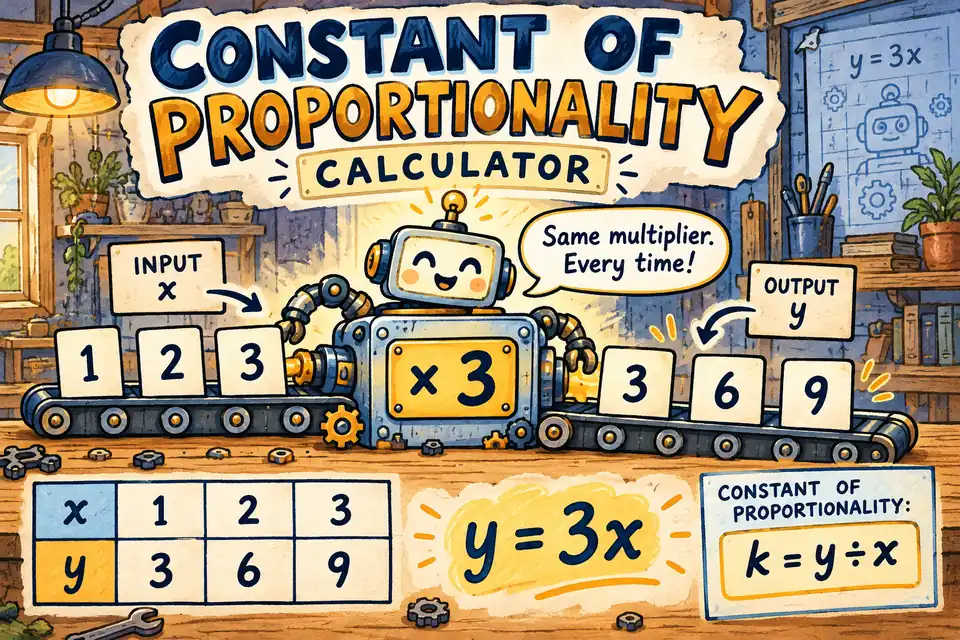
In a proportional relationship, yes. If y = kx, then k is the amount of y for 1 unit of x, which is the unit rate. For example, if apples cost $1.75 per pound, the cost is y = 1.75x, and 1.75 is both the unit rate and the constant of proportionality.

Related to This Article
More math articles
- 5th Grade KAP Math Worksheets: FREE & Printable
- The Best Grade 3 Math Book for Maine Students
- Malcolm X, Black Power and Urban Uprisings
- Commerce Clause
- Top 10 TSI Math Prep Books (Our 2023 Favorite Picks)
- Editing a Whole Passage
- How Long Is the ALEKS Placement Test? Time, Questions and Retakes
- Free Utah Grade 2 Math Worksheets
- Free Grade 8 English Worksheets for Iowa Students
- 3rd Grade PARCC Math FREE Sample Practice Questions












What people say about "Unit Rate Calculator: Unit Price + Better Buy, with Steps"?
No one replied yet.