The long-run firm has excess capacity
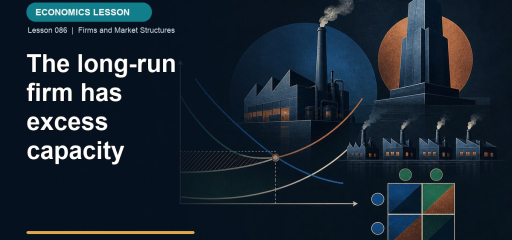
The long-run firm has excess capacity: this Effortless Math guide explains the topic in plain language, shows how it works through solved examples, and gives you free practice to try immediately, so the idea sticks instead of staying abstract.
Zero profit does not imply competitive efficiency.
Compared with perfect competition, monopolistic competition offers
- greater product variety but some markup and excess capacity
- less product variety and no market power
- the same homogeneous product at minimum ATC
- permanent economic profit because entry is blocked
- allocative efficiency because price equals marginal cost
greater product variety but some markup and excess capacity The tradeoff is valuable variety and differentiation versus a price markup and production below minimum efficient scale.
Excess capacity means that the firm
- produces beyond the output that minimizes ATC
- cannot cover variable cost
- produces less than the output that minimizes ATC
- has no unused physical equipment
- faces perfectly inelastic demand
produces less than the output that minimizes ATC The long-run tangency occurs to the left of minimum ATC, so the firm produces below the scale that minimizes average cost.
Watch the idea in action
A focused video lesson from Khan Academy.
Tangency occurs on the downward-sloping portion of ATC, so output is below the quantity that minimizes ATC. This unused ability to produce at a lower average cost is excess capacity. Price also exceeds MC, so the model lacks allocative efficiency.
Excess capacity is the gap between the firm’s long-run equilibrium output and the output that minimizes ATC. It does not mean machines literally sit idle every hour or that producing at minimum ATC would be profitable given the firm’s demand. It is a cost-curve comparison showing the firm operates left of efficient scale.
At tangency, P=ATC but demand slopes downward, so MR lies below price. Because the firm sets MR=MC, it follows that P>MC. Zero economic profit therefore coexists with markup and allocative inefficiency. The absence of excess profit does not make the outcome perfectly competitive.
Consumers may value variety, convenience, and innovation, so the efficiency comparison is not a claim that all differentiation is waste. The standard graph measures cost and willingness to pay but may not capture every benefit from variety.
The tradeoff is between higher unit cost or markup and differentiated choice. A world of identical products might lower production cost but reduce match quality and variety. The textbook graph identifies the conventional cost and allocation gaps. A full welfare judgment can include consumer value from variety.
Advertising can supply information or create perceived differentiation. If it informs buyers about price, quality, or location, it may improve matching and intensify competition. If it mainly strengthens brand loyalty, it can make demand less elastic and increase markup. Economics exam questions ordinarily specify the mechanism. “advertising always raises welfare” and “advertising is always wasteful” are both too broad.
| Long-run feature | Monopolistic competition | Perfect competition |
|---|---|---|
| Economic profit | Zero | Zero |
| Price versus MC | P>MC |
P=MC |
| Output versus min ATC | Below. Excess capacity | At minimum ATC |
| Product | Differentiated | Identical |
| Firm demand | Downward sloping | Horizontal |
Zero profit does not erase markup
A café’s long-run demand is tangent to ATC at 200 drinks and price $5. ATC is $5, so economic profit is zero. MC is $3.80, so the café still charges above marginal cost and produces below the ATC-minimizing scale. Entry removed profit, not differentiation.
Advertising appears twice in the source model because it can work through different channels. Treat informative and persuasive effects separately, and include advertising expenditure in cost. A rightward demand shift can be outweighed by the campaign’s cost.
The exam may ask why firms accept excess capacity. Expanding to minimum ATC would require lowering price along downward-sloping demand and may push MR below MC. The profit-maximizing quantity remains smaller even though average cost would be lower at a larger output.
Do not transfer the competitive long-run graph
Both models reach zero economic profit, but only perfect competition has P=MC=min ATC. Monopolistic competition has P=ATC>MC and output below minimum ATC.
The tangency selects zero profit. Its location relative to minimum ATC identifies excess capacity and preserves the model distinction.
Read the tangency carefully
At the long-run equilibrium, the demand curve is tangent to ATC at the firm’s chosen quantity, so price equals average total cost and economic profit is zero. That tangency occurs to the left of minimum ATC. Moving to the minimum-cost output would require selling a larger quantity at a lower price, and the added revenue would not cover the added cost. Mark both quantities on the horizontal axis before deciding whether the graph shows zero profit, excess capacity, or allocative efficiency.

Reza is an experienced Math instructor and a test-prep expert who has been tutoring students since 2008. He has helped many students raise their standardized test scores--and attend the colleges of their dreams. He works with students individually and in group settings, he tutors both live and online Math courses and the Math portion of standardized tests. He provides an individualized custom learning plan and the personalized attention that makes a difference in how students view math.
Related to This Article
More math articles
- The Best Grade 8 Math Book for Wyoming Students
- The Best Grade 3 ELA Practice Tests for Florida Students
- Manage both timed sections without rushing
- Scientific Calculators for School and College: Casio vs. TI
- Free Grade 3 English Worksheets for Delaware Students
- Urinary System and Skin
- NREMT Paramedic Exam Changes: What the 2024 Shift Means for 2027 Prep
- Illinois Algebra 1 Free Worksheets: Printable Algebra 1 Practice, Answers Included
- Converting Customary Units for 5th Grade: Length, Weight, Capacity
- Unions, Unemployment, and Work-Family Boundaries






















What people say about "The Long-Run Firm Has Excess Capacity"?
No one replied yet.