Constant of Proportionality Calculator (From a Table, Point or Equation)
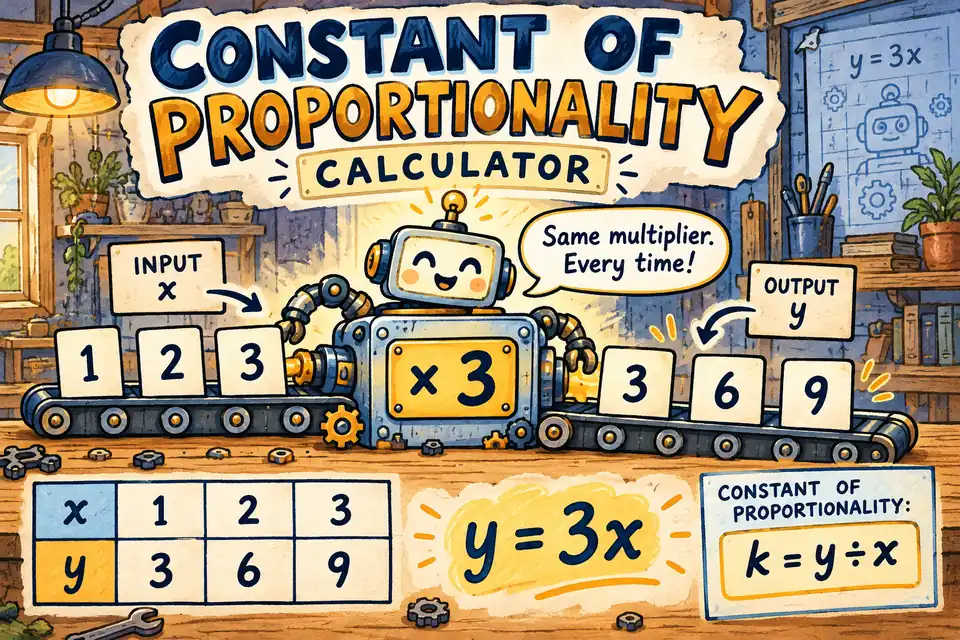
The constant of proportionality is the number k in y = kx, and you find it by dividing y by x: if every pair gives the same quotient, that quotient is k. This constant of proportionality calculator finds k from a table, a single point or an equation, tells you whether the relationship is proportional at all, and points to the exact row that breaks the pattern when it is not. It shows k as a fraction and a decimal, writes the equation, and graphs the line through the origin.
How to use the Constant of Proportionality Calculator
- Choose A table, One point or An equation.
- Enter your values. Tables take up to 12 rows; use + Add row for more. Integers, decimals and fractions such as 3/4 all work.
- Press Calculate or the Enter key.
- Read whether the relationship is proportional, the value of k, the equation y = kx and the unit rate. The steps show every y ÷ x calculation, and the graph marks the unit-rate point (1, k).
- Try the practice questions below the tool to check that you can do it on your own.
How to find the constant of proportionality from a table
Two quantities are proportional when one is always the same multiple of the other. In symbols, y = kx, where k is the constant of proportionality. Dividing both sides by x gives k = y ÷ x, so the test is simple: divide each y-value by its x-value. If every quotient is the same, the table is proportional and that quotient is k. If even one quotient is different, the table is not proportional.
Example 1: a proportional table
A farm stand sells grapes by the pound.
| Pounds (x) | Cost in dollars (y) | y ÷ x |
|---|---|---|
| 3 | 7.50 | 7.50 ÷ 3 = 2.5 |
| 6 | 15.00 | 15 ÷ 6 = 2.5 |
| 9 | 22.50 | 22.5 ÷ 9 = 2.5 |
| 12 | 30.00 | 30 ÷ 12 = 2.5 |
Every quotient is 2.5, so the relationship is proportional and k = 2.5, or 5/2 as a fraction. The equation is y = 2.5x. In context, k is the unit rate: the grapes cost $2.50 per pound. Check: 2.5 × 12 = 30, which matches the last row.
Example 2: a table that is not proportional
| x | y | y ÷ x |
|---|---|---|
| 2 | 9 | 9 ÷ 2 = 4.5 |
| 4 | 15 | 15 ÷ 4 = 3.75 |
| 6 | 21 | 21 ÷ 6 = 3.5 |
| 8 | 27 | 27 ÷ 8 = 3.375 |
The quotients change, so there is no constant of proportionality. Notice that y still goes up by 6 every time x goes up by 2. The table is linear, y = 3x + 3, but its line crosses the y-axis at 3 instead of passing through (0, 0). A steady pattern alone is not enough; a proportional relationship must also start at the origin.
From a point or an equation
If you know that a relationship is proportional and the point (4, 14) is on its graph, then k = 14 ÷ 4 = 3.5 and y = 3.5x. With an equation, get y by itself. For 3y = 12x, divide both sides by 3 to get y = 4x, so k = 4. An equation like y = 4x + 1 is not proportional, because the extra 1 means y is not 0 when x is 0.
Working with ratios is the core skill here, so the proportions practice and the simplify fractions calculator are good companions to this tool.
Quick reference: k in every representation
| Given | How to find k | Proportional if |
|---|---|---|
| Table | Divide y by x in each row | Every quotient is the same |
| One point (x, y) | k = y ÷ x | You are told it is proportional (one point cannot prove it) |
| Graph | Read the y-value at x = 1, or use rise over run | It is a straight line through (0, 0) |
| Equation | Solve for y; k is the coefficient of x | It can be written as y = kx with no added constant |
| Word problem | Find the amount for one unit (the unit rate) | Doubling one quantity always doubles the other |
Common mistakes to avoid
- Dividing x by y. For y = kx, k is y ÷ x. Dividing the other way gives 1/k, which is the constant for x in terms of y.
- Checking only one row. Any single row gives some quotient. You have to check every row to know the table is proportional.
- Confusing “linear” with “proportional.” Every proportional relationship is linear, but a linear table such as y = 3x + 3 is not proportional.
- Using differences instead of quotients. If y goes up by 6 each time, that is the rate of change between rows, not k. It only equals k when the line passes through the origin.
- Rounding too early. 2 ÷ 3 is exactly 2/3. Writing 0.67 and then multiplying can make a proportional table look like it is not.
Where this topic is taught
The constant of proportionality is a grade 7 topic in the Common Core. Standard 7.RP.A.2 asks students to recognize and represent proportional relationships. Part 7.RP.A.2a covers deciding whether a relationship is proportional by testing a table for equivalent ratios or checking that the graph is a straight line through the origin. Part 7.RP.A.2b asks students to identify the constant of proportionality, the unit rate, in tables, graphs, equations, diagrams and verbal descriptions. Part 7.RP.A.2c covers writing equations such as y = kx, and 7.RP.A.2d asks what the points (0, 0) and (1, r) mean on the graph. In grade 8 the same idea becomes slope.
Check your answer
Multiply k by each x-value in the table. If every product equals the matching y-value, your k is right. On a graph, the point (1, k) should sit exactly on the line.
Constant of proportionality practice quiz: 10 questions
Test yourself with 10 multiple-choice questions. Choose an answer and press Submit to see if you are right and why. Your score appears at the end.
Only the first has the same y ÷ x in every row (3). In the others the ratio changes, for example 4/1 then 5/2.
y = kx is a straight line, and when x = 0, y = 0. It passes through (1, k), not (1, 1) unless k = 1.
15 ÷ 5 = 3 and 24 ÷ 8 = 3, but 37 ÷ 12 ≈ 3.08. For k = 3 the last row would need y = 36.
Quiz complete
Frequently asked questions
How do you find the constant of proportionality from a table?
Divide each y-value by its x-value. If every quotient is the same, that number is the constant of proportionality k, and the equation is y = kx. If the quotients are different, the table is not proportional and has no constant of proportionality.
Is the constant of proportionality the same as the unit rate?
Yes. The constant of proportionality is the amount of y for one unit of x, which is the unit rate. If 3 pounds of grapes cost $7.50, both the unit rate and k are $2.50 per pound.
Is the constant of proportionality the same as slope?
For a proportional relationship, yes. The graph of y = kx is a straight line through the origin with slope k. A line that does not pass through the origin also has a slope, but it has no constant of proportionality.
How can you tell if a relationship is proportional?
In a table, every ratio y ÷ x must be equal. On a graph, the points must lie on a straight line that passes through (0, 0). In an equation, you must be able to write it as y = kx with no number added or subtracted.
Can the constant of proportionality be a fraction or a negative number?
Yes. In y = (2/3)x the constant is 2/3, and in y = −1.5x it is −1.5. In most grade 7 word problems k is positive, because the quantities, such as cost and weight, are positive.

Related to This Article
More math articles
- Voting-Age Population
- SSAT vs. ISEE: Which Test Should Your Child Take?
- Wisconsin FORWARD Grade 6 Math Free Worksheets: Free Printable PDFs Covering Every Grade 6 Skill
- Full-Length ISEE Lower Level Math Practice Test
- The Best Grade 5 Math Book for Colorado Students
- How to Use Expanded Form to Multiply One-Digit Numbers By 3-digit or 4-digit Numbers
- What Is the Highest Score for SHSAT Test?
- What’s The Best Laptop For Online Math Teachers?
- Social welfare policy
- Environment, Resources, and Sustainability














What people say about "Constant of Proportionality Calculator from a Table"?
No one replied yet.