The substitution effect follows relative price
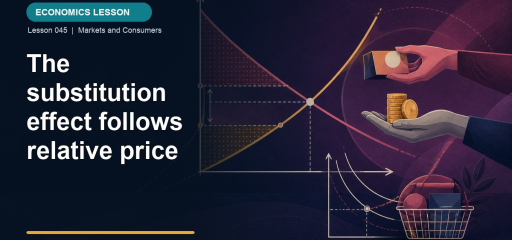
The substitution effect follows relative price: this Effortless Math guide explains the topic in plain language, shows how it works through solved examples, and gives you free practice to try immediately, so the idea sticks instead of staying abstract.
It always moves consumption toward the relatively cheaper good.
If the price of bus travel falls while other prices stay fixed, bus travel becomes cheaper relative to driving or ride-share. Holding the consumer at the original utility level, the substitution effect increases bus trips. For an own-price increase, the substitution effect reduces the good’s quantity demanded.
The substitution effect isolates the change in relative price. When bus fare falls, one bus trip sacrifices fewer units of other goods. Even if the consumer were compensated or charged just enough to remain at the original satisfaction level, the new relative price would encourage a bundle with more bus travel. For the good whose own price changes, substitution always moves opposite the price change.
The effect also changes consumption of alternatives. If bus travel and ride-share are substitutes, cheaper bus travel leads the consumer away from ride-share through substitution. The exact size depends on preferences and available alternatives, but the relative-price direction is determinate.
Graphically, a price change rotates the budget line. To isolate substitution, economists imagine a compensated budget line with the new slope that just reaches the old indifference curve. The movement along that old utility level is the substitution effect. An introductory question usually tests direction rather than construction.
Do not describe substitution as “the consumer has more money left.” That phrase concerns purchasing power and belongs to the income effect. Substitution can be identified even when a hypothetical compensation removes the purchasing-power change. Its defining cause is the altered opportunity cost between goods.
| Own-price change | Substitution effect on focal good | Reason |
|---|---|---|
| Price falls | Consumption rises | Focal good is cheaper relative to alternatives |
| Price rises | Consumption falls | Focal good is more expensive relative to alternatives |
Hold satisfaction conceptually fixed
Coffee price falls while tea price stays fixed. Imagine adjusting the consumer’s income so the old satisfaction level is just attainable at the new relative prices. The consumer chooses more coffee and less tea along that old utility level. That movement is substitution. Any additional change caused by greater real purchasing power is counted separately.
The substitution effect does not depend on whether the good is normal or inferior. Those labels determine the income effect. This is why a price decrease always creates a substitution push toward the focal good even when the income effect later pushes in the opposite direction.
For labor supply, leisure has an opportunity price equal to the wage. A higher wage makes an hour of leisure more expensive in forgone earnings, so substitution favors more work and less leisure. The same relative-price reasoning applies even though one “good” is time.
Substitution effects also appear when the price of a related good changes, but the formal own-price decomposition follows the focal good’s price. If tea price falls while coffee price stays fixed, substitution can reduce coffee consumption because tea became relatively cheaper. Keep the focal quantity and changed price explicit in the final sentence.
The direction follows relative price even when the consumer’s nominal income never changes.
That sentence is the fastest check against an option that mistakenly attributes substitution to purchasing power.
A normal good’s price falls in a competitive market. Which pair of effects both raises quantity demanded?
- A leftward demand shift and a rightward supply shift
- A lower marginal cost and a higher income elasticity
- A substitution effect away from the good and a negative income effect
- A substitution effect toward the good and a positive real-income effect
- A fall in demand and an increase in quantity supplied
A substitution effect toward the good and a positive real-income effect The lower relative price causes substitution toward the normal good, and the gain in purchasing power raises consumption through the income effect.
A Giffen good is an unusual inferior good for which
- the substitution and income effects both favor the cheaper good
- quantity demanded does not respond to price
- income elasticity is positive rather than negative
- the income effect dominates, so a higher price raises quantity demanded
- marginal utility rises whenever price rises
the income effect dominates, so a higher price raises quantity demanded For a Giffen good, the adverse real-income effect of a price rise is so strong that it outweighs substitution and quantity demanded rises.
Watch the idea in action
A focused video lesson from dE eCoNoMiSt.

Reza is an experienced Math instructor and a test-prep expert who has been tutoring students since 2008. He has helped many students raise their standardized test scores--and attend the colleges of their dreams. He works with students individually and in group settings, he tutors both live and online Math courses and the Math portion of standardized tests. He provides an individualized custom learning plan and the personalized attention that makes a difference in how students view math.
Related to This Article
More math articles
- Single-issue groups
- Using Number Lines to Represent Absolute Value of Integers
- Other Bill of Rights protections
- AI Contract Makers: How to Make Drafting Easier
- How to Solve Word Problems of Subtracting Numbers Up to 7 Digits
- War powers
- Culture, Material Life, and Learned Meaning
- Geometry Puzzle – Challenge 62
- Geometry Puzzle – Challenge 77
- Natural-monopoly regulation trades efficiency for cost recovery





















What people say about "The Substitution Effect and Relative Price"?
No one replied yet.