Crash Games Explained: Auto Cash-Out, Multipliers, and the Math Underneath
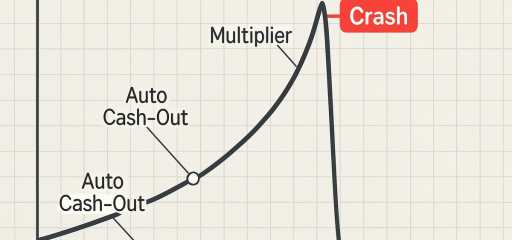
A little rocket climbs across your screen. The multiplier ticks up, 1.12x, 1.34x, 1.78x, and somewhere between “this is fine” and “just one more second,” it explodes. If you cashed out in time, you keep whatever multiple of your stake was showing. If you didn’t, the bet’s gone. That’s the entire loop of a crash game, and underneath the cartoon physics there’s a surprisingly clean probability problem that most players never bother to write down. Let’s write it down.
What a crash game actually is
Crash games, Aviator on Spribe, JetX from SmartSoft, the dozens of clones that have appeared on every major sportsbook over the last few years, share one mechanic. A round starts at 1.00x and a multiplier grows over time. You can press cash-out at any moment to lock in stake × current multiplier. At some random point the round ends, and if you haven’t cashed out yet, your stake is lost. The crash point is fixed at the start of the round by an RNG, even though the visual climb makes it feel like the rocket is “deciding” in real time.
That visual climb is doing a lot of psychological work, by the way. There’s a reason these games look like a slow-motion countdown rather than, say, a single dice roll. More on that further down. For now, the important point is that the multiplier you see is just a clock counting up to a number that was already drawn before the round began.
The probability distribution underneath
Most commercial crash games use a distribution that’s easy to describe and a little harder to feel. Let X be the crash multiplier. For a typical 1% house-edge variant, the probability that the round survives at least to multiplier x is roughly:
\[P(X \geq x) \approx \frac{0.99}{x}, \quad x \geq 1\]
So the probability of crashing before x is $1 – 0.99/x$. Plug in x = 2 and you get about a 50.5% chance the round crashes before doubling. Plug in x = 10 and you get about 90.1%. The 0.99 is where the house edge lives, in a perfectly fair version of the game it would be 1.00, and the operator’s long-run take would be zero. With 0.99 it’s 1%, which is competitive with European roulette and a lot kinder than most slots.
One thing worth flagging: there’s usually a small probability mass at exactly 1.00x (an “instant crash”). Different providers handle this slightly differently, and it’s part of how the 1% edge gets enforced. If you’ve ever watched a round just refuse to launch, that’s not the algorithm being mean to you. That’s the edge.
Auto cash-out: picking your target
Auto cash-out is the feature that turns crash from a reflex game into a math game. You set a multiplier, say 2.00x, and the game will cash you out automatically the instant the rocket touches that value. No human reaction time, no flinching. If the round crashes before 2.00x, you lose your stake. If it reaches 2.00x, you collect $2 per $1 staked.
Expected value per $1 wagered at target t, using the model above, is:
\[\mathrm{EV}(t) = P(X \geq t) \cdot (t – 1) – P(X < t) \cdot 1 = \frac{0.99}{t}(t – 1) – \left(1 – \frac{0.99}{t}\right)\]
Simplify and you get \(\mathrm{EV}(t) = 0.99 – 1 = -0.01\). That’s the punchline most players don’t want to hear: the expected return per dollar is about −1 cent regardless of where you set your target. The house edge doesn’t care whether you cash at 1.2x or 50x. Strategy only changes the shape of your outcomes, not their average.
A worked example: 1.5x vs 5x vs 20x
Theory’s nice. Numbers are better. Here’s what three common auto-cashout choices look like on a $1 stake, using $P(X \geq x) = 0.99/x$.
| Target multiplier | Hit probability | Win per hit | Avg loss when busted | EV per $1 | Hits in 100 rounds (avg) |
|---|---|---|---|---|---|
| 1.5x | 66.0% | $0.50 | $1.00 | −$0.01 | 66 |
| 2.0x | 49.5% | $1.00 | $1.00 | −$0.01 | ~50 |
| 5.0x | 19.8% | $4.00 | $1.00 | −$0.01 | ~20 |
| 20.0x | 4.95% | $19.00 | $1.00 | −$0.01 | ~5 |
| 100.0x | 0.99% | $99.00 | $1.00 | −$0.01 | ~1 |
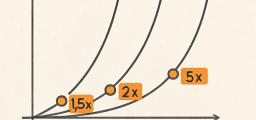
Same expected loss, wildly different lived experiences. The 1.5x grinder will spend most of an evening watching small green numbers pile up and feel like they’re winning, right up until a four- or five-round losing streak wipes the session. The 20x chaser will spend long stretches staring at zeros and then occasionally laugh out loud when the rocket clears 25x. Which one feels worse depends entirely on your personality, not your math.
Volatility, bankroll, and what “strategy” really buys you
If expected value is fixed, what does picking a target actually do? It buys you a variance profile. The UK Gambling Commission’s RTP and volatility framework is the cleanest way to think about this, Return To Player tells you the long-run share you get back (here, about 99%), and volatility tells you how bumpy the road is. Low-target crash play behaves like a low-volatility slot. High-target crash play behaves like a lottery ticket with better odds.
Here’s the practical consequence. With a $100 bankroll and $1 stakes:
- Auto-cash at 1.2x: your bankroll will drift gently downward, with occasional ugly stretches when the 17.5% bust rate clusters. You can play for hours.
- Auto-cash at 2x: roughly coin-flip outcomes. Expect bankroll swings of $20, $30 in either direction in a normal session.
- Auto-cash at 10x: about a 9.9% hit rate. You’ll bust your $100 fairly often before you see a single payout. When you do hit, you’ll double your starting bankroll on one round.
- Auto-cash at 100x: this is just buying a $1 lottery ticket every round with a roughly 1% win rate and a 99x payout. Romantic. Also empties your wallet quickly.
None of these is “smart” or “dumb.” They’re entertainment products with different shapes. The only genuinely bad choice is treating any of them as a path to profit. That’s where the edge stops being abstract.
The two-cashout trick (and why it doesn’t beat the house)
Most crash games let you place two bets per round with independent targets. A common pattern: cash bet A at 1.5x to recoup most of your combined stake, then let bet B ride to 5x or 10x for the upside. People talk about this like it’s a hedge. It isn’t, really. It’s just two independent wagers with the same negative expectation glued together.
Run the numbers. Two $1 bets, target A = 1.5x, target B = 5x. EV of bet A is −$0.01. EV of bet B is −$0.01. Total expected loss per round: $0.02 on $2 wagered. Same 1% edge. The combined distribution looks calmer than chasing 5x alone because the small win from A softens the busts on B, but it doesn’t change where you end up over ten thousand rounds. I’ll admit I find this one genuinely interesting, the math is honest, but the felt experience of “I almost always get something back” is a very effective illusion.
Provably fair, and what it does and doesn’t guarantee
Most crypto-native crash games advertise “provably fair” RNG. The mechanic is roughly: the server commits to a hash of the next round’s seed before the round starts, you contribute a client seed, and after the round both seeds are revealed so you can reproduce the crash point yourself. Chainlink’s primer on provably fair gaming walks through the cryptography if you want the gritty version.
What provably fair guarantees: the operator didn’t tamper with this specific round after seeing your bet. What it doesn’t guarantee: that the distribution itself is what they claim, or that the edge isn’t higher than advertised. The seed scheme proves consistency, not honesty about the underlying parameters. For regulated operators that’s usually fine. For random offshore sites, “provably fair” can be a marketing word doing more work than the cryptography.
Why crash games feel different from slots
Here’s the personal-feeling bit. I think crash games are uniquely sticky because the multiplier curve hands you a constant, visible chance to be right. A slot spin is binary and instant. You pulled, you got an outcome, the dopamine fires once. A crash round stretches that single decision across five, ten, sometimes thirty seconds, and every tenth of a second you’re choosing to stay in. Cashing out at 2.4x when the round eventually crashes at 14x doesn’t feel like a win. It feels like leaving money on the table, even though leaving money on the table is mathematically the only way you ever win at this game.
That asymmetry between felt regret and actual outcome is, I think, the engine. It’s also why “just set an auto-cashout and walk away” is genuinely better advice than it sounds. It removes the second-by-second decision that crash games are engineered to exploit. None of which is to scold anyone. Adults gamble, and crash games at a real 99% RTP are honestly one of the less predatory things on a casino menu. Just go in clear-eyed.
FAQ
Can I beat a crash game with a Martingale on auto-cashout 2x?
No. Doubling after every loss at 2x sounds bulletproof until you notice that the bust rate is 50.5%, not 50%, and that bankroll caps and table limits eat the strategy long before you’d recover. You can find Martingale analysis in more depth on Effortless Math’s probability primer, but the one-line version: any progression on a negative-EV game has the same negative EV, just with scarier variance.
Is the rocket’s path actually random, or is it animated to a pre-drawn number?
Animated to a pre-drawn number. The crash point is generated when the round starts, then the visual interpolates upward at a fixed rate until it hits that value. The suspense is real but the outcome was already decided before you saw 1.10x.
Does setting a very small auto-cashout (like 1.01x) basically guarantee profit?
It guarantees a very high hit rate, about 98%, but the win per hit is a penny per dollar, and roughly 2% of rounds still crash at exactly 1.00x. Long run, you still bleed the 1% edge. Short run, you can have a brutal streak of bad luck that wipes a bankroll because the wins are so tiny relative to the busts.
What’s a sensible bankroll if I just want to play for fun?
Roughly 50× your stake for low-target play (1.2x, 2x) and 200× or more for chasing 10x+, where variance is brutal. And set a session loss limit before you log in, not after the rocket has personally insulted you three times in a row.
Are Aviator and JetX mathematically the same?
They use the same family of distributions and similar advertised edges (around 1 to 3%), but the exact RTP, the instant-crash probability, and the multi-bet rules differ. Always check the help screen, the published RTP is the only number that matters, and it’s usually buried two clicks deep.
Closing thought
Crash games are one of the more elegant gambling products out there, in the sense that the math is almost embarrassingly simple once you write it on paper. A single hyperbolic distribution, one tunable edge parameter, and a UI that turns it all into a suspense movie. If you play, play for the show, pick a target you can live with, set the auto-cashout, and let the rocket do what it was always going to do. The interesting question isn’t whether you can win in the long run. You can’t, and that’s been settled by arithmetic. The interesting question is whether, knowing that, you still find it fun to watch the number climb. For a lot of people the answer is still yes, and there’s nothing wrong with that as long as the stake you’re risking is genuinely the stake you came to risk.

Related to This Article
More math articles
- Louisiana LEAP Grade 8 Math Free Worksheets: Free PDF Math Worksheets with Clear Answer Keys
- Race as a Social Construction
- Praxis Core Math Practice Test PDF with Answers (5733)
- Building Strong Body Paragraphs
- School prayer
- How Mathematical Thinking Transforms Your View of Life
- Money Market, Loanable Funds, and Interest Rates
- What is the difference between LCM and HCF and how to calculate these properly?
- Slope Unity in Mean Value Theorem: Average Meets Instant
- Natural-monopoly regulation trades efficiency for cost recovery







What people say about "Crash Games Explained: Auto Cash-Out, Multipliers, and the Math Underneath - Effortless Math"?
No one replied yet.